






What Do Marimo Eat? They Make Their Own Food
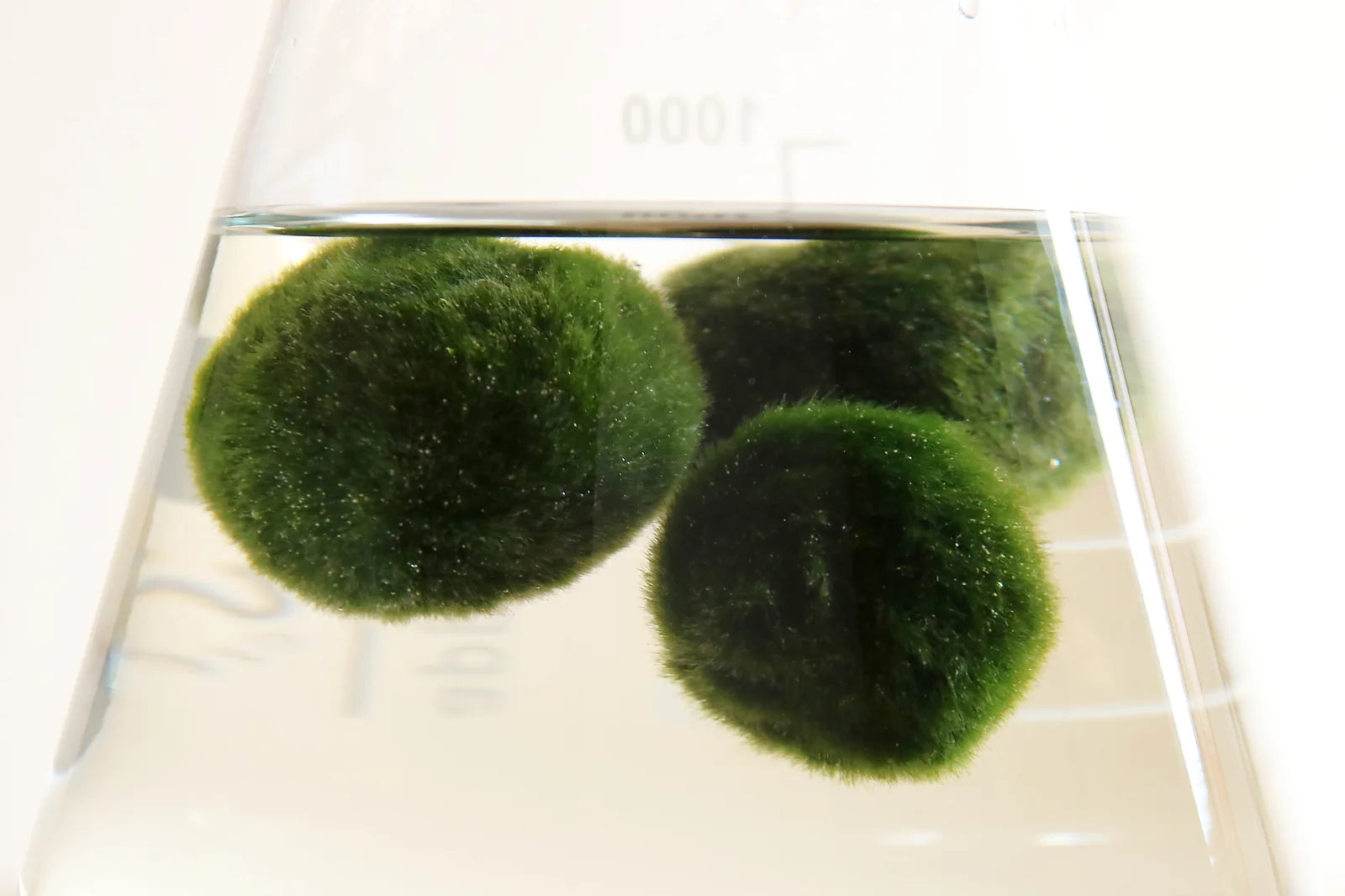

Marimo make their own food from light, water and carbon dioxide, so they don't need feeding. They have no mouth, and the whole ball makes sugar from light. They also take up some minerals and a little nitrogen from the water, but that isn't a meal.
Quick facts
- Their food they make it from light, water and carbon dioxide, which is photosynthesis. They have no mouth and don't need feeding.1
- The whole ball does the work there is no special leaf, and the green cells all through the body make food from light.1
- Minerals and nitrogen they take up nitrogen, phosphorus and minerals such as calcium from the water around them. That isn't the same as needing to be fed.23
- Museum tanks staff sometimes add a small amount of nitrogen to big display tanks when the filaments look yellow-green. That is expert practice for large tanks, not our care.4
- Wild lakes nutrient pollution is the main suspected cause of marimo vanishing from many lakes.5 Lake Akan's own story is more mixed, and sources don't fully agree.6
How do marimo make their food?
Marimo are alive. They are green algae, and every cell in a ball can make sugar from light, water and carbon dioxide.1 An official Lake Akan FAQ answers "Where is the mouth?" the same way: they have no mouth, but the whole body takes in light and makes sugar.1 That's what "eating light" means here. It's a figure of speech for photosynthesis, and nothing is swallowed.
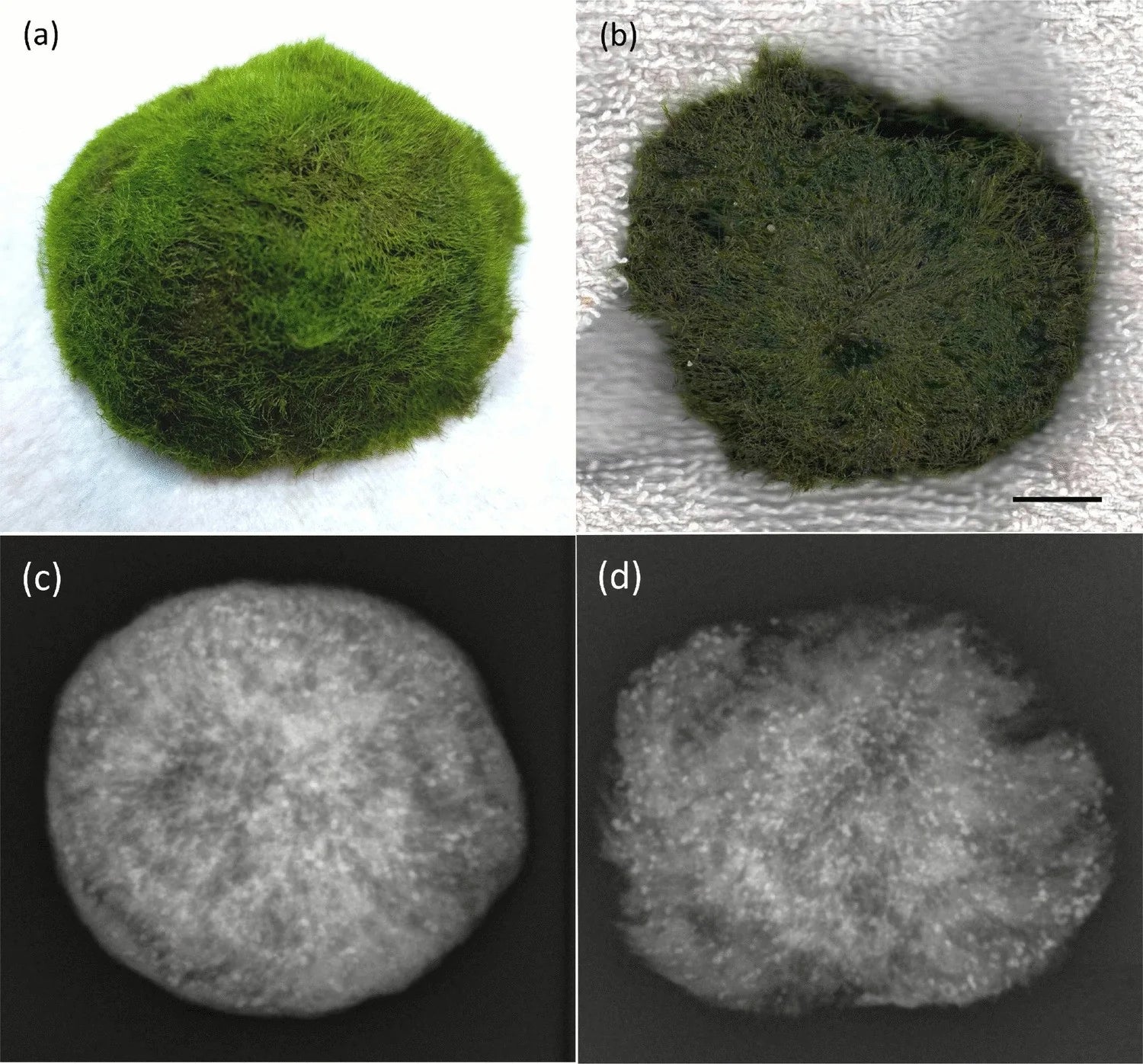
They use the carbon dioxide already dissolved in the water. No published study says a home jar needs extra.7 In lab measurements on whole balls, the outside does most of the photosynthesizing in the light, and the inside is much less active then.8
Making food gives off oxygen, and tiny bubbles can lift a ball. That story is in Why is my marimo floating? They need light for this, but they don't need strong light. See Marimo light and temperature
Do marimo need fish food, plant food or fertilizer?
No. They make their own food, so there is nothing to drop in as a meal.
No published study has tested aquarium plant fertilizer, houseplant food or other added plant nutrients on a marimo in a home jar. Hobby pages disagree. Some say none is needed, and some suggest a drop of plant food. Those are opinions, not tests, so we won't tell you that fertilizer helps, and we won't tell you that it harms.
The nearest expert practice is at big museum display tanks. When the deep green of the filaments takes on a yellow-green tint, the expert who describes the Lake Akan Eco-Museum Center says nitrogen may be too low, and staff add a small amount of it to the tank water.4 That is expert display-tank practice, not our care values, and we don't publish the doses because they are for large tanks and not for a jar. If your marimo's color worries you, see Is my marimo dead?
What nutrients and minerals do marimo take up?
Making sugar from light is their food. They also take up nutrients and minerals from the water, as other algae do.2 Marimo use nitrogen as a nutrient, and big wild balls host bacteria that work with nitrogen inside them.9 None of that is a reason to feed one.
In wild balls, rolling swaps water between the inside and the outside, so nutrients from material that decays in the center can be reused for growth.10 That's lake science, and the longer story is in How marimo become balls In a still jar, our care card says to roll them to keep round. More in Cleaning and rolling your marimo
Minerals matter too. In lab culture, marimo filaments needed minerals such as calcium, magnesium, boron and iron, and they could turn white, or sometimes die, in distilled or low-mineral water, even with nutrients added.11 In the wild, the species mostly lives in lakes with moderate to high calcium.12 That's why our care card says: Use bottled spring water, or tap water treated with a dechlorinator (water conditioner). Tap water left out for a few days works only if your city uses chlorine, not chloramine. Never use distilled.
There is no published study or historical record for a mineral level a home jar needs, so we don't give a number. The full water story is in Marimo water
Do marimo clean the water?
Marimo use nutrients, and they give off oxygen in the light. But using nutrients isn't the same as cleaning a tank. No published study has measured ammonia or nitrate cleaning benefit in a home tank. In one 2025 lab filter test, marimo trapped particles and germs, but other nutrients did not change in a significant way after 24 hours. That is a lab prototype, not a home tank.13 So we don't call them a natural filter.
What about fish food and fish waste in a shared tank?
Fish food is for the fish, not for the marimo. No published study has tested leftover fish food or fish waste on a home-kept marimo. So we don't add a step for it. Tank mates and shared-tank care are in Marimo in aquariums
Has nutrient pollution hurt wild marimo?
In many wild lakes, yes. Worldwide, marimo had not been seen in the last 30 years at more than half of the places they were known. Nutrient pollution (eutrophication) is the main suspected cause, and ball-shaped marimo have declined faster than the attached form.5 That's a wild-lake story. It is not a reason to add fertilizer at home, and it says nothing about where our marimo come from. Lake Akan in Japan is one wild lake, and marimo grow in lakes in several countries, not only Japan.14
Lake Akan's own story is where sources disagree, so here are the sides, with no winner picked. - The labels differ. A 2010 review listed Lake Akan among lakes with a nutrient problem and a decline.5 A 2021 study of one bay measured very low dissolved nitrogen and phosphorus in the water around the balls and called the bay oligotrophic, which means low in nutrients.10 Another 2021 paper called the lake mesotrophic, which means middling.15 An official monitoring page describes its 2022 nitrogen as an oligotrophic level and its phosphorus as a mesotrophic level.16 These came from different years, places and measures. - The older colony losses. Lake Akan once had four ball colonies. The two western ones were lost. Sources agree silt from logging was central at Shurikomabetsu, and they differ on how much to credit water-level drops from hydropower. It's not a proven eutrophication story.17 - The newest study. A 2025 sediment DNA paper estimates that marimo were once about 10 to 100 times more abundant than today. It says the decline began in the early 1900s, when muddy water and water-level changes were already under way, before sewage from tourism became a problem after the 1950s. The authors suggest that later nutrient pollution may have slowed recovery after those earlier harms ended.16 - Measured phosphorus. A 2023 paper estimates about 0.004 mg/L before nutrient pollution, from a 1931 measurement, and measured about 0.026 mg/L in 2013 to 2014.18 That is lake chemistry, not a number for a jar.
So we don't call Lake Akan simply "eutrophic" or simply "low in nutrients", and we don't say that eutrophication caused the loss of the two western colonies. The longer decline story is in Why wild marimo are declining
Feeding myths
- "Marimo need to be fed." No. They make their own food from light.1
- "Marimo grow fast if fed." No published study or historical record shows feeding or fertilizer speeds home growth, and growth is slow.
- "Marimo need fertilizer, plant food or fish food." No, and no published study has tested them.
What to do: our care steps
- Change water every 2 to 4 weeks.
- Use bottled spring water, or tap water treated with a dechlorinator (water conditioner). Tap water left out for a few days works only if your city uses chlorine, not chloramine. Never use distilled.
- Keep below 77°F, out of direct sun and away from heaters.
- Rinse in cool water, gently squeezing is OK, then roll to keep round.
With simple care, marimo can live for decades. The full guide is at Caring for your Moss Ball Pets™
FAQ
What do moss balls eat?
Nothing you need to give them. Marimo make their own food from light, water and carbon dioxide, and they have no mouth.1
Do marimo moss balls need fertilizer or plant food?
No. No published study has tested fertilizer or plant food on a marimo in a home jar.
Can I feed my marimo fish food?
Fish food is for fish. No published study has tested it on a marimo.
Do marimo need minerals?
Yes, some. In lab culture, marimo filaments needed minerals and could turn white in distilled water. Use bottled spring water, or tap water treated with a dechlorinator (water conditioner). Tap water left out for a few days works only if your city uses chlorine, not chloramine. Never use distilled.11
Do marimo clean fish tank water?
No published study or historical record shows marimo clean ammonia or nitrate out of a home tank.
Does the marimo in my jar need light to eat?
It needs light to make food, but not strong light. Keep below 77°F, out of direct sun and away from heaters.1
Discover the Magic of Marimo
Design your own terrarium, or start with a ready-made kit.
Footnotes
- Web and Akan", マリモの育て方(2) How to raise marimo; Cano-Ramirez et al. 2018; Umekawa, Wakana and Ohara 2021; Kushiro City, 阿寒湖のマリモ|釧路市ホームページ Marimo of Lake Akan.
- Isamu Wakana 2019; Boedeker et al. 2010; Isamu Wakana 2019; Nakai, Wakana and Niki 2021.
- Wakana et al. 2023; Nakayama et al. 2021.
- Isamu Wakana 2019. These are expert display-tank practices for large tanks, not care values, and the doses are not given here.
- Boedeker et al. 2010; Boedeker and Immers 2009.
- Nakayama et al. 2021; Nakai, Wakana and Niki 2021; Urabe et al. 2025.
- Web and Akan", マリモの育て方(2) How to raise marimo.
- Cano-Ramirez et al. 2018.
- Nakai, Wakana and Niki 2021; Isamu Wakana 2019.
- Nakayama et al. 2021.
- Isamu Wakana 2019; Boedeker et al. 2010.
- Boedeker et al. 2010; Wakana et al. 2023.
- Phillips et al. 2025.
- Einarsson and Station 2014; Boedeker et al. 2010.
- Nakai, Wakana and Niki 2021.
- Urabe et al. 2025; 地方独立行政法人北海道立総合研究機構, 北海道の湖沼(阿寒湖) Lakes of Hokkaido; Wakana et al. 2023.
- Kushiro City; plan adopted 2012 2012; Environment and Office, 環境省のマリモに関わる取組 Ministry of the Environment's marimo-relate; Nakayama et al. 2021. Sources agree logging silt was central at Shurikomabetsu and differ on how much to credit hydropower water-level drops.
- Wakana et al. 2023.
Sources
- MARIMO Web, official site of the Special Natural Monument "Marimo of Lake Akan" (run by Akan tourism groups, Kushiro City Board of Education and the marimo protection society). マリモの育て方(2) [How to raise marimo (2)]. Link: http://www.marimo-web.org/faq/qa_grow2.html. Checked 2026-11-04.
- Dora L. Cano-Ramirez, Tara Saskia de Fraine, Olivia G. Griffiths, Antony N. Dodd (2018). Photosynthesis and circadian rhythms regulate the buoyancy of marimo lake balls. Current Biology 28(16): R869-R870. Link: https://doi.org/10.1016/j.cub.2018.07.027. Checked 2026-11-10.
- Taketo Umekawa, Isamu Wakana, Masashi Ohara (2021). Reproductive behavior and role in maintaining an aggregative form of the freshwater green alga Marimo, Aegagropila linnaei, in Lake Akan, Hokkaido, Japan. Aquatic Botany 168: 103309. Link: https://doi.org/10.1016/j.aquabot.2020.103309. Checked 2026-11-10.
- Kushiro City (釧路市教育委員会 マリモ研究室). 阿寒湖のマリモ|釧路市ホームページ [Marimo of Lake Akan (Kushiro City website, Board of Education marimo page)]. Link: https://www.city.kushiro.lg.jp/museum/bunkazai/1005708/kinenbutsu/1005712.html. Checked 2026-11-12.
- Isamu Wakana (2019). ③ マリモ糸状体の生長条件 [(3) Growth conditions for marimo filaments]. Link: https://ameblo.jp/maromo-lab/entry-12465710386.html. Checked 2026-11-10.
- Christian Boedeker, Anja Eggert, Anne Immers, Erik Smets (2010). Global Decline of and Threats to Aegagropila linnaei, with Special Reference to the Lake Ball Habit. BioScience 60(3): 187-198. Link: https://doi.org/10.1525/bio.2010.60.3.5. Checked 2026-11-09.
- Isamu Wakana (若菜勇) (2019). ⑤ 球状マリモの栽培方法 (マリモ博士の研究日記) [(5) How to cultivate ball marimo (Dr. Marimo's research diary)]. Link: https://ameblo.jp/maromo-lab/entry-12473448831.html. Checked 2026-11-10.
- Ryosuke Nakai, Isamu Wakana, Hironori Niki (2021). Internal microbial zonation during the massive growth of marimo, a lake ball of Aegagropila linnaei in Lake Akan. iScience. Link: https://doi.org/10.1016/j.isci.2021.102720. Checked 2026-11-10.
- Isamu Wakana, Yasuro Kadono, Jotaro Urabe, Yuki Tamura, Yoshifusa Suzuki, Hiroyuki Yamada, Yoichi Oyama, Keiji Wada, Takeshi Hasegawa, Masashi Ohara (2023). Varying stages of ecological succession in lakes subdivided by volcanic eruptions at Akan Caldera, Japan. Hydrobiologia. Link: https://doi.org/10.1007/s10750-023-05231-5. Checked 2026-11-10.
- Keisuke Nakayama, Katsuaki Komai, Keisuke Ogata, Toshiro Yamada, Yukinobu Sato, Fumiya Sano, Shintarou Horii, Yuichiro Somiya, Etsuko Kumamoto, Yoichi Oyama (2021). The structure and formation of giant Marimo (Aegagropila linnaei) in Lake Akan, Japan. Scientific Reports 11: 22017. Link: https://doi.org/10.1038/s41598-021-01028-5. Checked 2026-11-10.
- Christian Boedeker, Anne K. Immers (2009). No more lake balls (Aegagropila linnaei Kützing, Cladophorophyceae, Chlorophyta) in The Netherlands? Aquatic Ecology. Link: https://doi.org/10.1007/s10452-009-9231-1. Checked 2026-11-04.
- Jotaro Urabe, Isamu Wakana, Hajime Ohtsuki, Masayuki K. Sakata, Yurie Otake, Ryotaro Ichige, Michinobu Kuwae, Toshifumi Minamoto (2025). Reconstruction of Marimo Population Dynamics Over 200 Years Using Molecular Markers and Fossil Plankton Remains. Environmental DNA. Link: https://doi.org/10.1002/edn3.70085. Checked 2026-11-10.
- Neil Phillips, Thomas C. Draper, Andrew P. Geary, Kathryn Lamb-Riddell, Darren M. Reynolds, Joshua A. C Steven, Freya Radford, Abdul R. Farooq, Andrew Adamatzky (2025). Marimo for monitoring and filtering of aquatic environments. Environmental Science and Pollution Research. Link: https://doi.org/10.1007/s11356-025-37259-6. Checked 2026-11-10.
- Árni Einarsson, Mývatn Research Station (RAMÝ) (2014). The lake balls of Mývatn (report). Náttúrufræðistofnun publications. Link: https://utgafa.natt.is/skyrslur/ramy/2014-Lake_Ball_in_memoriam.pdf. Checked 2026-11-12.
- Christian Boedeker, Anja Eggert, Anne Immers, Isamu Wakana (2010). Biogeography of Aegagropila linnaei (Cladophorophyceae, Chlorophyta): a widespread freshwater alga with low effective dispersal potential shows a glacial imprint in its distribution. Journal of Biogeography 37: 1491-1503. Link: https://doi.org/10.1111/j.1365-2699.2010.02309.x. Checked 2026-11-09.
- 地方独立行政法人北海道立総合研究機構 (Hokkaido Research Organization). 北海道の湖沼(阿寒湖) [Lakes of Hokkaido (Lake Akan)]. Link: https://www.hro.or.jp/lakes_in_hokkaido/n112_AKN.html. Checked 2026-11-10.
- Kushiro City; plan adopted 2012 (平成24年) (2012). マリモ保護管理計画 (阿寒湖のマリモ保全対策検討委員会) [Marimo Protection and Management Plan (Lake Akan Marimo Conservation Committee)]. Link: https://www.city.kushiro.lg.jp/_res/projects/default_project/_page_/001/005/712/hogokannrikikaku.pdf. Checked 2026-11-12.
- Ministry of the Environment, Kushiro Nature Conservation Office. 環境省のマリモに関わる取組 (資料1-5, 令和5年度) [Ministry of the Environment's marimo-related work (Document 1-5, fiscal 2023)]. Link: https://hokkaido.env.go.jp/kushiro/content/000207435.pdf. Checked 2026-11-04.
Related guides
Marimo Water: What to Use and How Often to Change It
Use bottled spring water, or tap water treated with a dechlorinator (water conditioner). Tap water left out for a few days works only if your city uses chlorine, not chloramine. Never use distilled. Change water every 2 to 4 weeks. Marimo need some minerals, and distilled water has had those taken out. Leaving tap water out can let free chlorine leave, but it does not remove chloramine, which many US water systems use. That's why a dechlorinator is the safer choice for tap water.
Read the guide →
Marimo Light and Temperature: How Much Light and How Cool?
Keep below 77°F, out of direct sun and away from heaters. Marimo make their food from gentle light and can live in quite dim conditions. Strong light is most clearly shown to hurt them in very cold water, and a sunny windowsill can still heat a jar. 77°F is our care ceiling, not a death point.
Read the guide →
Why Is My Marimo Floating? What the Bubbles Mean
A marimo usually floats because tiny bubbles of oxygen from photosynthesis get caught in it, and in lab studies it sinks again in the dark. Floating means it is making oxygen in the light, not that it feels happy. And a marimo that stays on the bottom is not, by that alone, unwell.
Read the guide →
Marimo in Aquariums and Fish Tanks
Yes, marimo are often kept in cool freshwater aquariums and fish tanks. Our care steps say keep the water below 77°F, out of direct sun and away from heaters. A tank kept warmer than that is not a match for those steps. Research does not tell us which tank mates are safe, or whether marimo clean a home tank.
Read the guide →
How Marimo Become Balls, and Whether You Can Make One
Gentle waves roll marimo along a shallow lake bottom, and that rolling makes them round. They are living green algae, a crowd of threads growing together, not moss and not built around a stone. The ball form is the rarest of the three forms. No published study has shown a way to make a true marimo ball at home.
Read the guide →
Why Are Wild Marimo Declining?
A 2010 survey found this alga had not been recorded in the previous 30 years at more than 50% of its known locations. Ball and free-floating forms declined more than attached forms. Nutrient pollution was the main cause the authors suspected. "Not recorded" is not the same as confirmed gone. Lake Akan lost two of its four historical ball colonies, mainly to logging silt. Lake Mývatn's large colonies were gone by about 2013 to 2014; the cause is still debated.
Read the guide →