






Lake Akan Marimo


Lake Akan is a freshwater lake in Kushiro City, Hokkaido, inside Akan-Mashu National Park. It sits in the Akan caldera. It is the only place now known with confidence to still hold colonies of large wild marimo balls, about 12 cm or more. The species itself does not grow only in Japan, and Japan has several lakes with the alga. This page is about the wild lake, not about the marimo we sell.
Quick facts
- Where it is in Kushiro City, Hokkaido, inside Akan-Mashu National Park. The park was designated Akan National Park on 4 December 1934 and renamed Akan-Mashu National Park on 8 August 2017.1
- Size and height official sources agree the lake surface sits at 420 m. The Hokkaido Research Organization gives a surface area of 13.25 km². The Ramsar site is 1,318 ha, a figure that excludes islands in the designated area, so it is not automatically the same as the lake area.4
- Depth official sources disagree, so we don't print one figure as settled. One official source gives a maximum of 44.8 m. A Ramsar panel gives a maximum of 42 m and a mean of 17 m. Official Ministry Ramsar materials give a mean of 18.7 m.4
- Protection a Natural Monument of Japan since 3 March 1921, a Special Natural Monument since 29 March 1952, and a Ramsar wetland (site 1540) since 8 November 2005.5
- Found and named found at the lake in 1897 and named "marimo" in 1898.6
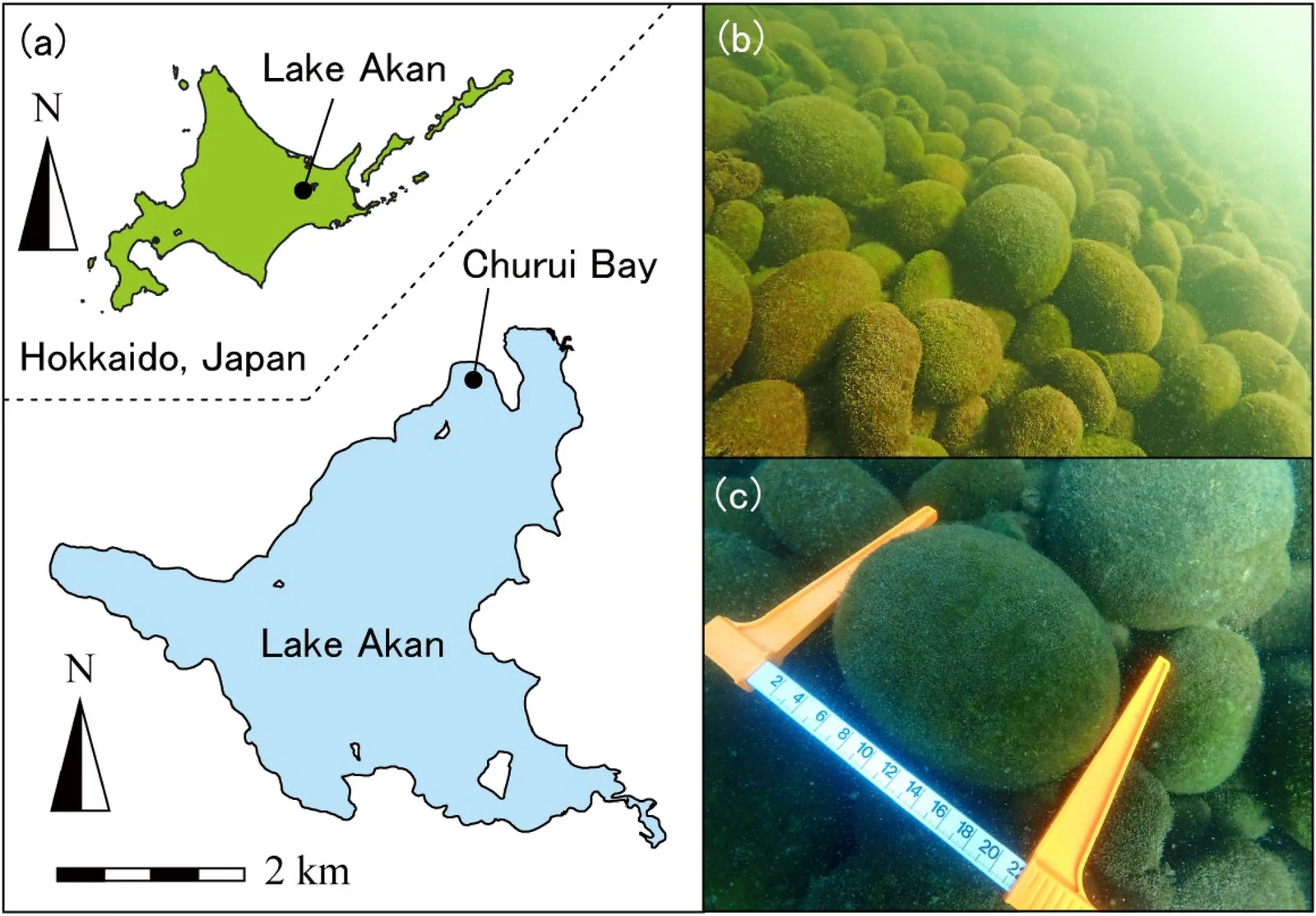
- Where the balls grow the lake once had four ball colonies. Two remain, in Churui and Kinetanpe bays, at about 2 to 3 m depth.7
- How big the largest recorded at the lake since 2000 is 34 cm. One paper cites a 40 cm figure from a 1985 book. No published study has documented a 95 cm marimo.8
- How they stay round gentle wind waves roll the balls on a shallow, firm bed.9
- Wash-ups storms and strong south winds wash big balls ashore. That breaking-apart is now understood as part of the life cycle, not simply damage.10
- The 2019 count a Churui Bay census, not a count of the whole lake, estimated about 106 million aggregation-type balls, about 131.6 tonnes in wet weight. About 111,000 were 15 cm or larger. 90 percent or more were under 5 cm. This is a 2019 estimate, not a current count.11
Where is Lake Akan?
Lake Akan (阿寒湖) is in the Akan district of Kushiro City, Hokkaido. It lies inside Akan-Mashu National Park, which was designated Akan National Park on 4 December 1934 and renamed on 8 August 2017.1
The lake sits in the Akan caldera.14 Official sources agree on that setting, but they disagree on the single word for how to classify the present lake, so here are both sides, with no winner picked: - A caldera lake: a 2025 Ministry Ramsar booklet uses that label, and the official designation document says the lake "is located at the centre of the Akan caldera." - A dammed lake: the Hokkaido Research Organization classifies the present lake that way, and a Ramsar municipalities page does too.
The official history is shared. The Ministry's park page says the caldera formed in volcanic activity from several hundred thousand to about 150,000 years ago. An earlier "old Akan lake" was divided about 10,000 years ago by the eruption of Mount Oakan, producing today's Lake Akan, Lake Panke and Lake Penke.14


Official sources agree the lake surface sits at 420 m. The Hokkaido Research Organization gives a surface area of 13.25 km² and a maximum depth of 44.8 m, citing the Geospatial Information Authority of Japan's 1978 lake survey. A town sign also gives 44.8 m. A Ramsar panel at the Eco-museum gives a maximum of 42 m, a mean of 17 m, and a circumference of 25.9 km. Official Ministry Ramsar materials give a mean depth of 18.7 m. The Ramsar site area is 1,318 ha, and the Ministry leaflet notes that islands in the designated area are excluded, so that figure is not automatically the same as the 13.25 km² lake area. We show the depth figures and don't pick a winner.4
Special Natural Monument and Ramsar status
Lake Akan's marimo were made a Natural Monument of Japan on 3 March 1921 and a Special Natural Monument on 29 March 1952.5 A claim that "marimo have been protected in Japan since 1920" is close, but a year early. The protection is of Lake Akan's marimo, not of every marimo everywhere.15
A water drop for hydropower in 1950, souvenir taking, and an "electricity or marimo?" debate helped lead to the 1952 upgrade. The fuller monument story is on Marimo as a Special Natural Monument, and the festival that grew from the same year is on Lake Akan Marimo Festival.16
Japan's 2025 Red List lists marimo in Japan as critically endangered (category IA, CR). This is a national list, not a global IUCN assessment. More on decline and protection outside this lake is on Why wild marimo are declining.17
Lake Akan (Akan-ko) was registered as a Ramsar wetland on 8 November 2005 as site 1540, with an area of 1,318 ha, in Kushiro City. A Ramsar listing is not the same as the Special Natural Monument.18
Where do the balls grow?
Colonies of large balls, about 12 cm or more, are now known with confidence only from Lake Akan. Older sources also list Lake Mývatn, now collapsed, and Lake Svityaz, whose status is not confirmed. Japan has other lakes with the species, but not those giant colonies. The wider map is on Where marimo grow in the wild.219
The lake once had four ball colonies. Two, including Shurikomabetsu Bay, where they were first found in 1897, were lost. Two remain, in Churui and Kinetanpe bays. Sources agree the losses involve logging and development. They disagree on the exact years and on how much to credit hydropower, so we give the range and pick no winner: two of the four colonies were lost by around the mid-20th century, and sources date that loss from the early 20th century to the 1940s and 1950s.20
Giant balls grow at a water depth of about 2 to 3 m in Churui and Kinetanpe bays. Collapsed balls and unattached floating mats exist in deeper water. Balls from a few centimeters to about 30 cm form layers, with the smallest at the bottom and the giant balls on top. This describes the wild lake. Attached or other forms also occur more widely in the lake, so the species does not live only in those two bays.21
How big do they get?
The largest marimo recorded in Lake Akan since 2000 is 34 cm across. One paper says lake balls can reach 40 cm, citing a 1985 Japanese book. There is no published study or historical record for a 95 cm, or "almost 40 inch," marimo.8
Signs at the lake say about 30 cm, or over 30 cm. A Ramsar panel says balls collapse into filaments once over 20 cm, and a lab poster says they "often reach 20 cm." Those look like typical or collapse sizes rather than one maximum, so we don't treat 20 cm as a hard collapse size, and we don't pick 20 cm or 30 cm as the one maximum.22
Wild lake balls come in two kinds: a tangled type that usually stays smaller, and a radial type that can grow much larger, occasionally to about 30 cm.23
Why do waves roll them into balls?
Balls form when gentle wind waves roll the alga on a shallow, firm lake bottom. Rolling keeps all sides lit and shakes off debris.9
At Lake Akan, wind waves, not inflow currents, make the balls oscillate and rotate. In one English 2021 study, balls 15 to 25 cm across began to rotate at a critical wind speed of 4.8 m/s when the wind was from the southeast to southwest, from June to October when the lake is free of ice. These are wild-lake figures, not home-jar advice.24
Rolling also exchanges water between the inside and the outside, so nutrients from material that decays in the center can be reused. When the lake is iced over (December to April in the 2021 study), there is no wave motion and the surface becomes looser.25
Once a central cavity forms, the ball becomes lighter underwater, so the largest sit on top of the colony and waves move them more easily. That helps explain why big hollow balls wash ashore.26
Forming balls can also pack more living material into a small suitable patch than a flat mat can. The general formation story is on How marimo become balls.27
Why do marimo wash ashore?
In Lake Akan, big balls are washed ashore and broken by storms every several years, and the pieces regrow into new balls. The cycle is widely described as about 5 to 9 years, and one government study calls that cycle estimated, not proven. We use "every several years" or "about 5 to 9 years," and we don't treat a shorter figure as settled.28
Wash-ups happen when typhoons or low-pressure systems drive sustained, very strong south winds into the lake. Big hollow balls are lighter and drift easily. Wash-ups were once treated as damage and fought, but are now understood as part of the life cycle: balls break into smaller pieces on shore, increasing in number, and the pieces return and regrow. Balls stranded far up the shore cannot get back, and local people have returned them to the lake for more than 60 years.10
Two official accounts from 2021 show how that works. A strong south wind on 4 June 2021 washed large numbers ashore along the Churui Bay coast, over about 1,300 m², thought to be on the same scale as a 2013 wash-up. That article lists recent mass wash-ups in 1995, 2002, 2007 and 2013, on a 5 to 9 year cycle, and says the life-cycle reading has been understood since 1999.10
Later that year, a strong wind on 1 December 2021 washed marimo up along about 150 m of the Churui Bay shore, from the east side toward the centre of the bay. The Marimo Lab confirmed it on 2 December. On 9 December, about 50 people spent about 6 hours carrying the balls back. Yoichi Oyama of the Kushiro Marimo Lab is quoted as saying that wash-up is normally one way big balls break apart and return to the lake, and is needed for them to increase, but this storm landed them beyond the reach of the waves, so people returned them. The official blog also says the team was hurrying because the lake surface had not yet frozen.29
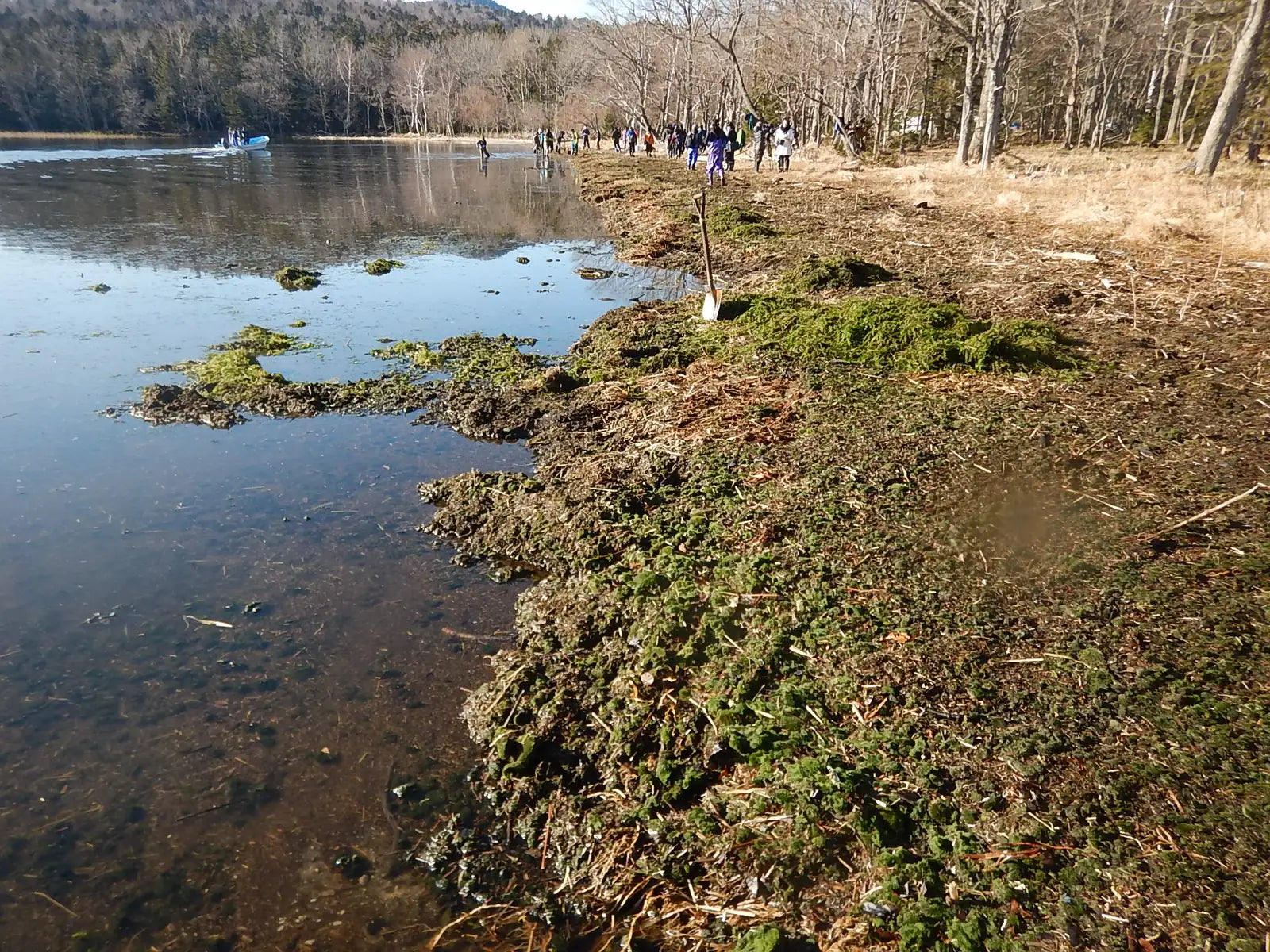
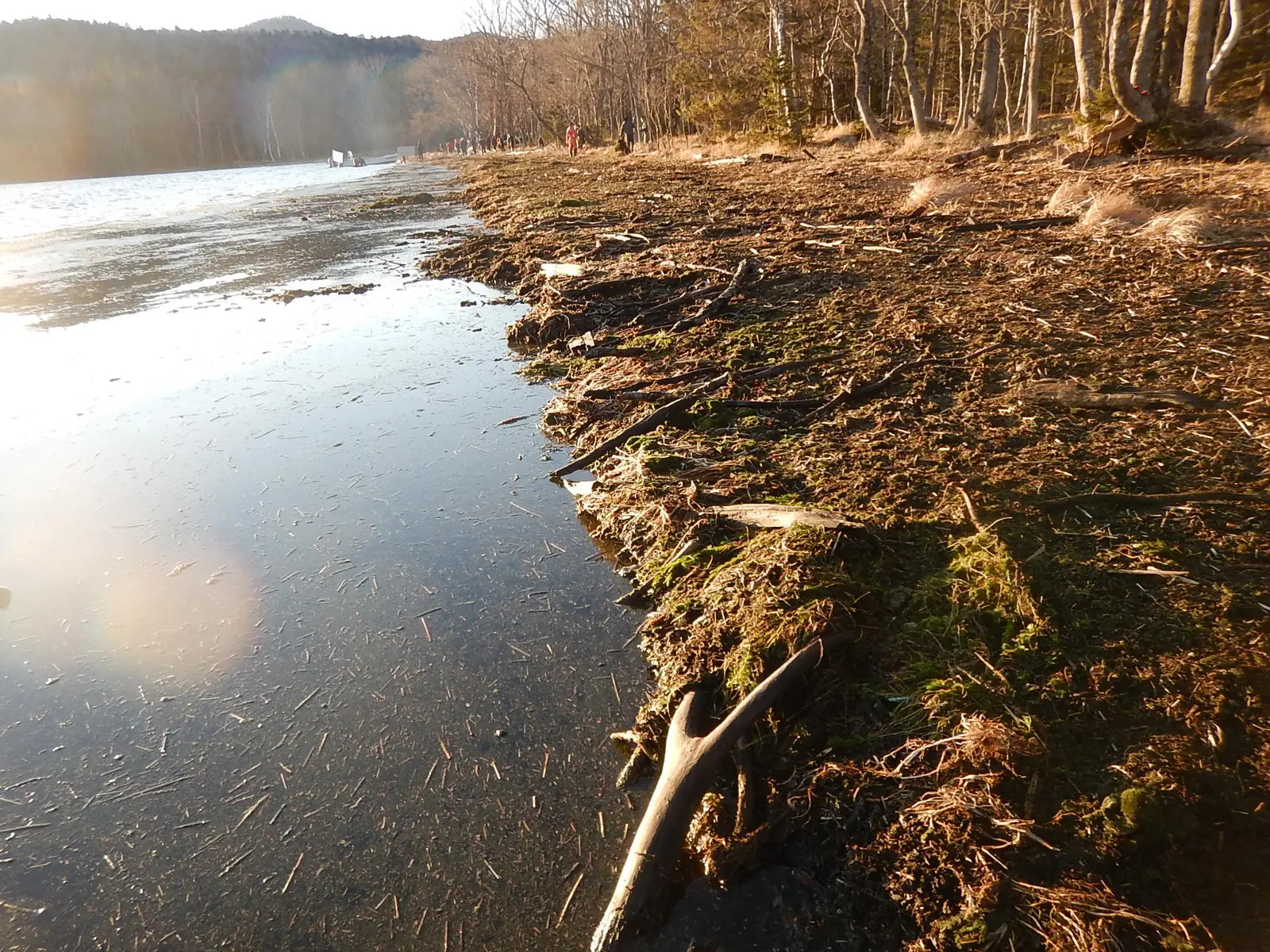
There is no published study or historical record for ice push, meaning ice expansion or drifting ice shoving balls ashore, as a cause of Lake Akan wash-ups. Winter rescues are sometimes done so stranded balls do not freeze and die. That is not the same as ice push throwing them ashore.13
Washing ashore and breaking apart is not usually a sign that the balls are damaged or dying, though balls left above the waves need help to get back.10
Counting Lake Akan's marimo (2019)
The figures in this section come from Kushiro City's official March 2021 report, not only from a museum sign. The count covers Churui Bay only, not the whole lake and not Kinetanpe Bay. The work ran from 23 July to 1 September 2019. Volunteers measured balls for eight days, from 25 August to 1 September. Divers sampled 84 sites with cylindrical frames.1130
The report estimated about 106 million aggregation-type marimo (集合型マリモ), with balls under 5 cm in long diameter making up 90 percent or more. Their estimated wet weight totaled 131.6 tonnes. About 111,000 were 15 cm or larger. Including unattached filaments, total wet weight in Churui Bay was estimated at 164.3 tonnes (131.6 tonnes of aggregation-type balls plus 32.7 tonnes of filaments). These are estimates, not a head count of every ball in the bay, and they describe 2019, not the lake today.11
Compared with a 1997 survey by the Akan Town Board of Education, the official report says the 2019 aggregation-type count is about one quarter of the 1997 figure (about 106 million versus about 427 million), mainly because smaller balls under 5 cm were lost offshore as water plants spread. Large balls of 15 cm or more were about 111,000 versus about 105,000. The report says no large change was found there, and also that the estimates include error and cannot be compared simply. Aggregation-type wet weight was 131.6 tonnes versus 143.6 tonnes, described as not greatly different. Total wet weight including filaments was 164.3 tonnes versus 254.3 tonnes, about 65 percent, with the drop mainly in filaments. High-density aggregation area, meaning 80 percent cover or more, was about 9,200 m² in 2019, 12,500 m² in 1997, and 8,600 m² in 2011. The original 1997 survey report itself was not read; these 1997 figures are those quoted in the later Kushiro City documents.12
Sources also disagree on the 2019 method counts, so here are both sides, with no winner picked: - 160 volunteer participations, and about 20,000 balls measured: the official report and a 2023 Kushiro plan say 160 volunteer participations. The 2023 plan and the Eco-museum sign say about 20,000 balls were measured. - 163 volunteer participations, and about 18,000 balls measured: a committee web report gives 163 participations, ages 11 to 85, and says about 18,000 balls were measured.
The population totals, about 106 million and 131.6 tonnes, come from the official report, and they match the sign. We keep that disagreement in view, and we don't let it hide the official totals.30
For Kinetanpe Bay, a 2023 plan, citing the 1997 survey, gives about 223 million aggregation-type balls and about 161.5 tonnes there in 1997, and says no similar total has been made since. A new count is planned for the final year of that project. No published post-1997 total for Kinetanpe Bay is available. We do not add the 1997 Kinetanpe figure to the 2019 Churui figure and call it how many marimo are in Lake Akan now.12
Older public figures still disagree, and the 2019 bay total does not settle a whole-lake historic number, so we pick no winner there either: - About 900,000 balls of 10 cm or more in 1997 appears in one public source. - "600 million aggregates" appears in another.
The official 1997 Churui and Kinetanpe aggregation estimates (about 427 million plus about 223 million) sit close to that "600 million" line, but they count small balls too, and they are not the same cut as "10 cm or more."12
A later report says the large balls of Churui Bay broke up and disappeared in 2021, after this count. Sources disagree on why large Churui balls have been breaking, as in the next section, and we do not treat the 2019 total as a current live census. No later whole-bay census has replaced the 2019 Churui Bay estimates as a current count.31
Threats and decline
Two of the four colonies were lost to silt from log floating, deforestation, and water-level changes, with sources disagreeing on the exact years, as above. A 2025 sediment-DNA study found that, after a correction for DNA breakdown, marimo were historically about 10 to 100 times more abundant than they are today, and that the decline began in the early 20th century, before mid-century nutrient pollution was pronounced. The authors suggest that later sewage from tourism hindered recovery. We don't say nutrient pollution caused the loss of the two western colonies, and we don't give the lake a single "eutrophic" or "oligotrophic" label, because official sources don't agree on one.32
Tourism after the 1950s brought hotels that discharged sewage until a sewerage system began service in 1986. Clarity later improved.32
Since about 2010, water plants have spread in Churui Bay as the water got clearer, weakening the flow that rolls the balls, shrinking the marimo area, and leaving more broken and mud-covered balls. Plants are now cut back by hand. That is one side of why large balls have been breaking. The other side is a 2023 paper linking thinner walls to warmer water, which Wakana disputes. We don't state warming, or water plants, as the settled cause.33
The wider decline story is on Why wild marimo are declining.
Conservation work
Current work includes cutting excess water plants, regular diving surveys, trial monitoring with a radio-controlled boat and underwater camera, citizen growth surveys, and observation meetings. Entry to the habitat is strictly restricted. The Lake Akan Marimo Conservation Promotion Committee received a Hokkaido Governor's award on 31 January 2019.34
A restoration project has tried to return cultivated balls to Shurikomabetsu Bay, tying them with thread so they do not wash away. The Ministry still reports that the colony has not been restored.35
The Marimo Festival began in 1950, including a return of souvenir balls to the lake, with Ainu kamuynomi prayers from the start. That story is on Lake Akan Marimo Festival. The Ainu role is on The Ainu and marimo.36
Moss Ball Pets™ marimo don't come from Lake Akan or from Japan. Lake Akan's marimo are protected and cannot be taken.37 If the trade name "Japanese moss balls" comes up, that story is on Why are they called "Japanese moss balls"?.
Lake Akan myths
- "Marimo washed ashore by storms are damaged or dying." Mostly false. Not usually: washing ashore and breaking apart is part of the natural cycle, though balls stranded far up the shore cannot get back without help.10
- "Marimo have been protected in Japan since 1920." Partly true. Protection started in 1921, not 1920, and it covers Lake Akan's marimo.15
- "Lake Akan is the only place in Japan with marimo." False. Japan has several lakes with the alga. Only the giant ball colonies are unique to Lake Akan today. See Where marimo grow in the wild.19
- "Marimo only grow in Japan." False. They grow in many Northern Hemisphere lakes, mostly in Europe. See Where marimo grow in the wild.3
- "Marimo sold in pet shops are wild balls taken from Lake Akan." False. Lake Akan's marimo are protected and cannot be taken.37 Our marimo don't come from Lake Akan.
- "DNA has shown that all marimo came from Lake Akan." Not supported as a settled Lake Akan origin. DNA suggests Japan or Asia as an ancestral area, but the paper does not name Lake Akan, and it compared 34 DNA sequences, not 34 lakes. See Where marimo grow in the wild.38
Keeping a marimo at home
This page is about the wild lake, so we don't give home care steps here. Wild-lake conditions are not home advice. If you'd like to know how to keep one in a jar, our care guide is at Caring for your Moss Ball Pets™
FAQ
Where is Lake Akan, and what kind of lake is it?
What legal protection does it have?
Where in the lake do the balls grow?
How big do Akan balls get?
The largest recorded at the lake since 2000 is 34 cm across. One paper cites a 40 cm figure from a 1985 book. No published study has documented a 95 cm marimo.8
Why do marimo wash ashore, and is that damage?
Storms and strong south winds wash big balls ashore. Breaking apart is part of their life cycle, though balls left above the waves need help to get back. It is not usually a sign that they are dying.10
How many marimo were counted in 2019?
A 2019 survey estimated about 106 million aggregation-type marimo in Churui Bay, about 131.6 tonnes in wet weight, with about 111,000 of 15 cm or larger. That is an estimate for one bay in one year, not a count of the whole lake today.11
Do Moss Ball Pets™ marimo come from Lake Akan?
No. Moss Ball Pets™ marimo don't come from Lake Akan or from Japan. Lake Akan's marimo are protected and cannot be taken.37
Discover the Magic of Marimo
Design your own terrarium, or start with a ready-made kit.
Footnotes
- 地方独立行政法人北海道立総合研究機構, 北海道の湖沼(阿寒湖) Lakes of Hokkaido; Environment and Japan, 「阿寒国立公園」が「阿寒摩周国立公園」へ名称変更します! / 阿寒摩周国立公園の特徴 / 阿寒摩周国立公園 指定書.
- Nakayama et al. 2021; Einarsson and Station 2014; Kushiro City; plan adopted 2012 2012. Lake Svityaz's current status is not confirmed.
- Boedeker et al. 2010; Boedeker et al. 2010; Volkova and Chemeris 2023; Einarsson and Station 2014; Science and Tokyo, 微小藻の世界 The world of microalgae.
- 地方独立行政法人北海道立総合研究機構, 北海道の湖沼(阿寒湖) Lakes of Hokkaido; Environment and Japan, ラムサール条約湿地 阿寒湖(あかんこ) Ramsar wetland Lake Akan; not shown on the photographed part, ラムサール条約湿地 ④ 阿寒湖 Ramsar Sites, no. 4: Akan-ko; not shown, 阿寒湖 / 阿寒湖のマリモ Lake Akan / Lake Akan's marimo. Official sources disagree on the exact maximum and mean depth. We show the figures and don't pick a winner.
- Affairs and Japan, 国指定文化財等データベース: 阿寒湖のマリモ Database of National Cultural Prop; Affairs and Japan, 阿寒湖のマリモ Marimo of Lake Akan; Environment and Japan, ラムサール条約湿地 阿寒湖(あかんこ) Ramsar wetland Lake Akan.
- Kushiro City, 阿寒湖のマリモ|釧路市ホームページ Marimo of Lake Akan; Environment and Office, 環境省のマリモに関わる取組 Ministry of the Environment's marimo-relate.
- Kushiro City; plan adopted 2012 2012; Environment and Office, 環境省のマリモに関わる取組 Ministry of the Environment's marimo-relate; Nakayama et al. 2021.
- Nakayama et al. 2023; Togashi, Sasaki and Yoshimura 2014.
- Nakayama et al. 2021; Nakayama et al. 2015; Hayashi et al. 2019.
- Kushiro City, 阿寒湖のマリモの世界的な価値|釧路市ホームページ The global value of Lake Akan's; Environment et al. 2021; Affairs et al. 2021; Kushiro City Board of Education Marimo Lab, マリモの打ち上げ Marimo wash-ups.
- Kushiro City Board of Education 2021. These figures are estimates for Churui Bay in 2019, from the official March 2021 Kushiro City report. They are not a count of the whole lake, and they are not a live later census. The Japanese was read twice for these numbers.
- Kushiro City Board of Education 2021; Kushiro City Board of Education 2023. The original 1997 Akan Town Board of Education survey report itself was not read; 1997 figures used here are those quoted in the 2021 and 2023 Kushiro City documents.
- Environment et al. 2021; Affairs et al. 2021.
- Environment and Japan, 「阿寒国立公園」が「阿寒摩周国立公園」へ名称変更します! / 阿寒摩周国立公園の特徴 / 阿寒摩周国立公園 指定書; 地方独立行政法人北海道立総合研究機構, 北海道の湖沼(阿寒湖) Lakes of Hokkaido; Environment and Japan, ラムサール条約湿地 阿寒湖(あかんこ) Ramsar wetland Lake Akan. Official sources disagree on whether to call the present lake a caldera lake or a dammed lake, so we give the history rather than one label. The Japanese was read twice for these sentences.
- Affairs and Japan, 国指定文化財等データベース: 阿寒湖のマリモ Database of National Cultural Prop; Affairs and Japan, 阿寒湖のマリモ Marimo of Lake Akan.
- Jon L. Pitt 2024; Japan Tourism Agency multilingual commentary database, マリモ:はじめに / Marimo: Introduction; Kushiro City; plan adopted 2012 2012.
- Environment and Japan 2025; Kushiro City, 阿寒湖のマリモ|釧路市ホームページ Marimo of Lake Akan; Ministry of the Environment, 阿寒摩周国立公園 指定植物リスト(378種) Akan-Mashu National Park designate.
- Environment and Japan, ラムサール条約湿地 阿寒湖(あかんこ) Ramsar wetland Lake Akan. The Japanese figures were read twice from the official Ministry leaflet.
- Science and Tokyo, 微小藻の世界 The world of microalgae; Nakayama et al. 2021.
- Kushiro City; plan adopted 2012 2012; Environment and Office, 環境省のマリモに関わる取組 Ministry of the Environment's marimo-relate; Nakayama et al. 2021. Sources disagree on the exact years of the loss and on how much to credit hydropower.
- Nakayama et al. 2021; Togashi, Sasaki and Yoshimura 2014.
- Nakayama et al. 2023; Togashi, Sasaki and Yoshimura 2014; not shown on the photographed part, ③ 大型球状体の「阿寒湖のマリモ」 Large spherical Marimo in Lake Akan. Sources describe typical or collapse sizes around 20 cm and maxima around 30 cm or the 34 cm record, so we don't pick one maximum.
- Nakai, Wakana and Niki 2021; Isamu Wakana 2025; Einarsson and Station 2014.
- Nakayama et al. 2021. We use the 4.8 m/s figure from the English 2021 paper. These are wild-lake figures, not home-jar advice.
- Nakayama et al. 2021.
- Nakayama et al. 2021.
- Togashi, Sasaki and Yoshimura 2014.
- Kushiro City, 阿寒湖のマリモの世界的な価値|釧路市ホームページ The global value of Lake Akan's; Nakayama et al. 2021; not shown on the photographed part, ③ 大型球状体の「阿寒湖のマリモ」 Large spherical Marimo in Lake Akan. The cycle length is widely described as about 5 to 9 years, and one government study calls it estimated.
- Environment et al. 2021. Official Ministry of the Environment Hokkaido blog, posted 2021-12-20. The Japanese was read twice for the 150 m, 50 people and 6 hours figures.
- Kushiro City Board of Education 2021; 阿寒湖のマリモ保全推進委員会 and report 2019; Kushiro City Board of Education 2023; Kushiro City Board of Education Marimo Lab, マリモの生育量 Marimo volume. Sources disagree on the 2019 volunteer and measured-sample counts. The population totals come from the official report.
A later report says the large balls of Churui Bay broke up and disappeared in 2021, after this count. Sources disagree on why large Churui balls have been breaking, as in the next section, and we do not treat the 2019 total as a current live census. No later whole-bay census has replaced the 2019 Churui Bay estimates as a current count.
- Urabe et al. 2025; 地方独立行政法人北海道立総合研究機構, 北海道の湖沼(阿寒湖) Lakes of Hokkaido; Kushiro City; plan adopted 2012 2012. Sources disagree about a single nutrient-status label, and about how much later pollution caused the decline versus later hindered recovery.
- Kushiro City Board of Education Marimo Lab, マリモ生育地の現状 Current state of the marimo habitat; Agriculture, Bioindustry and Dept, マリモの保護活動① Marimo conservation 1; Isamu Wakana 2025. Sources disagree on why large Churui balls have been breaking: warmer water versus spreading water plants after the water got clearer. We don't state a settled cause.
- Agriculture, Bioindustry and Dept, マリモの保護活動① Marimo conservation 1; Lab, Agriculture and lab, マリモの最新研究② Latest marimo research 2; Akankohan Eco-museum Center touchscreen display, The ecology of Marimo.
- Akankohan Eco-museum Center touchscreen display, The ecology of Marimo; Environment and Office, 環境省のマリモに関わる取組 Ministry of the Environment's marimo-relate.
- Takashi Irimoto 2004; Environment and Office, 環境省のマリモに関わる取組 Ministry of the Environment's marimo-relate; 阿寒湖温泉アイヌ文化推進実行委員会 and website 2012.
- Affairs and Japan, 国指定文化財等データベース: 阿寒湖のマリモ Database of National Cultural Prop; Boedeker et al. 2010; Boedeker et al. 2010. These sources support that Lake Akan's marimo are protected and cannot be taken. The line that Moss Ball Pets™ marimo don't come from Lake Akan or from Japan is an owner-approved brand statement, not a finding of those papers.
- Hokkaido Shimbun, 世界のマリモ 阿寒湖起源 13万年前から 渡り鳥が運び役? 釧路の学芸員ら遺伝子解析 The world's ma; Boedeker et al. 2010; Volkova and Chemeris 2023. We follow the paper, not the headline.
Sources
- 地方独立行政法人北海道立総合研究機構 (Hokkaido Research Organization). 北海道の湖沼(阿寒湖) [Lakes of Hokkaido (Lake Akan)]. Link: https://www.hro.or.jp/lakes_in_hokkaido/n112_AKN.html. Checked 2026-11-10.
- Ministry of the Environment, Japan (環境省). 「阿寒国立公園」が「阿寒摩周国立公園」へ名称変更します! / 阿寒摩周国立公園の特徴 / 阿寒摩周国立公園 指定書 [Official Ministry materials on Akan-Mashu National Park: the 2017 rename press release, the park feature page, and the 8 August 2017 designation document]. Link: https://www.env.go.jp/press/104367.html. Checked 2026-11-10.
- Keisuke Nakayama, Katsuaki Komai, Keisuke Ogata, Toshiro Yamada, Yukinobu Sato, Fumiya Sano, Shintarou Horii, Yuichiro Somiya, Etsuko Kumamoto, Yoichi Oyama (2021). The structure and formation of giant Marimo (Aegagropila linnaei) in Lake Akan, Japan. Scientific Reports 11: 22017. Link: https://doi.org/10.1038/s41598-021-01028-5. Checked 2026-11-10.
- Árni Einarsson, Mývatn Research Station (RAMÝ) (2014). The lake balls of Mývatn (report). Náttúrufræðistofnun publications. Link: https://utgafa.natt.is/skyrslur/ramy/2014-Lake_Ball_in_memoriam.pdf. Checked 2026-11-12.
- Kushiro City; plan adopted 2012 (平成24年) (2012). マリモ保護管理計画 (阿寒湖のマリモ保全対策検討委員会) [Marimo Protection and Management Plan (Lake Akan Marimo Conservation Committee)]. Link: https://www.city.kushiro.lg.jp/_res/projects/default_project/_page_/001/005/712/hogokannrikikaku.pdf. Checked 2026-11-12.
- Christian Boedeker, Anja Eggert, Anne Immers, Isamu Wakana (2010). Biogeography of Aegagropila linnaei (Cladophorophyceae, Chlorophyta): a widespread freshwater alga with low effective dispersal potential shows a glacial imprint in its distribution. Journal of Biogeography 37: 1491-1503. Link: https://doi.org/10.1111/j.1365-2699.2010.02309.x. Checked 2026-11-09.
- Christian Boedeker, Anja Eggert, Anne Immers, Erik Smets (2010). Global Decline of and Threats to Aegagropila linnaei, with Special Reference to the Lake Ball Habit. BioScience 60(3): 187-198. Link: https://doi.org/10.1525/bio.2010.60.3.5. Checked 2026-11-09.
- Polina A. Volkova, Elena V. Chemeris (2023). Enhanced sampling refines the biogeography of the freshwater green alga Aegagropila linnaei (Cladophoraceae). Phycologia. Link: https://doi.org/10.1080/00318884.2023.2201152. Checked 2026-11-04.
- National Museum of Nature and Science, Tokyo (kahaku.go.jp). 微小藻の世界 (マリモ) [The world of microalgae (marimo page)]. Link: https://www.kahaku.go.jp/special/past/bisyoso/ipix/mo/1/1_10b.html. Checked 2026-11-09.
- Ministry of the Environment, Japan (環境省). ラムサール条約湿地 阿寒湖(あかんこ) [Ramsar wetland Lake Akan (Akan-ko)]. Link: https://www.env.go.jp/nature/ramsar/conv/ramsarleaflet/6_Akan-ko.pdf. Checked 2026-11-10.
- not shown on the photographed part (wall panel at the Eco-museum Center). ラムサール条約湿地 ④ 阿寒湖 [Ramsar Sites, no. 4: Akan-ko]. Checked 2026-11-04.
- not shown. 阿寒湖 / 阿寒湖のマリモ [Lake Akan / Lake Akan's marimo (the English text is behind a QR code and was not captured)]. Checked 2026-11-04.
- Agency for Cultural Affairs, Japan. 国指定文化財等データベース: 阿寒湖のマリモ [Database of National Cultural Properties: Marimo of Lake Akan]. Link: https://kunishitei.bunka.go.jp/heritage/detail/401/2. Checked 2026-11-12.
- Agency for Cultural Affairs, Japan (文化庁). 阿寒湖のマリモ (文化遺産オンライン) [Marimo of Lake Akan (Cultural Heritage Online)]. Link: https://online.bunka.go.jp/heritages/detail/204523. Checked 2026-11-12.
- Kushiro City (釧路市教育委員会 マリモ研究室). 阿寒湖のマリモ|釧路市ホームページ [Marimo of Lake Akan (Kushiro City website, Board of Education marimo page)]. Link: https://www.city.kushiro.lg.jp/museum/bunkazai/1005708/kinenbutsu/1005712.html. Checked 2026-11-12.
- Ministry of the Environment, Kushiro Nature Conservation Office. 環境省のマリモに関わる取組 (資料1-5, 令和5年度) [Ministry of the Environment's marimo-related work (Document 1-5, fiscal 2023)]. Link: https://hokkaido.env.go.jp/kushiro/content/000207435.pdf. Checked 2026-11-04.
- Keisuke Nakayama, Katsuaki Komai, Motoshi Amano, Shintarou Horii, Yuichiro Somiya, Etsuko Kumamoto, Yoichi Oyama (2023). Ideal water temperature environment for giant Marimo (Aegagropila linnaei) in Lake Akan, Japan. Scientific Reports 13: 16834. Link: https://doi.org/10.1038/s41598-023-43792-6. Checked 2026-11-10.
- Tatsuya Togashi, Hironobu Sasaki, Jin Yoshimura (2014). A geometrical approach explains Lake Ball (Marimo) formations in the green alga, Aegagropila linnaei. Scientific Reports 4: 3761. Link: https://doi.org/10.1038/srep03761. Checked 2026-11-10.
- Keisuke Nakayama, Gongo Ito, Isamu Wakana, Takefumi Kitamura, Yukinobu Sato, Katsuaki Komai, Tomohiko Takeuchi (names from page text; romanization of some names not confirmed) (2015). マリモ球状体に回転運動を引き起こす阿寒湖チュウルイ湾の風波特性 [Characteristics of wind waves in Churui Bay, Lake Akan, that cause rotation of spherical marimo]. Journal of JSCE B3 (Ocean Engineering) (土木学会論文集B3(海洋開発)) vol. 71, no. 2, I_945-I_950. Link: https://www.jstage.jst.go.jp/article/jscejoe/71/2/71_I_945/_pdf. Checked 2026-11-10.
- Noriko Hayashi, Keisuke Nakayama, Yoichi Oyama, Katsuaki Komai (2019). 数値計算によるマリモの移動限界と波動による回転角度の推定 [Estimation of rotation angle and critical velocity of marimos due to waves and currents]. Journal of JSCE B1 (Hydraulic Engineering) 75(2): I_775-I_780. Link: https://doi.org/10.2208/jscejhe.75.2_i_775. Checked 2026-11-10.
- Kushiro City (text credited to MARIMO Web). 阿寒湖のマリモの世界的な価値|釧路市ホームページ [The global value of Lake Akan's marimo (Kushiro City)]. Link: https://www.city.kushiro.lg.jp/machi/kankyou/1004295/1008323/1005713.html. Checked 2026-11-12.
- Ministry of the Environment, Japan, Hokkaido Regional Environment Office (環境省 北海道環境局); blog post by 鉾之原頌吾, Akan Lake Management Office (2021). マリモ、救出作戦 [Marimo rescue operation]. Link: https://hokkaido.env.go.jp/blog/2021/12/post-710.html. Checked 2026-11-10.
- Agency for Cultural Affairs, Japan (文化庁), 広報誌 ぶんかる; article by 田中厚志, 文化財第二課 (天然記念物部門) (2021). 「大量打ち上げ」から考えるマリモの秘密 [What a mass wash-up can tell us about marimo]. Link: https://www.bunka.go.jp/prmagazine/rensai/news/news_001.html. Checked 2026-11-10.
- Kushiro City Board of Education Marimo Lab. マリモの打ち上げ (打ち上げによるマリモの崩壊・再生の過程) [Marimo wash-ups (how wash-ups break up and renew marimo)]. Checked 2026-11-04.
- Kushiro City Board of Education (釧路市教育委員会) (2021). 平成30年度-令和2年度文化庁天然記念物再生事業 特別天然記念物「阿寒湖のマリモ」および生育地の保全再生事業 報告書 [Report on the conservation and restoration project for the Special Natural Monument "Marimo of Lake Akan" and its habitat (Agency for Cultural Affairs natural-monument restoration project, fiscal 2018 to 2020)]. Link: https://www.city.kushiro.lg.jp/_res/projects/default_project/_page_/001/005/712/saiseizigyou.pdf. Checked 2026-11-10.
- Kushiro City Board of Education (釧路市教育委員会) (2023). 「阿寒湖のマリモ」天然記念物緊急調査 調査計画(令和6年度~) [Survey plan for the natural-monument emergency survey of "Marimo of Lake Akan" (from fiscal 2024)]. Link: https://www.city.kushiro.lg.jp/_res/projects/default_project/_page_/001/005/712/6kinnkyuutyosakeikaku.pdf. Checked 2026-11-10.
- Jon L. Pitt (University of California, Irvine) (2024). Becoming Marimo: The Curious Case of a Charismatic Algae and Imagined Indigeneity. In: Being Algae: Transformations in Water, Plants (Critical Plant Studies 8), eds. Hendlin, Weggelaar, Derossi, Mugnai, pp. 195 to 214. Publisher: Brill (open access, CC BY-NC 4.0). Link: https://doi.org/10.1163/9789004683310_011. Checked 2026-11-04.
- Japan Tourism Agency multilingual commentary database (MLIT). マリモ:はじめに / Marimo: Introduction (official multilingual commentary). Link: https://www.mlit.go.jp/tagengo-db/en/H30-00018.html. Checked 2026-11-10.
- Ministry of the Environment, Japan (2025). 環境省レッドリスト2025 (第5次) 藻類 / 新旧対照表 [Ministry of the Environment Red List 2025 (5th edition), algae, with old-versus-new comparison]. Link: https://www.env.go.jp/nature/kisho/5th-rl-2025-book/03-5thredlist-algae.pdf. Checked 2026-11-10.
- Ministry of the Environment. 阿寒摩周国立公園 指定植物リスト(378種) [Akan-Mashu National Park designated plant list (378 species)]. Link: https://www.env.go.jp/content/000164476.pdf. Checked 2026-11-04.
- not shown on the photographed part (exhibit label at the center). ③ 大型球状体の「阿寒湖のマリモ」 [Large spherical Marimo in Lake Akan]. Checked 2026-11-04.
- Ryosuke Nakai, Isamu Wakana, Hironori Niki (2021). Internal microbial zonation during the massive growth of marimo, a lake ball of Aegagropila linnaei in Lake Akan. iScience. Link: https://doi.org/10.1016/j.isci.2021.102720. Checked 2026-11-10.
- Isamu Wakana (2025). 「ほっかいどう学」第44回 北海道のマリモ①-阿寒湖 [Hokkaido studies no. 44: Hokkaido's marimo (1), Lake Akan]. Magazine: 開発こうほう (Kaihatsu Kouhou) no. 743, Hokkaido Development Association. Link: https://www.hkk.or.jp/kouhou/file/no743_hokkaido.pdf. Checked 2026-11-04.
- 阿寒湖のマリモ保全推進委員会 (Lake Akan Marimo Conservation Promotion Committee), Hokkaido e-Water Project report (2019). 阿寒湖チュウルイ湾でのマリモ総個体数一斉調査プロジェクト (Webレポート) [Churui Bay marimo total-count census project (web report)]. Link: https://emizu.heco-spc.or.jp/2019/report/391. Checked 2026-11-10.
- Kushiro City Board of Education Marimo Lab (same credit as ). マリモの生育量 (チュウルイ湾のマリモの一斉調査結果) [Marimo volume (results of the Churui Bay marimo census)]. Checked 2026-11-04.
- Jotaro Urabe, Isamu Wakana, Hajime Ohtsuki, Masayuki K. Sakata, Yurie Otake, Ryotaro Ichige, Michinobu Kuwae, Toshifumi Minamoto (2025). Reconstruction of Marimo Population Dynamics Over 200 Years Using Molecular Markers and Fossil Plankton Remains. Environmental DNA. Link: https://doi.org/10.1002/edn3.70085. Checked 2026-11-10.
- Kushiro City Board of Education Marimo Lab. The graph credit says it is based on public water-quality data released by Hokkaido (北海道が公開する公共用水データを基に作成).. マリモ生育地の現状 [Current state of the marimo habitat]. Checked 2026-11-04.
- Kushiro City Board of Education Marimo Lab; joint research credit to Tokyo University of Agriculture, Faculty of Bioindustry, Dept. of Northern Bioindustry Agriculture (東京農業大学 生物産業学部 北方圏農学科). マリモの保護活動① (増えすぎた水草を刈り取ることで、マリモの生育を支えています) [Marimo conservation 1 (cutting excess water plants to support marimo growth)]. Checked 2026-11-04.
- Kushiro City Board of Education Marimo Lab, with Hokkaido University Graduate School of Agriculture, Ecological Environment Physics lab. マリモの最新研究② [Latest marimo research 2 (new monitoring technology)]. Checked 2026-11-04.
- Akankohan Eco-museum Center touchscreen display. The ecology of Marimo (touchscreen pages: What is Marimo? / Marimo Habitats / The conservation movement of Marimo: Surveys, Promotions, Growing experiments / Let's visit "Marimo Exhibition and Observation Center"). Checked 2026-11-04.
- Takashi Irimoto (煎本孝) (2004). Creation of the Marimo Festival: Ainu Identity and Ethnic Symbiosis. Senri Ethnological Studies 66: 11-38, National Museum of Ethnology, Osaka. Link: https://doi.org/10.15021/00002684. Checked 2026-11-09.
- 阿寒湖温泉アイヌ文化推進実行委員会 (Lake Akan Onsen Ainu culture promotion committee), Akan Ainu Kotan website (2012). [継承文化] 時を超え現代へと紡ぐ [Inherited culture (Marimo Festival section)]. Link: https://www.akanainu.jp/culture/keisyoubunka/. Checked 2026-11-10.
- Hokkaido Shimbun (北海道新聞). 世界のマリモ 阿寒湖起源 13万年前から 渡り鳥が運び役? 釧路の学芸員ら遺伝子解析 [The world's marimo originated in Lake Akan: from 130,000 years ago, carried by migratory birds? Genetic analysis by Kushiro curator and others]. Checked 2026-11-04.
Related guides

Where Marimo Grow in the Wild
Marimo grow wild in many lakes across the Northern Hemisphere, mostly in northern and central Europe, plus Japan and a few other places. They do not grow only in Japan. The same green alga can live attached to rocks, as loose tufts, or as balls, and the ball form is the rarest. Colonies of big balls, about 12 cm or more, are now known with confidence only from Lake Akan, in Japan.
Read the guide →
How Marimo Become Balls, and Whether You Can Make One
Gentle waves roll marimo along a shallow lake bottom, and that rolling makes them round. They are living green algae, a crowd of threads growing together, not moss and not built around a stone. The ball form is the rarest of the three forms. No published study has shown a way to make a true marimo ball at home.
Read the guide →
Lake Mývatn Marimo
Lake Mývatn, a shallow lake in north Iceland, once held dense beds of lake balls, mostly about 10 to 15 cm across. Those beds collapsed between the 1990s and about 2013. Small balls have turned up since 2016, but published surveys have not documented a returned large colony. This page is about the wild lake, not about the marimo we sell.
Read the guide →
Lake Akan Marimo Festival
The Lake Akan Marimo Festival (まりも祭り) began in 1950 as a new event to protect Lake Akan's marimo and return balls that people had taken. It uses Ainu ritual forms, but it is not an ancient Ainu tradition. It is held every year on 8, 9 and 10 October. Its public rites welcome the marimo, protect them, and send them back to the lake by dugout canoe. Years of collecting, and a drop in the lake level for hydropower in spring 1950, led to the festival. In 1952 Japan raised the marimo to Special Natural Monument.
Read the guide →
Why Are Marimo a Special Natural Monument in Japan?
Lake Akan's marimo (阿寒湖のマリモ, Marimo of Lake Akan) were made a Natural Monument of Japan on 3 March 1921 and a Special Natural Monument on 29 March 1952. That is the higher class under the 1950 Law for the Protection of Cultural Properties. It covers the whole of Lake Akan and protects the wild population and its habitat. Altering its current state needs the Commissioner's permission. It does not make cultivated, shop or foreign marimo a Special Natural Monument. This page is general information, not legal advice. Rules change, so check with your state's agriculture or wildlife agency before buying, selling or shipping moss balls.
Read the guide →
Why Are Wild Marimo Declining?
A 2010 survey found this alga had not been recorded in the previous 30 years at more than 50% of its known locations. Ball and free-floating forms declined more than attached forms. Nutrient pollution was the main cause the authors suspected. "Not recorded" is not the same as confirmed gone. Lake Akan lost two of its four historical ball colonies, mainly to logging silt. Lake Mývatn's large colonies were gone by about 2013 to 2014; the cause is still debated.
Read the guide →
The Ainu and Marimo: Names, the Festival and the Love Story
Ainu names for marimo exist, and sources translate them in different ways. The famous story of two lovers who became marimo was written in 1922 by a non-Ainu author and later presented as Ainu legend. The Lake Akan Marimo Festival, begun in 1950, is a modern event in which Ainu kamuynomi prayers have had a part from the start.
Read the guide →
Japanese Moss Balls
"Japanese moss ball" is an English trade and hobby name for marimo, not a label of where they grow. Marimo is a green alga, not a moss, and "marimo" is Japanese for "ball alga". Wild marimo grow in hundreds of lakes, mostly in northern and central Europe. There is no published study or historical record for who first used the phrase or why. It was in use by 2004 at the latest.
Read the guide →
Marimo Myths, Checked
Marimo are living green algae, not moss and not animals. They do not need distilled water, salt, or fertilizer, and can live for decades. They grow wild in many countries, not only in Japan. There is no historical or botanical record that they grant wishes or bring luck. They are not banned as a plant by the US federal government, and official pages do not say every ball is contaminated. Lake Akan wash-ups are part of the natural cycle.
Read the guide →