






Cleaning and Rolling Your Marimo: Rinsing, Squeezing and Shape

Rinse in cool water, gently squeezing is OK, then roll to keep round. In a lake, gentle waves roll marimo and keep them round. In a still jar they can go flat or shaggy, so a gentle roll helps.
Quick facts
- Our care line Rinse in cool water, gently squeezing is OK, then roll to keep round.
- In a lake gentle waves roll the balls, keep all sides lit and shake off debris.1
- In still water filaments can grow long and the ball can turn loose and shaggy, and a ball that never turns can crack on the side kept from light.2
- Rinsing in one lab paper, rinsing in clean, free-flowing water could partly wash out trapped debris.3
- Handling museum staff gently wipe attached algae off big display balls and keep them wet, because sudden drying can damage cells.34
How do I clean a marimo?
Rinse in cool water, gently squeezing is OK, then roll to keep round.
That's our care card, and it's the whole routine. A rinse can wash some loose debris out of the ball. In one lab paper, rinsing in clean, free-flowing water partly washed out trapped debris.3 The researchers went on to use lab equipment to get more out, and that part isn't for home.3
So keep it simple and gentle. The expert who describes the Lake Akan Eco-Museum Center says staff gently wipe attached algae off big display balls. The same expert's advice for other museums is to keep each ball thoroughly wet and return it to the water quickly, because sudden drying can damage the cells.3 That is expert practice for large tanks, not an extra step for you.
Drying is the thing to avoid. In a 1959 lab study, a single filament dried in under a minute in room air, and dried balls put back in water fell apart in 2 to 3 weeks.4 So when you rinse, keep your marimo wet and put it back in its water.
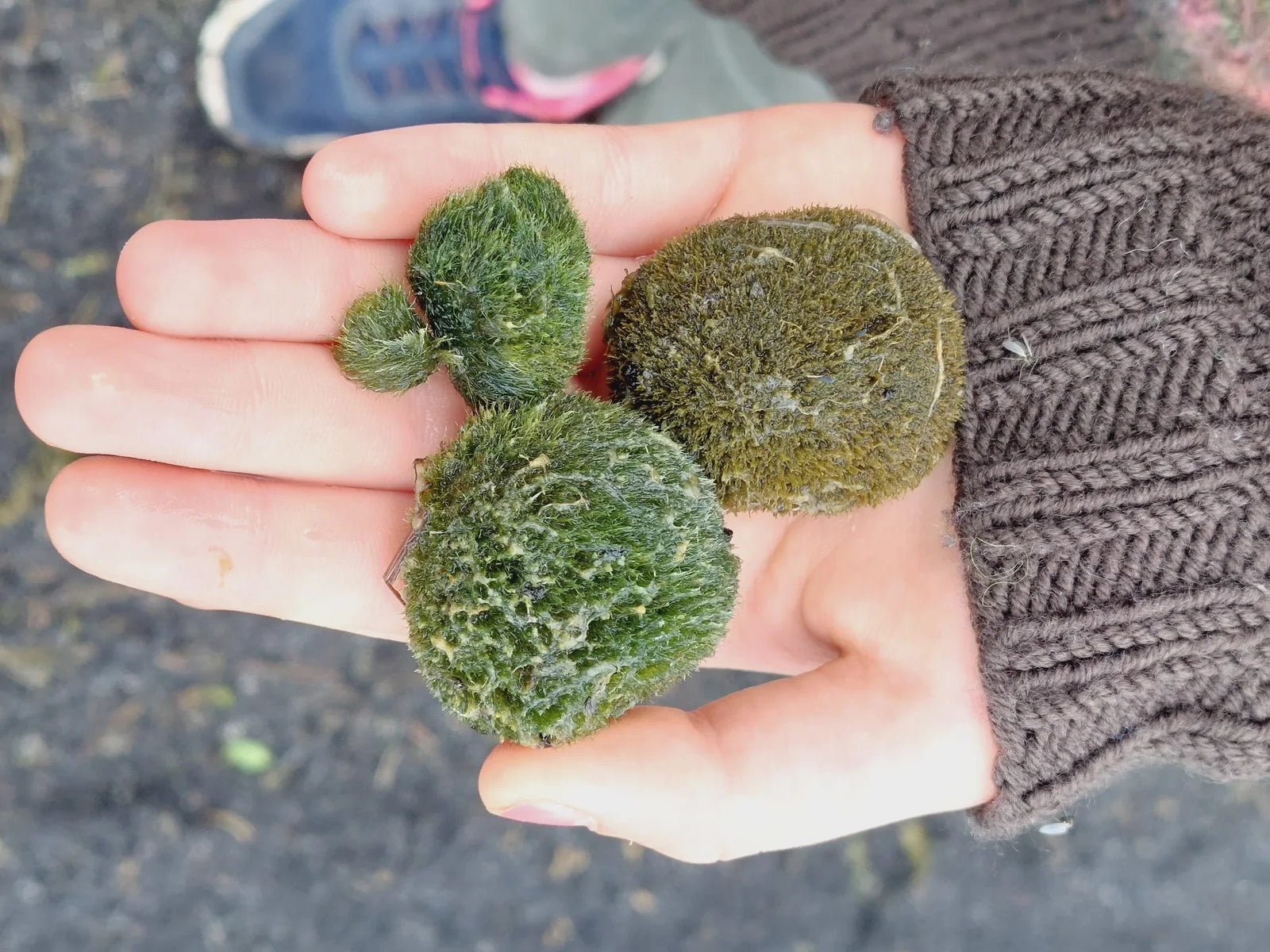
Is it OK to squeeze a marimo?
Our care card says gentle squeezing is OK, so yes, gently, when you rinse.
Other public advice differs. Some pages say never squeeze, and others say to squeeze to rinse or to make a ball float. Those are opinions, not tests, so we're not adding "never squeeze" or "squeeze to float" to our care steps.
The nearest lab mention is a 1959 freezing study. A light squeeze and a pinch were used there as a lab method and a damage sign, because freeze-damaged balls lost their springiness. That wasn't a test of squeezing as care.5 More on squeezing and floating is in Why is my marimo floating?
Why roll a marimo, and why does it go flat?
In a lake, waves do the rolling for them. Balls form when gentle wind waves roll the alga on a shallow, firm lake bottom. Rolling keeps all sides lit and shakes off debris, which researchers often call polishing.1 The longer story is in How marimo become balls
In a still jar, that job is yours, which is why our care card says to roll them to keep round. Without enough turning, the green threads grow long and the ball turns loose and shaggy, and marimo kept a long time in tanks usually lose their round shape. A ball that never turns can crack on the side kept from light.2 So "marimo stay round on their own" is only partly true: waves keep them round in lakes, and at home a gentle roll helps.1
So we don't give a set schedule. What we do at home is in the box below. Light and where to set the jar are in Marimo light and temperature.
How do I clean the jar?
What we do at home is in the box below.
What we can say is that we change the water every 2 to 4 weeks, and the water you use matters. See Marimo water. The expert who describes the Lake Akan Eco-Museum Center's display tanks says staff wipe attached algae off the balls there. The same expert's advice for other museums is to wash the tank and the marimo promptly if fine algae appear.3 Those are expert methods for large tanks, not our care steps.
Can I use soap or other chemicals on a marimo?
Please don't wash the ball with soap or chemicals.
That is a cautious step, not a proven rule. No published study has tested soap, detergent, lotion or other household chemicals on a marimo, so we can't say how much harm they do, and we won't claim soap is a proven poison. Until someone tests it, plain cool water is the safe choice, and it's what our care card says.
What about debris and brown patches?
A rinse is the care for loose debris. There is no sure home test that brown means a marimo is dead. A living wild ball can even look brownish from plankton on its surface, and an expert links a yellow-green tint to too little nitrogen.6 That's about wild balls and expert practice, not a home test. For what to look for and what to do next, see Is my marimo dead?
Should I trim or split a marimo?
In nature, marimo mostly spread by breaking into pieces that keep growing, and even a small clump or a single green thread can grow into a new marimo.7 That is biology, not a how-to. We don't recommend cutting a healthy ball in half as routine care; for our care team's hands-on notes on trimming surface-white ends or wrapping firm falling-apart pieces with thread, see Is my marimo dead?. More on pieces and baby marimo is in Marimo babies and splitting
What not to do
This is a short list of things we're not adding, not a second care card. - Don't wash the ball with soap or chemicals. - Don't let the ball dry out while you handle it.4 - Don't treat "never squeeze" or "squeeze to make it float" as care steps. - Don't cut into a healthy ball as routine care (see Is my marimo dead? for our care-team notes on surface-white tips or firm falling-apart pieces). - Don't pour old marimo water outside or down a drain. Why that matters is in Are marimo moss balls illegal?
Floating after handling
A marimo usually floats because oxygen bubbles from photosynthesis get caught in it.8 No published study has tested whether leftover air after handling causes floating, or whether squeezing is needed to pop the bubbles. So there's no "if it floats, squeeze it" step. See Why is my marimo floating?
What to do: our care steps
- Rinse in cool water, gently squeezing is OK, then roll to keep round.
- Change water every 2 to 4 weeks.
- Use bottled spring water, or tap water treated with a dechlorinator (water conditioner). Tap water left out for a few days works only if your city uses chlorine, not chloramine. Never use distilled.
- Keep below 77°F, out of direct sun and away from heaters.
With simple care, marimo can live for decades. The full guide is at Caring for your Moss Ball Pets™
FAQ
How do I clean a marimo moss ball?
Rinse in cool water, gently squeezing is OK, then roll to keep round.
Does squeezing a moss ball kill it?
Our care card says gentle squeezing is OK. Other public advice differs.
Why is my marimo flat?
In a still jar, nothing rolls it the way waves do in a lake, so it can go flat or shaggy. A gentle roll helps keep it round.2
Can I wash a marimo with soap?
Please don't. No published study has tested soap on a marimo, so we take the cautious route and use cool water only.
Can I trim the brown off a marimo?
For brown patches, see Is my marimo dead? for what to look for.
Should I squeeze a floating marimo to pop the bubbles?
You don't need to. No published study says it's needed.8
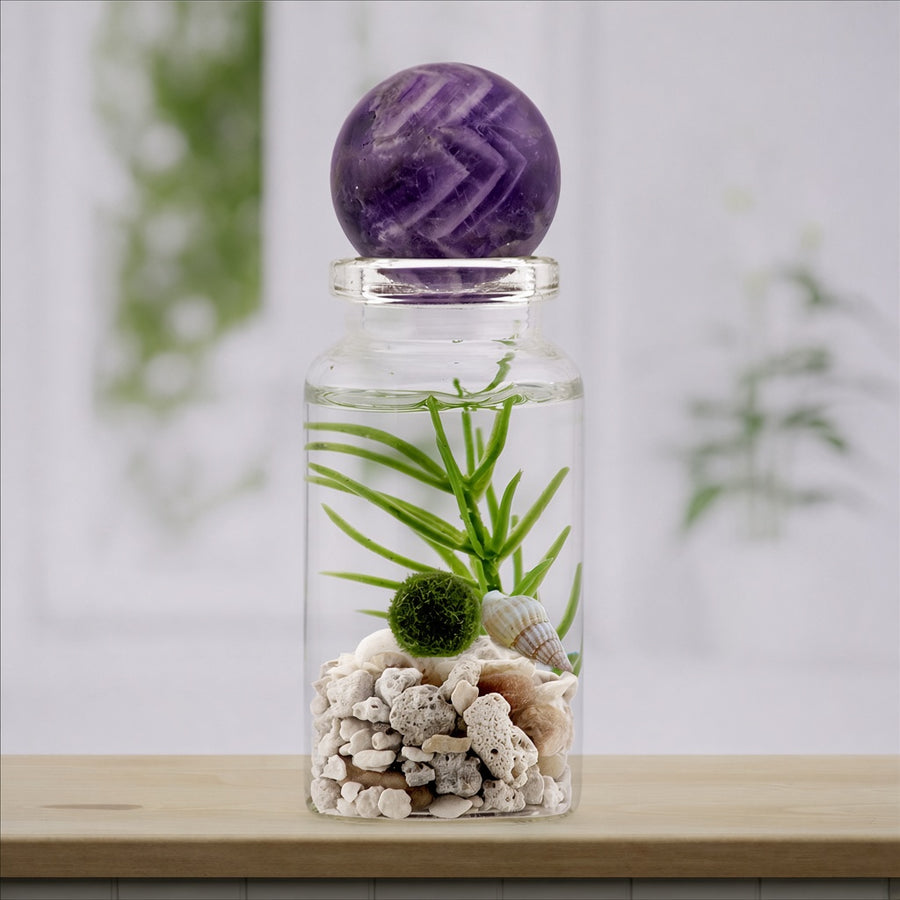
Discover the Magic of Marimo
Design your own terrarium, or start with a ready-made kit.
Footnotes
- Nakayama et al. 2021; Hayashi et al. 2019; Nakayama et al. 2015.
- Isamu Wakana 2019; Isamu Wakana 2019.
- Phillips et al. 2025; Isamu Wakana 2019.
- Isao Terumoto 1959; Boedeker et al. 2010; Isamu Wakana 2019.
- Isao Terumoto 1959. The light squeeze and the pinch in that 1959 study were a lab method and a damage sign, not a test of squeezing as care.
- Environment and office 2024; Isamu Wakana 2019.
- Umekawa, Wakana and Ohara 2021; Science, Tokyo and Botany 2024.
- Cano-Ramirez et al. 2018.
Sources
- Keisuke Nakayama, Katsuaki Komai, Keisuke Ogata, Toshiro Yamada, Yukinobu Sato, Fumiya Sano, Shintarou Horii, Yuichiro Somiya, Etsuko Kumamoto, Yoichi Oyama (2021). The structure and formation of giant Marimo (Aegagropila linnaei) in Lake Akan, Japan. Scientific Reports 11: 22017. Link: https://doi.org/10.1038/s41598-021-01028-5. Checked 2026-11-10.
- Noriko Hayashi, Keisuke Nakayama, Yoichi Oyama, Katsuaki Komai (2019). 数値計算によるマリモの移動限界と波動による回転角度の推定 [Estimation of rotation angle and critical velocity of marimos due to waves and currents]. Journal of JSCE B1 (Hydraulic Engineering) 75(2): I_775-I_780. Link: https://doi.org/10.2208/jscejhe.75.2_i_775. Checked 2026-11-10.
- Keisuke Nakayama, Gongo Ito, Isamu Wakana, Takefumi Kitamura, Yukinobu Sato, Katsuaki Komai, Tomohiko Takeuchi (names from page text; romanization of some names not confirmed) (2015). マリモ球状体に回転運動を引き起こす阿寒湖チュウルイ湾の風波特性 [Characteristics of wind waves in Churui Bay, Lake Akan, that cause rotation of spherical marimo]. Journal of JSCE B3 (Ocean Engineering) (土木学会論文集B3(海洋開発)) vol. 71, no. 2, I_945-I_950. Link: https://www.jstage.jst.go.jp/article/jscejoe/71/2/71_I_945/_pdf. Checked 2026-11-10.
- Isamu Wakana (2019). ④ 球状マリモ栽培の基本的な考え方 [(4) Basic approach to growing ball marimo]. Link: https://ameblo.jp/maromo-lab/entry-12465712763.html. Checked 2026-11-10.
- Isamu Wakana (2019). ② 球状マリモの生長特性 (マリモの育て方, 国立台湾博物館用マニュアル) [(2) Growth traits of ball marimo (How to raise marimo, manual written for the National Taiwan Museum)]. Link: https://ameblo.jp/maromo-lab/entry-12465480295.html. Checked 2026-11-10.
- Neil Phillips, Thomas C. Draper, Andrew P. Geary, Kathryn Lamb-Riddell, Darren M. Reynolds, Joshua A. C Steven, Freya Radford, Abdul R. Farooq, Andrew Adamatzky (2025). Marimo for monitoring and filtering of aquatic environments. Environmental Science and Pollution Research. Link: https://doi.org/10.1007/s11356-025-37259-6. Checked 2026-11-10.
- Isamu Wakana (若菜勇) (2019). ⑤ 球状マリモの栽培方法 (マリモ博士の研究日記) [(5) How to cultivate ball marimo (Dr. Marimo's research diary)]. Link: https://ameblo.jp/maromo-lab/entry-12473448831.html. Checked 2026-11-10.
- Isao Terumoto (照本勲) (1959). マリモの凍害と乾燥害 [Freezing injury and drying injury in marimo]. 低温科學 生物篇 (Low Temperature Science, Series B: Biological Sciences) 17: 1 to 7, Institute of Low Temperature Science, Hokkaido University. Link: https://eprints.lib.hokudai.ac.jp/repo/huscap/all/17616/. Checked 2026-11-10.
- Christian Boedeker, Anja Eggert, Anne Immers, Isamu Wakana (2010). Biogeography of Aegagropila linnaei (Cladophorophyceae, Chlorophyta): a widespread freshwater alga with low effective dispersal potential shows a glacial imprint in its distribution. Journal of Biogeography 37: 1491-1503. Link: https://doi.org/10.1111/j.1365-2699.2010.02309.x. Checked 2026-11-09.
- Ministry of the Environment, Lake Akan ranger office (2024). 「大きな球状マリモの生息地へ!」|北海道環境局|環境省 ["To the home of the big ball marimo!" (Ministry of the Environment, Hokkaido office blog)]. Link: https://hokkaido.env.go.jp/blog/page_00348.html. Checked 2026-11-04.
- Taketo Umekawa, Isamu Wakana, Masashi Ohara (2021). Reproductive behavior and role in maintaining an aggregative form of the freshwater green alga Marimo, Aegagropila linnaei, in Lake Akan, Hokkaido, Japan. Aquatic Botany 168: 103309. Link: https://doi.org/10.1016/j.aquabot.2020.103309. Checked 2026-11-10.
- National Museum of Nature and Science, Tokyo (Kahaku), Department of Botany (2024). 我が家にまりも!?~一般家庭の水槽で見つかったまりもの調査~ (pages: マリモ; 「まりも」と「マリモ」; 調査のこれから; 分類について) [Marimo in my home!? Survey of marimo found in household tanks (pages: Marimo; "まりも" and "マリモ"; Next steps; About classification)]. Link: https://www.kahaku.go.jp/research/db/botany/microalgae/marimo/index.html. Checked 2026-11-10.
- Dora L. Cano-Ramirez, Tara Saskia de Fraine, Olivia G. Griffiths, Antony N. Dodd (2018). Photosynthesis and circadian rhythms regulate the buoyancy of marimo lake balls. Current Biology 28(16): R869-R870. Link: https://doi.org/10.1016/j.cub.2018.07.027. Checked 2026-11-10.
Related guides
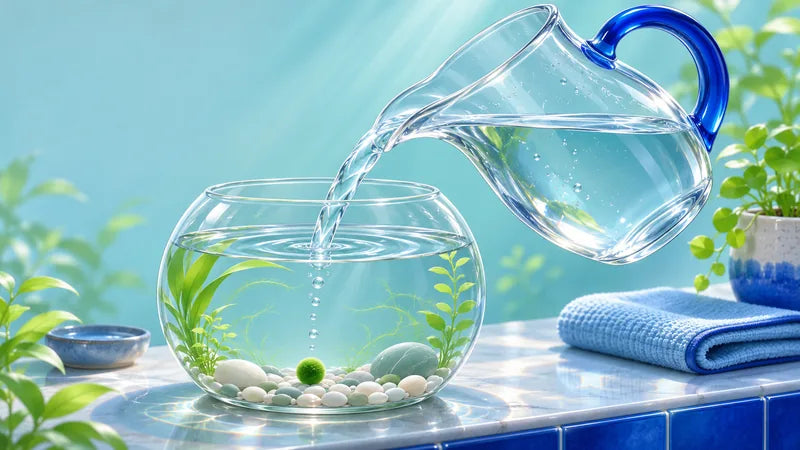
Marimo Water: What to Use and How Often to Change It
Use bottled spring water, or tap water treated with a dechlorinator (water conditioner). Tap water left out for a few days works only if your city uses chlorine, not chloramine. Never use distilled. Change water every 2 to 4 weeks. Marimo need some minerals, and distilled water has had those taken out. Leaving tap water out can let free chlorine leave, but it does not remove chloramine, which many US water systems use. That's why a dechlorinator is the safer choice for tap water.
Read the guide →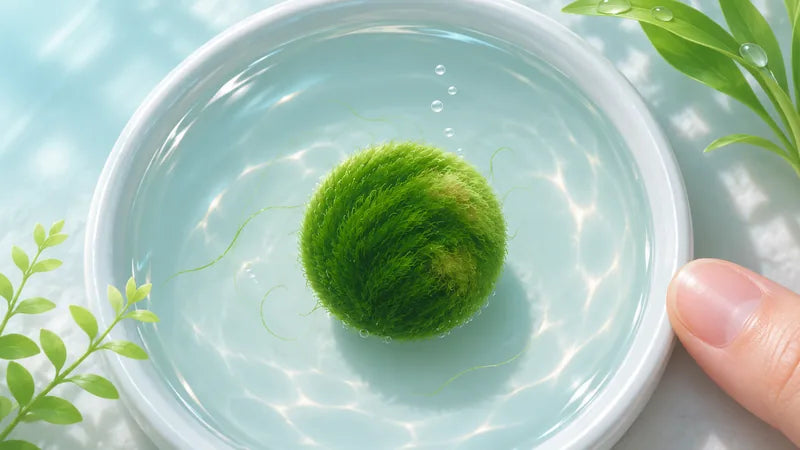
Is My Marimo Dead? Brown, White or Falling Apart
There is no sure home test for whether a marimo is dead or alive. A 2017 library reference answer said that, in general, it is difficult to tell. Green color alone is not proof of life. Brown, white, a smell, floating, or falling apart can be clues, not proof.
Read the guide →
What Are Marimo Babies? How Moss Balls Multiply
"Marimo babies" is a friendly way to talk about new pieces, not a biological baby. Marimo mostly make new marimo by breaking into pieces that keep growing. Even a small clump or a single green thread can grow into a new one. Spores are rare, and a sexual cycle is not confirmed.
Read the guide →
Why Is My Marimo Floating? What the Bubbles Mean
A marimo usually floats because tiny bubbles of oxygen from photosynthesis get caught in it, and in lab studies it sinks again in the dark. Floating means it is making oxygen in the light, not that it feels happy. And a marimo that stays on the bottom is not, by that alone, unwell.
Read the guide →
How Marimo Become Balls, and Whether You Can Make One
Gentle waves roll marimo along a shallow lake bottom, and that rolling makes them round. They are living green algae, a crowd of threads growing together, not moss and not built around a stone. The ball form is the rarest of the three forms. No published study has shown a way to make a true marimo ball at home.
Read the guide →
Marimo Light and Temperature: How Much Light and How Cool?
Keep below 77°F, out of direct sun and away from heaters. Marimo make their food from gentle light and can live in quite dim conditions. Strong light is most clearly shown to hurt them in very cold water, and a sunny windowsill can still heat a jar. 77°F is our care ceiling, not a death point.
Read the guide →