






What Are Marimo Babies? How Moss Balls Multiply
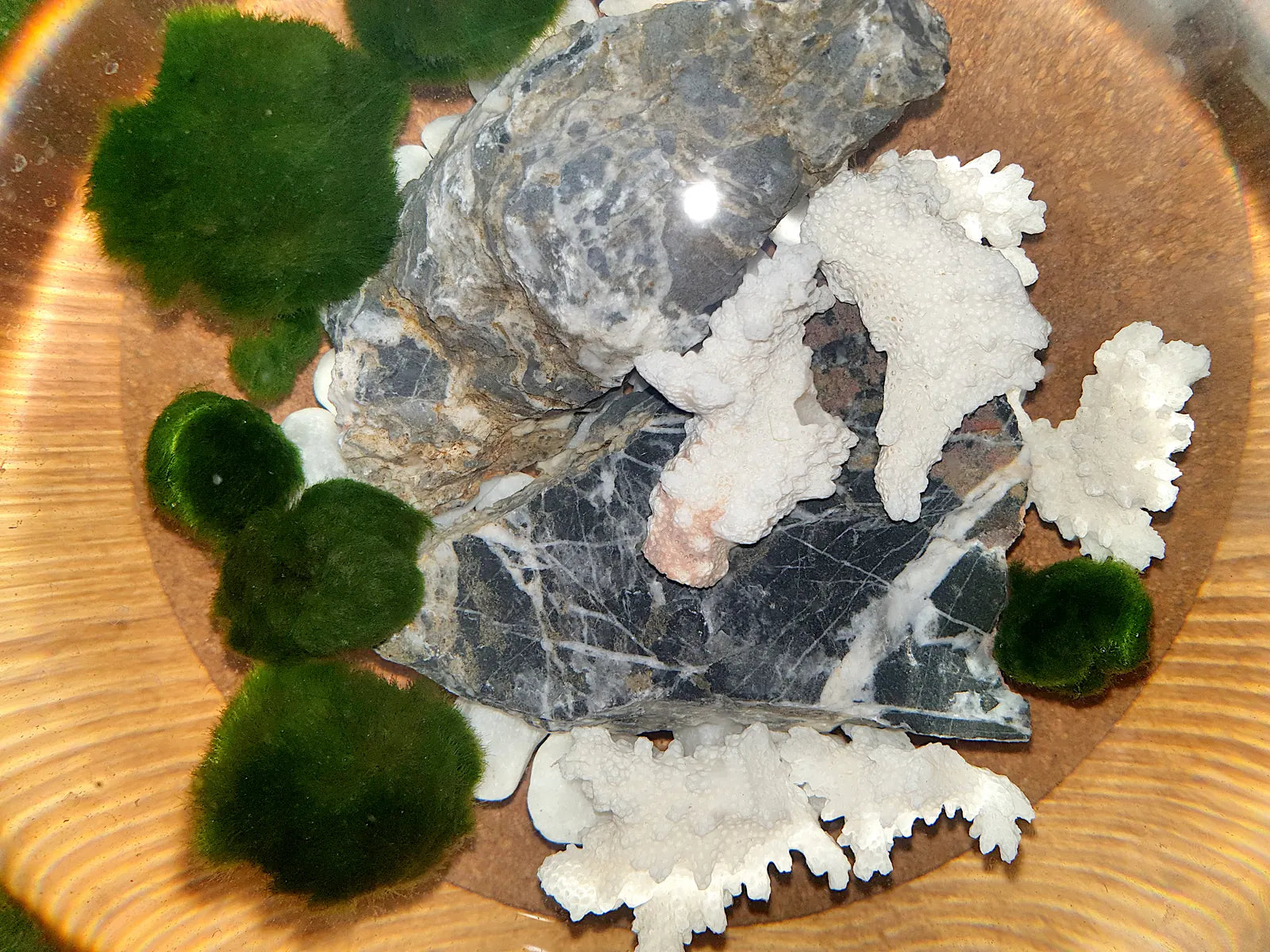
"Marimo babies" is a friendly way to talk about new pieces, not a biological baby. Marimo mostly make new marimo by breaking into pieces that keep growing. Even a small clump or a single green thread can grow into a new one. Spores are rare, and a sexual cycle is not confirmed.
What are marimo babies?
When people say a marimo had babies, they usually mean a small piece or a new little ball. These are new pieces of the same living alga, which keep growing on their own.1 Marimo are living green algae, not moss and not animals that give birth.2
Quick facts
- What it is a living green alga, not a moss.2
- Scientific name Aegagropila linnaei (also listed as A. brownii).3
- How it's built many living threads growing together, not one plant.4
- How it spreads mostly by breaking into pieces that keep growing.1
- From a tiny start even a small clump, or a single green thread, can grow into a new marimo.5
- Spores do form in the wild, but rarely.1
- In lakes storms can break big balls apart, and the pieces regrow.67
- A small green ball in a tank may be a different alga, not a marimo.9
How do marimo reproduce?
Marimo mostly spread and persist by breaking into pieces that keep growing. Spores (zoospores) do form in the wild, but rarely.1
Marimo are alive. Each ball is made of living green algae cells that make their own food from light, water and carbon dioxide, grow, and can reproduce. They have no mouth and do not need feeding.10 For more, see Are marimo moss balls alive? and What do marimo eat?
Each ball is a mass of many branching, thread-like filaments growing together, not one plant. That's why a piece can keep living on its own.4
Japan's national science museum states that if a spherical marimo falls apart, it can grow large again from small clumps, and that a single filament, or a branch that has come off a filament, can grow into a new individual. It calls this vegetative reproduction, like taking cuttings of a plant.5 That's a biology fact about how the alga grows, not a how-to for cutting a home ball.
The same alga also grows attached to rocks or as loose floating tufts, and the ball form is the rarest.11 Those other forms are not "babies." See What is a marimo?
Balls form when gentle wind waves roll the alga on a shallow, firm lake bottom.12 Pieces become new balls in the lake by this rolling, not by "giving birth." See How marimo become balls
Marimo grow very slowly, roughly a centimeter a year or less in the wild.13 No home growth rate was measured in the sources we found. More in How long do marimo live?
Splitting in the wild
In Lake Akan, Japan, big balls are washed ashore and broken by storms every several years, and the pieces regrow into new balls.67 That storm cycle is a wild-lake story, not a home-care timetable. More in Lake Akan, Japan. At home, a ball falling apart can mean decay, so if yours is coming apart, see Is my marimo dead?
Studies do not agree on one size at which hollowness begins, or on one thickness for the living layer. Balls larger than about 10 cm are often described as hollow inside, because light cannot reach the center, with a living layer about 4 to 5 cm thick.14 Radial-type balls are also said to start going hollow from about 7 to 10 cm across, and a later study of two large radial balls measured an outer algal mass about 2.5 cm thick.14 So the exact cutoff and the thickness of the living layer are still a range, not a single settled figure. This describes large wild lake balls, not typical home size. See How marimo become balls
What about "pregnant" marimo?
Calling a marimo "pregnant," or saying it has "babies," is only a figure of speech. Marimo spread mostly by breaking into pieces that grow on their own. Spores are rare.8
People sometimes use "pregnant" for a bump or a small piece on a larger ball, but there is no published study or historical record for that look.
In still water, filaments can grow long and the ball can turn loose and shaggy. Balls kept a long time in tanks usually lose their round shape.15 A loose or irregular shape is not a sign of pregnancy. If your marimo is shedding or losing its shape, see Is my marimo dead? or Cleaning and rolling your marimo
Is that small ball in my tank a marimo baby?
Not every small green ball in a tank is a marimo. Japan's national science museum found other ball-forming algae (Motosu marimo, Tateyama marimo, and Aomisou, also called Pithophora) appearing in home tanks across Japan. The museum describes some finds as linked to aquatic plants, a river stone, or shells. The museum asks people never to release tank algae into the wild.9 That survey describes where the museum looked, not where our marimo come from, and it does not mean marimo live only in Japan.
A new small ball may be a different alga, not a marimo. There is no published study or historical record for budding of true marimo in home jars.9 There is also no reliable home test in our sources for telling these algae apart without a specialist.
True marimo have no tough resting stage (akinetes are not formed). The museum says Aomisou (Pithophora) does form akinetes, but that contrast is not a home identification test.16
Spores, rarely
Spores are rare. A 2020 field study found only four-flagella zoospores, and did not confirm a sexual life cycle.17
In a 2017 and 2018 field study at Lake Akan, Japan, four-flagella zoospores formed in mid-August and early September at three of five sites, and were not found at two sites. The share of zoospore-producing filaments was extremely low (at most 1.3%). The zoospores were teardrop or straw-bag shaped, 10 to 30 micrometers across, with an eyespot and four flagella. The authors did not observe the two-flagella zoospores reported in older culture studies cited in the 2020 paper. They concluded that rare zoospore formation can supply a few new individuals, while the low rate helps the ball form persist by vegetative growth. A full sexual life cycle was left as an open possibility, not a confirmed finding.17
This was a wild Lake Akan study, not a home-jar result. It does not mean a home marimo will make spores in late summer.
The sources disagree about sexual reproduction. The 2020 field study found only four-flagella zoospores and left a sexual life cycle as an open possibility. A page from Japan's national science museum cites that paper and says marimo appears to carry out sexual reproduction by the joining of male and female gametes that have two tail-like flagella.17 A sexual cycle is not confirmed.
Can I split a marimo at home?
There is no published study or historical record for budding of true marimo in home jars, or for a marimo splitting into two at home.9
Pieces can keep growing: that much is sourced,15 including in research trials that tied fragments with thread.18 That is a research trial, not a tested home method, and it is not a reason to recommend cutting a ball in half. Those trials are not where our marimo come from.
No published study has tested cutting or splitting a home marimo in half, so we do not treat that as a published rule.
If a ball is already in pieces, start with Is my marimo dead?. Rinse in cool water, gently squeezing is OK, then roll to keep round.
FAQ
What are marimo babies?
"Babies" is a friendly way to talk about new pieces, not a biological baby. Marimo mostly make new marimo by breaking into pieces that keep growing.1
How do marimo moss balls reproduce?
What does a pregnant moss ball look like?
People sometimes use "pregnant" for a bump or a small piece on a larger ball, but there is no published study or historical record for that look.8
Can I split or cut a marimo to make two?
Is every small green ball in my tank a marimo baby?
No. A small green ball may be a different alga that came in on plants or stones.9
Discover the Magic of Marimo
Design your own terrarium, or start with a ready-made kit.
Footnotes
- Umekawa, Wakana and Ohara 2021.
- Hanyuda et al. 2002; Boedeker et al. 2012; Umekawa, Wakana and Ohara 2021.
- Guiry and Frödén 2023; AlgaeBase, Aegagropila linnaei Kützing 1843; World Register of Marine Species, Aegagropila linnaei Kützing, 1843.
- Nakayama et al. 2021; Kushiro City, 阿寒湖のマリモ|釧路市ホームページ Marimo of Lake Akan.
- Science, Tokyo and Botany 2024.
- Kushiro City, 阿寒湖のマリモの世界的な価値|釧路市ホームページ The global value of Lake Akan's.
- Nakayama et al. 2021.
- Umekawa, Wakana and Ohara 2021.
- Science, Tokyo and Botany 2024.
- Umekawa, Wakana and Ohara 2021; Web and Akan", マリモの育て方(2) How to raise marimo.
- Boedeker et al. 2010.
- Nakayama et al. 2021.
- Nakayama et al. 2021; Boedeker et al. 2010.
- Nakayama et al. 2021; Isamu Wakana 2019; Togashi, Sasaki and Yoshimura 2014; Kushiro City, 阿寒湖のマリモ|釧路市ホームページ Marimo of Lake Akan; Nakai, Wakana and Niki 2021.
- Isamu Wakana 2019; Isamu Wakana 2019.
- Boedeker et al. 2010; Science, Tokyo and Botany 2024.
- Umekawa, Wakana and Ohara 2021; Science, Tokyo and Botany 2024.
- Digital and pages 2018.
Sources
- Taketo Umekawa, Isamu Wakana, Masashi Ohara (2021). Reproductive behavior and role in maintaining an aggregative form of the freshwater green alga Marimo, Aegagropila linnaei, in Lake Akan, Hokkaido, Japan. Aquatic Botany 168: 103309. Link: https://doi.org/10.1016/j.aquabot.2020.103309. Checked 2026-11-10.
- Takeaki Hanyuda, Isamu Wakana, Shogo Arai, Kazuyuki Miyaji, Yasuyuki Watano, Kunihiko Ueda (2002). Phylogenetic relationships within Cladophorales (Ulvophyceae, Chlorophyta) inferred from 18S rRNA gene sequences, with special reference to Aegagropila linnaei. Journal of Phycology 38(3): 564-571. Link: https://doi.org/10.1046/j.1529-8817.2002.01151.x. Checked 2026-11-04.
- Christian Boedeker, Charles J. O'Kelly, Wim Star, Frederik Leliaert (2012). Molecular phylogeny and taxonomy of the Aegagropila clade (Cladophorales, Ulvophyceae), including the description of Aegagropilopsis gen. nov. and Pseudocladophora gen. nov. Journal of Phycology 48(3): 808-825. Link: https://biblio.ugent.be/publication?q=keyword+exact+%22LINNAEI%22. Checked 2026-11-04.
- Michael D. Guiry, Patrik Frödén (2023). Aegagropila brownii (Dillwyn) Kützing is the correct name for Aegagropila linnaei Kützing, the type of Aegagropila Kützing (Pithophoraceae, Chlorophyta), widely known as "Marimo" or "Cladophora Balls". Notulae Algarum 293: 1-7. Link: https://notulaealgarum.org/2023/documents/Notulae%20Algarum%20No.%20293.pdf. Checked 2026-11-10.
- AlgaeBase (Guiry & Guiry, University of Galway). Aegagropila linnaei Kützing 1843 (species record). Link: https://www.algaebase.org/search/species/detail/?species_id=59094. Checked 2026-11-10.
- World Register of Marine Species. Aegagropila linnaei Kützing, 1843 (WoRMS name details). Link: https://www.marinespecies.org/aphia.php?id=381150&p=taxdetails. Checked 2026-11-10.
- Keisuke Nakayama, Katsuaki Komai, Keisuke Ogata, Toshiro Yamada, Yukinobu Sato, Fumiya Sano, Shintarou Horii, Yuichiro Somiya, Etsuko Kumamoto, Yoichi Oyama (2021). The structure and formation of giant Marimo (Aegagropila linnaei) in Lake Akan, Japan. Scientific Reports 11: 22017. Link: https://doi.org/10.1038/s41598-021-01028-5. Checked 2026-11-10.
- Kushiro City (釧路市教育委員会 マリモ研究室). 阿寒湖のマリモ|釧路市ホームページ [Marimo of Lake Akan (Kushiro City website, Board of Education marimo page)]. Link: https://www.city.kushiro.lg.jp/museum/bunkazai/1005708/kinenbutsu/1005712.html. Checked 2026-11-12.
- National Museum of Nature and Science, Tokyo (Kahaku), Department of Botany (2024). 我が家にまりも!?~一般家庭の水槽で見つかったまりもの調査~ (pages: マリモ; 「まりも」と「マリモ」; 調査のこれから; 分類について) [Marimo in my home!? Survey of marimo found in household tanks (pages: Marimo; "まりも" and "マリモ"; Next steps; About classification)]. Link: https://www.kahaku.go.jp/research/db/botany/microalgae/marimo/index.html. Checked 2026-11-10.
- Kushiro City (text credited to MARIMO Web). 阿寒湖のマリモの世界的な価値|釧路市ホームページ [The global value of Lake Akan's marimo (Kushiro City)]. Link: https://www.city.kushiro.lg.jp/machi/kankyou/1004295/1008323/1005713.html. Checked 2026-11-12.
- MARIMO Web, official site of the Special Natural Monument "Marimo of Lake Akan" (run by Akan tourism groups, Kushiro City Board of Education and the marimo protection society). マリモの育て方(2) [How to raise marimo (2)]. Link: http://www.marimo-web.org/faq/qa_grow2.html. Checked 2026-11-04.
- Christian Boedeker, Anja Eggert, Anne Immers, Isamu Wakana (2010). Biogeography of Aegagropila linnaei (Cladophorophyceae, Chlorophyta): a widespread freshwater alga with low effective dispersal potential shows a glacial imprint in its distribution. Journal of Biogeography 37: 1491-1503. Link: https://doi.org/10.1111/j.1365-2699.2010.02309.x. Checked 2026-11-09.
- Isamu Wakana (2019). ② 球状マリモの生長特性 (マリモの育て方, 国立台湾博物館用マニュアル) [(2) Growth traits of ball marimo (How to raise marimo, manual written for the National Taiwan Museum)]. Link: https://ameblo.jp/maromo-lab/entry-12465480295.html. Checked 2026-11-10.
- Tatsuya Togashi, Hironobu Sasaki, Jin Yoshimura (2014). A geometrical approach explains Lake Ball (Marimo) formations in the green alga, Aegagropila linnaei. Scientific Reports 4: 3761. Link: https://doi.org/10.1038/srep03761. Checked 2026-11-10.
- Ryosuke Nakai, Isamu Wakana, Hironori Niki (2021). Internal microbial zonation during the massive growth of marimo, a lake ball of Aegagropila linnaei in Lake Akan. iScience. Link: https://doi.org/10.1016/j.isci.2021.102720. Checked 2026-11-10.
- Isamu Wakana (2019). ④ 球状マリモ栽培の基本的な考え方 [(4) Basic approach to growing ball marimo]. Link: https://ameblo.jp/maromo-lab/entry-12465712763.html. Checked 2026-11-10.
- Asahi Shimbun Digital, Hokkaido regional pages (2018). 若菜勇さん(4)大量打ち上げの真相 / (5)マイマリモで再生めど [Wakana Isamu interview series, parts 4 and 5 (the truth about mass wash-ups; "My Marimo" regeneration)]. Link: http://www.asahi.com/area/hokkaido/articles/MTW20180115011190002.html. Checked 2026-11-12.
Related guides
What Is a Marimo? The Moss Ball, Explained
A marimo, often called a moss ball, is a ball of green algae, not moss. Each one is made of many fine threads of the alga Aegagropila linnaei growing together. In a few lakes, gentle waves roll those threads into round balls. Marimo are alive and make their own food from light, so they need no feeding.
Read the guide →
Are Marimo Moss Balls Alive? Yes, and Here's How You Can Tell
Yes, marimo moss balls are alive. Each one is a ball of living green algae that makes its own food from light, so it never needs feeding. Marimo grow, can make new marimo, and can even float when oxygen bubbles from photosynthesis get caught in their threads. They are not moss, and they are not a toy.
Read the guide →
Is My Marimo Dead? Brown, White or Falling Apart
There is no sure home test for whether a marimo is dead or alive. A 2017 library reference answer said that, in general, it is difficult to tell. Green color alone is not proof of life. Brown, white, a smell, floating, or falling apart can be clues, not proof.
Read the guide →
How Long Do Marimo Live, and How Big Do They Get?
With simple care, marimo can live for decades. The longest published home record is a family that kept a close relative of the marimo for more than 50 years. No published study has documented any single ball reaching 100 years.
Read the guide →
How Marimo Become Balls, and Whether You Can Make One
Gentle waves roll marimo along a shallow lake bottom, and that rolling makes them round. They are living green algae, a crowd of threads growing together, not moss and not built around a stone. The ball form is the rarest of the three forms. No published study has shown a way to make a true marimo ball at home.
Read the guide →
Lake Akan Marimo
Lake Akan is a freshwater lake in Kushiro City, Hokkaido, inside Akan-Mashu National Park. It sits in the Akan caldera. It is the only place now known with confidence to still hold colonies of large wild marimo balls, about 12 cm or more. The species itself does not grow only in Japan, and Japan has several lakes with the alga. This page is about the wild lake, not about the marimo we sell.
Read the guide →