






Is My Marimo Dead? Brown, White or Falling Apart
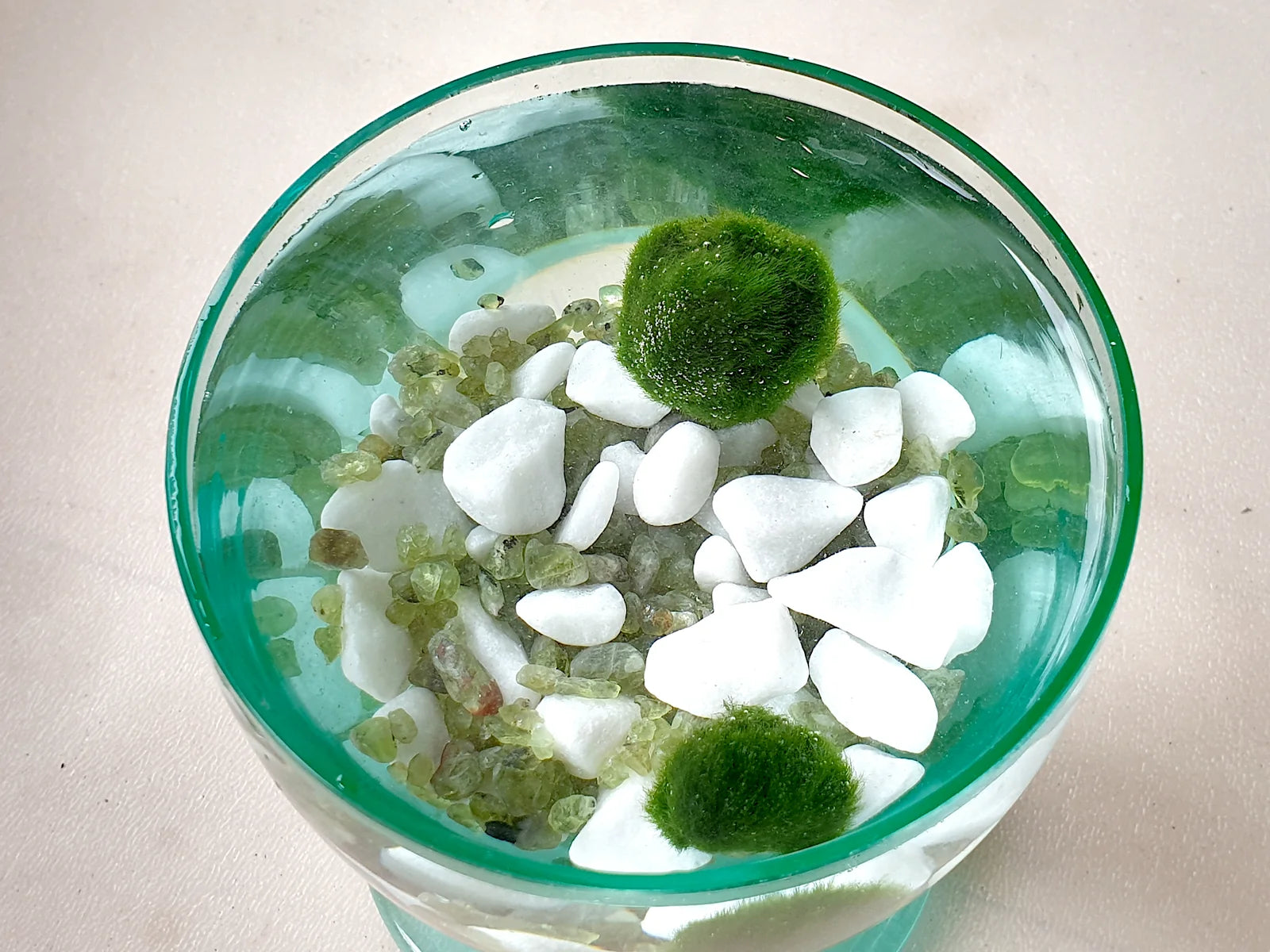
There is no sure home test for whether a marimo is dead or alive. A 2017 library reference answer said that, in general, it is difficult to tell. Green color alone is not proof of life. Brown, white, a smell, floating, or falling apart can be clues, not proof.
Is my marimo dead?
There is no sure home test for whether a marimo is dead or alive. A 2017 answer from a Japanese public library, in the National Diet Library's collaborative reference database, said that whether a marimo is alive or dead can apparently be told by looking at the cells under a microscope, but that in general it is difficult to tell.1 That is one hedged library answer, not a home method, and we are not giving a microscope protocol.
Green color alone does not prove a marimo is alive. In a lab test, marimo cells that had died stayed green for at least 15 days at low temperature.2 That test was on cells, not whole balls, and it was not done at room temperature.
The signs below are clues, not proof. A color, a smell, floating or not floating, or a green surface does not, by itself, prove that a ball is dead or alive. For the basic question of whether marimo are living things, see Are marimo moss balls alive?
Quick facts
- No sure test there is no sure home test of dead or alive.12
- Green is not proof dead cells can stay green for a while.2
- Brown can mean trouble, but a living wild ball can also look brownish from plankton on its surface.34
- White or pale can appear in distilled or low-mineral water, and in some cases the filaments die.5
- Smell or mud a rotten smell or mud-like matter coming out is a sign of decay inside, not proof of death.6
- Falling apart can mean decay, but in the wild the pieces often keep growing.789
- Springiness a damaged ball may lose its springiness and feel like wet cotton, even while it still looks green.10
- Floating usually means oxygen bubbles from photosynthesis are caught in it; not floating does not, by itself, mean it is unwell.1112
- Dried out dried-out balls usually fall apart, though a few new green threads may slowly regrow.39
- Care if you use care steps, use only the ones at the end of this page.
What a healthy, living marimo is like
Marimo are alive. They are living green algae that make their own food from light and never need feeding.13 See Are marimo moss balls alive?
Healthy marimo make food from light and can float when oxygen bubbles get caught in them.1311 Not floating does not, by itself, mean a marimo is unwell.12 More on floating is in Why is my marimo floating?
In a 1959 lab study, freeze-damaged balls lost their springiness and felt like wet cotton, even while they still looked green.10 The same wet-cotton loss of springiness also appeared in dried balls after they were put back in water.3 These are lab observations, not a home squeeze test. Our care line only says gentle squeezing is OK, and we do not use squeezing as a test of health.
Why is my marimo turning brown?
What you see: brown or red-brown color, or brown patches.
What the research says: brown can mean trouble, but there is no sure home test for what a brown marimo means.
Dried balls put back in water broke apart in 2 to 3 weeks and turned red-brown in a lab study, though a few new green filaments regrew months later.3
A living wild Lake Akan ball can also look brownish because plankton is stuck on the surface, not because it is dead.4 That is a wild lake observation, not a home diagnosis, and it is not something to assume about a home marimo.
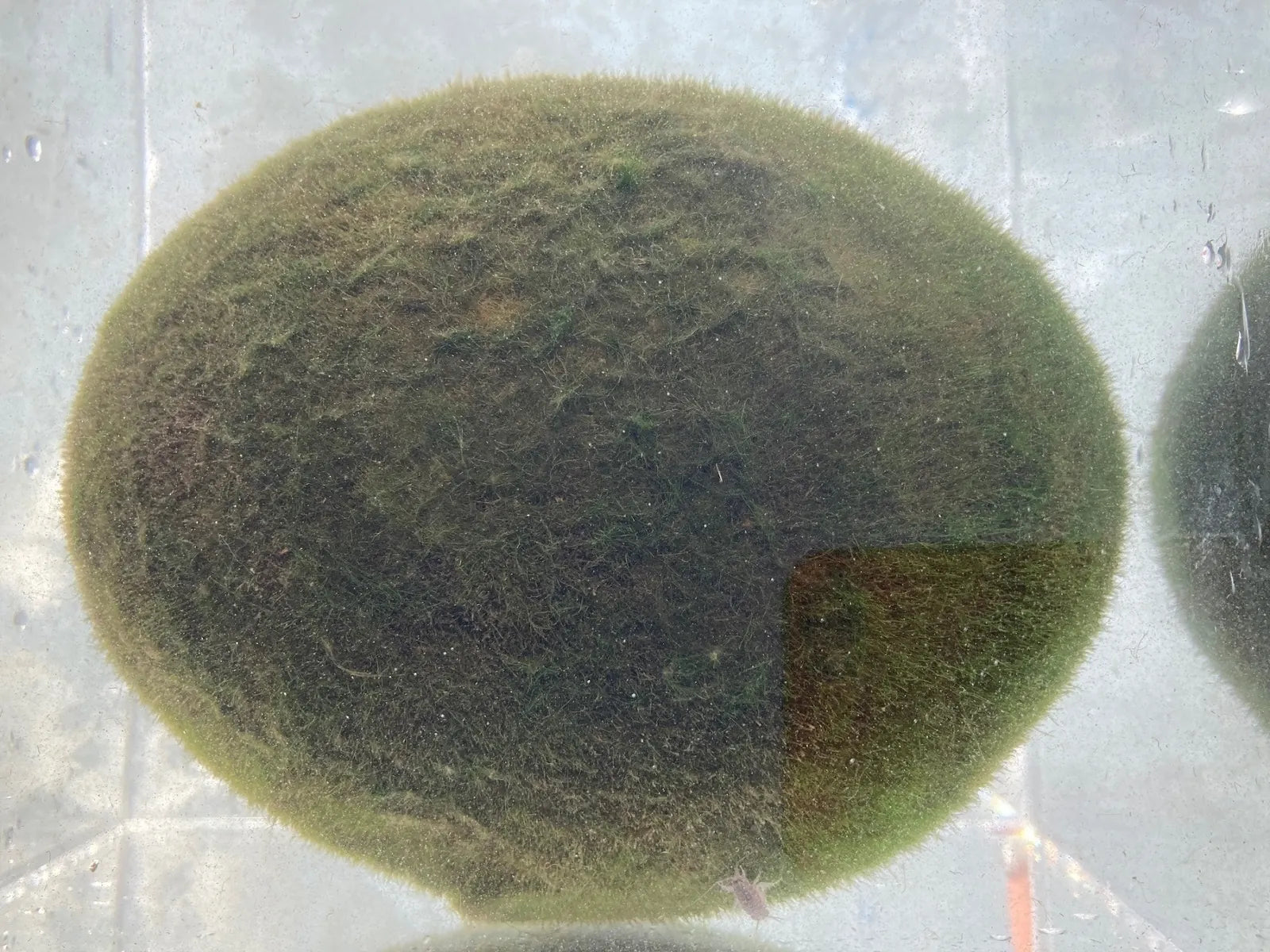
Strong light can harm marimo, especially in cold water. In lab tests, strong light damaged and killed marimo cells.14 That research is on lake and lab conditions. No source in our set ties that damage to a brown color at home.
Other home causes of brown, such as heat, poor water, or "black rot," are not established by a published study, except the drying example and the wild plankton example above. No published study has tested trimming brown patches with scissors as a home method.
What to do: Keep below 77°F, out of direct sun and away from heaters. Change water every 2 to 4 weeks. Use bottled spring water, or tap water treated with a dechlorinator (water conditioner). Tap water left out for a few days works only if your city uses chlorine, not chloramine. Never use distilled.
Why is my marimo white or pale?
What you see: white or pale filaments or patches.
What the research says: in culture, filaments may turn white, and in some cases die, in distilled water or low-mineral tap water, even with nutrients added.5 That is one reason our care line says never to use distilled water. Other causes of white, such as strong light or death, are not established by a published home test. A white marimo is not, by itself, proof that the whole ball is dead.
What to do: Use bottled spring water, or tap water treated with a dechlorinator (water conditioner). Tap water left out for a few days works only if your city uses chlorine, not chloramine. Never use distilled. See Marimo water: what to use and how often
Why is it yellow-green?
What you see: a yellow-green color, rather than a deeper green.
What the research says: an expert grower says a yellow-green color may mean too little nitrogen.6 That is expert practice, not a peer-reviewed home test. We do not advise fertilizer or adding nitrogen. The expert adds nitrogen in museum tanks, which is not part of our care values, and no source in our set shows that feeding helps at home.
What to do: use only our usual care steps, listed at the end of this page.
Why is my marimo falling apart or mushy?
What you see: the ball is coming apart, feels mushy, or has lost its springiness.
What the research says: very warm water can make the inside of a ball decompose faster and the ball fall apart. A lab study cited by Nakayama and colleagues reported that a marimo held at 35°C (95°F) for 24 hours fell apart after 80 days.7 That figure is not our care limit. Our care line is: Keep below 77°F, out of direct sun and away from heaters.
Falling apart is also natural in the wild. Big Lake Akan balls get washed ashore by storms and break up, and the pieces regrow.815 That is a wild-lake cycle, not a home-care timetable. See Lake Akan, Japan
In a 1959 lab study, freeze-damaged or dried balls lost their springiness and felt like wet cotton.103 That is a lab observation, not a home squeeze test.
Large wild balls can also go hollow inside, which is a different story from a typical home ball falling apart. Studies do not agree on one size at which hollowness begins, or on one thickness for the living layer. Balls larger than about 10 cm are often described as hollow inside, because light cannot reach the center, with a living layer about 4 to 5 cm thick.16 In Lake Akan's Churui Bay, radial-type balls are also said to start going hollow from about 7 to 10 cm across, as filaments inside get no light and die and decay.17 A later study of two large radial balls measured an outer algal mass about 2.5 cm thick, with a hollow core.17 So hollowness in large wild balls is well established, but the exact cutoff and the thickness of the living layer are still a range, not a single settled figure. This describes large wild lake balls, not typical home size. There is no published study or historical record for whether a typical home-sized ball is hollow in that sense, and a home marimo should not be captioned as hollow.
Large radial balls in Lake Akan also have inner layers of sediment and bacteria.18 That finding is about large wild balls. No source in our set covers bacteria in home-kept marimo, and we are not tying a home smell to bacteria.
Marimo mostly spread by breaking into pieces that keep growing, and a small clump or even a single green thread can grow into a new marimo.199 In nature, broken pieces keep growing. That is a biology fact. See our care-team note below for what we do with firm pieces. See Marimo babies and splitting and How marimo become balls
What to do: Keep below 77°F, out of direct sun and away from heaters. Rinse in cool water, gently squeezing is OK, then roll to keep round.
Why is my moss ball shedding, shaggy or flat?
What you see: loose threads, a shaggy surface, or a ball that is going flat.
What the research says: in still water, filaments can grow long and the ball can turn loose and shaggy. Balls kept a long time in tanks usually lose their round shape. Balls that never turn can crack on the side kept from light.20
In lakes, gentle waves roll marimo and keep them round.21 At home, a gentle roll helps. There is no sure home test for telling shedding from dying.
What to do: Rinse in cool water, gently squeezing is OK, then roll to keep round. See Cleaning and rolling your marimo
Why does it smell, or why is mud coming out?
What you see: a rotten smell, or mud-like matter coming out of the ball.
What the research says: an expert grower says mud-like breakdown matter coming out of the ball, or a rotten smell, means the inside is decaying, and the water should be kept cooler.6 The expert treats a rotten smell as a sign of decay inside, not proof of death.
Freeze-damaged balls in a lab study smelled grassy before falling apart.10
What to do: Keep below 77°F, out of direct sun and away from heaters. Change water every 2 to 4 weeks. Rinse in cool water, gently squeezing is OK, then roll to keep round.
What about black patches, rot or mold?
What you see: black patches, dark spots, slime, fuzz, or what people sometimes call "black rot."
An expert grower describes mold on museum display marimo, and lists treatments used by trained staff, including a bleach wipe or cutting out the diseased part.22 Museum staff also use fridge storage or a seawater soak to remove heavy algae growth.23 These methods are expert practice only, not our recommended care, and we are not giving a how-to for them.
What to do: use only our usual care steps, listed at the end of this page. We do not recommend bleach, fridge storage, seawater soaks, or cutting into the ball itself (see our care-team note above on gently trimming surface-white ends).
It is still green; does that mean it is fine?
What you see: the ball is still green, but something else seems wrong.
What the research says: a dead marimo can still look green for a while.2 Green is not a reliable test of life.
A freeze-damaged marimo can look fine at first. In a lab study, damage showed as loss of springiness, a grassy smell, then slow loss of color and falling apart over weeks.10
What to do: use only our usual care steps, listed at the end of this page, and read the matching symptom cards above.
Why is it floating, or not floating?
What you see: the ball is floating, staying up, or staying on the bottom.
What the research says: marimo float when bubbles of oxygen from photosynthesis get caught in them, and they sink in the dark. Under light and dark cycles, their place in the water rises and falls over the day; under constant light they stay buoyant. How fast they become buoyant when light is given follows a daily body clock.11 These are lab results. That does not mean every home marimo floats every day, or that not floating means it is unwell.
In a 2019 lab study, all the balls produced bubbles, but only some gained enough buoyancy to float. Floating required bubbles to stay attached to the filaments.12 So not every bubbling ball floats. That study is not a care guide, and it is not about where our marimo come from.
"Floating from trapped air after handling" at home has no published study, so we cover it strictly as our own experience in our care-team note below rather than as a sourced science claim.
A different floating story belongs to large wild balls, not a typical home jar. Once a central cavity forms, the ball becomes lighter underwater and is more easily moved by waves and washed ashore.2415 In one official account, wash-up is normally one way big balls break apart and return to the lake; rescue was needed only because that storm landed them beyond the reach of the waves.15 Balls washing ashore are not usually dying. More in Lake Akan, Japan
In one study of large radial Lake Akan balls, the authors found it is difficult for water to enter the inner cavity. Once the inside water is removed, the ball can float on water for days.25 That is a result for large wild balls, not a home-jar finding, and it is not a how-to for squeezing water out of a ball.
The longer day-night floating story is on Why is my marimo floating?
What to do: no care step of ours is a floating test. If you handle the ball, stay with this line: Rinse in cool water, gently squeezing is OK, then roll to keep round (and see our care-team note below if trapped air is making it float).
It dried out; can it come back?
What you see: the ball dried out, or was left out of water.
What the research says: marimo die if they dry out. Their cells are very sensitive to drying, and quick drying breaks the cell structure.26 Marimo have no tough resting stage.27
A single filament dried in under a minute in room air. Dried balls put back in water broke apart in 2 to 3 weeks and turned red-brown, though a few new green filaments regrew months later.3 That is not a promise that a dried home ball will recover, and it is not a method for bringing one back.
What to do: we have no separate locked care step for a dried-out marimo, and we do not promise recovery or invent a revival step. If the ball is already back in water, use only our usual care steps.
It got frozen
What you see: the ball was in water that froze, or may have been exposed to freezing.
What the research says: marimo survive freezing in water better than drying. In a 1959 lab test, Lake Akan marimo frozen in water survived 24 hours at minus 20°C; colder temperatures killed more cells, and all were dead at minus 38°C. Wild Akan marimo winter under ice.28 These were lab and wild-lake results, not a home freezer test, and we do not suggest freezing as care. There is no published study or historical record for what a home freezer does to a marimo.
Freeze damage can look fine at first and show up weeks later.10
What to do: use only our usual care steps, listed at the end of this page. Keep below 77°F, out of direct sun and away from heaters.
It got too warm
What you see: the ball has been in warm water, near a heater, or in a hot room.
What the research says: in lab tests, marimo filaments grew best at about 22°C (72°F) among temperatures tested from 5 to 22°C. An expert reading of lab data says photosynthesis starts to fail around 25°C (77°F) and respiration drops sharply at 30°C (86°F).29 Those figures are research background, not a new care limit. Japan's national science museum describes marimo as weak to heat.30 Very warm water also speeds decay inside the ball.7 Marimo do not do best in warm tropical tanks, as a rule.
What to do: Keep below 77°F, out of direct sun and away from heaters. More in Marimo light and temperature
Too much light
What you see: the ball has been in strong light or direct sun.
What the research says: strong light can harm marimo, especially in cold water.14 Wild Lake Akan marimo suffer light damage when strong spring sun hits cold water right after the ice melts, and recover over 20 to 30 days.31 That is a lake result, not a home-revival timetable, and not a claim that marimo need lots of light.
What to do: Keep below 77°F, out of direct sun and away from heaters.
Can brown or white parts recover?
What is sourced is biology, not a how-to. If a spherical marimo falls apart, it can grow large again from small clumps, and a single filament, or a branch that has come off a filament, can grow into a new individual.9 That is a biology statement, not care advice, and not a how-to for cutting a home ball.
After drying, a few new green filaments regrew months later from part of the collapsed tissue.3 That is not a promise that a dried home ball will recover, and it is not a method.
In large wild radial balls, inner filaments can stay green in the dark. A later paper, citing earlier work that we have not read, says that when those inner filaments are isolated and given light, photosynthetic activity recovers within a few days.32 That is about still-green interior filaments of large wild balls, not brown or white home patches, and not a home method.
Wild light damage can recover over 20 to 30 days in the lake.31 That is a lake result, not a home-revival timetable.
Museum staff may cut out diseased mold parts when other expert treatments fail.22 That is trained-staff practice, not our care, and it is about mold, not a general "trim the brown" method.
What to do: use only our usual care steps. For white surface tips, see our care-team note in "Why is my marimo white or pale?" above.
When is a ball truly gone?
There is no sure home test that a ball is truly gone. Green can last after death.2 A rotten smell, a wet-cotton feel, falling apart, or a red-brown color after drying can mean serious decay,61037 but living threads can still remain, and those threads can grow.39 A National Diet Library reference answer said that, in general, telling dead from living is difficult.1
If no living green threads remain and the ball has fallen apart, turned red-brown, and will not hold together, it may be beyond recovery, but no published study sets that line. That last sentence is a cautious way to talk about a ball that has clearly collapsed. It is not a sourced test.
We do not promise that standard care will bring a dying ball back, and we do not tell you to throw a ball away on the basis of one symptom. If you need to let a marimo go, see how to dispose of a marimo safely
What to do: our care steps
Use these care steps only, and our full guide at Caring for Your Moss Ball Pets™:
- Change water every 2 to 4 weeks.
- Use bottled spring water, or tap water treated with a dechlorinator (water conditioner). Tap water left out for a few days works only if your city uses chlorine, not chloramine. Never use distilled.
- Keep below 77°F, out of direct sun and away from heaters.
- Rinse in cool water, gently squeezing is OK, then roll to keep round.
With simple care, marimo can live for decades. More in How long do marimo live, and how big do they get?
FAQ
How to tell if a moss ball is dead?
What does a dead moss ball look like?
Why is my moss ball turning brown?
Why is my marimo moss ball falling apart?
Why is my moss ball shedding?
In lakes, gentle waves roll marimo and keep them round.21 At home, a gentle roll helps. There is no sure home test for telling shedding from dying.
Discover the Magic of Marimo
Design your own terrarium, or start with a ready-made kit.
Footnotes
- National Diet Library Collaborative Reference Database; providing library: Sakai City Central Library 2017.
- Obara et al. 2022.
- Isao Terumoto 1959; Boedeker et al. 2010; Isamu Wakana 2019.
- Environment and office 2024.
- Isamu Wakana 2019.
- Isamu Wakana 2019.
- Nakayama et al. 2023.
- Nakayama et al. 2021.
- Science, Tokyo and Botany 2024.
- Isao Terumoto 1959.
- Cano-Ramirez et al. 2018.
- Phillips et al. 2019.
- Web and Akan", マリモの育て方(2) How to raise marimo; Cano-Ramirez et al. 2018; Umekawa, Wakana and Ohara 2021; Kushiro City, 阿寒湖のマリモ|釧路市ホームページ Marimo of Lake Akan.
- Kono et al. 2025; Obara et al. 2022.
- Nakayama et al. 2021; Environment et al. 2021.
- Nakayama et al. 2021.
- Isamu Wakana 2019; Togashi, Sasaki and Yoshimura 2014; Kushiro City, 阿寒湖のマリモ|釧路市ホームページ Marimo of Lake Akan; Nakayama et al. 2021; Lab and Education, マリモの内部 The inside of Marimo; Nakai, Wakana and Niki 2021.
- Nakai, Wakana and Niki 2021.
- Umekawa, Wakana and Ohara 2021.
- Isamu Wakana 2019; Isamu Wakana 2019.
- Nakayama et al. 2021.
- Isamu Wakana 2019.
- Isamu Wakana 2019.
- Nakayama et al. 2021.
- Nakai, Wakana and Niki 2021.
- Boedeker et al. 2010; Isamu Wakana 2019.
- Boedeker et al. 2010.
- Isao Terumoto 1959; Nakayama et al. 2021.
- Nakayama et al. 2023; Isamu Wakana 2026.
- Science, Tokyo and Botany 2024; Isamu Wakana 2019.
- Kono et al. 2025; Obara et al. 2022; Center and Sciences 2025.
- Nakai, Wakana and Niki 2021.
Sources
- National Diet Library Collaborative Reference Database (レファレンス協同データベース); providing library: Sakai City Central Library (堺市立中央図書館) (2017). まりもの育て方について知りたい。まりもが生きているか死んでいるか判別する方法は? [I want to know how to raise marimo. Is there a way to tell whether a marimo is alive or dead?]. Link: https://crd.ndl.go.jp/reference/entry/index.php?id=1000219937&page=ref_view. Checked 2026-11-10.
- Akina Obara, Mari Ogawa, Yoichi Oyama, Yoshihiro Suzuki, Masaru Kono (2022). Effects of High Irradiance and Low Water Temperature on Photoinhibition and Repair of Photosystems in Marimo (Aegagropila linnaei) in Lake Akan, Japan. International Journal of Molecular Sciences 24(1): 60. Link: https://doi.org/10.3390/ijms24010060. Checked 2026-11-10.
- Isao Terumoto (照本勲) (1959). マリモの凍害と乾燥害 [Freezing injury and drying injury in marimo]. 低温科學 生物篇 (Low Temperature Science, Series B: Biological Sciences) 17: 1 to 7, Institute of Low Temperature Science, Hokkaido University. Link: https://eprints.lib.hokudai.ac.jp/repo/huscap/all/17616/. Checked 2026-11-10.
- Christian Boedeker, Anja Eggert, Anne Immers, Isamu Wakana (2010). Biogeography of Aegagropila linnaei (Cladophorophyceae, Chlorophyta): a widespread freshwater alga with low effective dispersal potential shows a glacial imprint in its distribution. Journal of Biogeography 37: 1491-1503. Link: https://doi.org/10.1111/j.1365-2699.2010.02309.x. Checked 2026-11-09.
- Isamu Wakana (若菜勇) (2019). ⑤ 球状マリモの栽培方法 (マリモ博士の研究日記) [(5) How to cultivate ball marimo (Dr. Marimo's research diary)]. Link: https://ameblo.jp/maromo-lab/entry-12473448831.html. Checked 2026-11-10.
- Ministry of the Environment, Lake Akan ranger office (2024). 「大きな球状マリモの生息地へ!」|北海道環境局|環境省 ["To the home of the big ball marimo!" (Ministry of the Environment, Hokkaido office blog)]. Link: https://hokkaido.env.go.jp/blog/page_00348.html. Checked 2026-11-04.
- Isamu Wakana (2019). ③ マリモ糸状体の生長条件 [(3) Growth conditions for marimo filaments]. Link: https://ameblo.jp/maromo-lab/entry-12465710386.html. Checked 2026-11-10.
- Keisuke Nakayama, Katsuaki Komai, Motoshi Amano, Shintarou Horii, Yuichiro Somiya, Etsuko Kumamoto, Yoichi Oyama (2023). Ideal water temperature environment for giant Marimo (Aegagropila linnaei) in Lake Akan, Japan. Scientific Reports 13: 16834. Link: https://doi.org/10.1038/s41598-023-43792-6. Checked 2026-11-10.
- Keisuke Nakayama, Katsuaki Komai, Keisuke Ogata, Toshiro Yamada, Yukinobu Sato, Fumiya Sano, Shintarou Horii, Yuichiro Somiya, Etsuko Kumamoto, Yoichi Oyama (2021). The structure and formation of giant Marimo (Aegagropila linnaei) in Lake Akan, Japan. Scientific Reports 11: 22017. Link: https://doi.org/10.1038/s41598-021-01028-5. Checked 2026-11-10.
- National Museum of Nature and Science, Tokyo (Kahaku), Department of Botany (2024). 我が家にまりも!?~一般家庭の水槽で見つかったまりもの調査~ (pages: マリモ; 「まりも」と「マリモ」; 調査のこれから; 分類について) [Marimo in my home!? Survey of marimo found in household tanks (pages: Marimo; "まりも" and "マリモ"; Next steps; About classification)]. Link: https://www.kahaku.go.jp/research/db/botany/microalgae/marimo/index.html. Checked 2026-11-10.
- Dora L. Cano-Ramirez, Tara Saskia de Fraine, Olivia G. Griffiths, Antony N. Dodd (2018). Photosynthesis and circadian rhythms regulate the buoyancy of marimo lake balls. Current Biology 28(16): R869-R870. Link: https://doi.org/10.1016/j.cub.2018.07.027. Checked 2026-11-10.
- Neil Phillips, Thomas C. Draper, Richard Mayne, Andrew Adamatzky (2019). Marimo machines: oscillators, biosensors and actuators. Journal of Biological Engineering 13: 72. Link: https://doi.org/10.1186/s13036-019-0200-5. Checked 2026-11-10.
- MARIMO Web, official site of the Special Natural Monument "Marimo of Lake Akan" (run by Akan tourism groups, Kushiro City Board of Education and the marimo protection society). マリモの育て方(2) [How to raise marimo (2)]. Link: http://www.marimo-web.org/faq/qa_grow2.html. Checked 2026-11-04.
- Taketo Umekawa, Isamu Wakana, Masashi Ohara (2021). Reproductive behavior and role in maintaining an aggregative form of the freshwater green alga Marimo, Aegagropila linnaei, in Lake Akan, Hokkaido, Japan. Aquatic Botany 168: 103309. Link: https://doi.org/10.1016/j.aquabot.2020.103309. Checked 2026-11-10.
- Kushiro City (釧路市教育委員会 マリモ研究室). 阿寒湖のマリモ|釧路市ホームページ [Marimo of Lake Akan (Kushiro City website, Board of Education marimo page)]. Link: https://www.city.kushiro.lg.jp/museum/bunkazai/1005708/kinenbutsu/1005712.html. Checked 2026-11-12.
- Masaru Kono, Akina Obara, Yoshihiro Suzuki, Akitoshi Iwamoto, Keisuke Yoshida, Yoichi Oyama (2025). Photoinhibition risk in marimo (Aegagropila brownii) during ice transition periods based on field observations and laboratory assessments. Phycological Research. Link: https://doi.org/10.1111/pre.70013. Checked 2026-11-10.
- Ministry of the Environment, Japan, Hokkaido Regional Environment Office (環境省 北海道環境局); blog post by 鉾之原頌吾, Akan Lake Management Office (2021). マリモ、救出作戦 [Marimo rescue operation]. Link: https://hokkaido.env.go.jp/blog/2021/12/post-710.html. Checked 2026-11-10.
- Isamu Wakana (2019). ② 球状マリモの生長特性 (マリモの育て方, 国立台湾博物館用マニュアル) [(2) Growth traits of ball marimo (How to raise marimo, manual written for the National Taiwan Museum)]. Link: https://ameblo.jp/maromo-lab/entry-12465480295.html. Checked 2026-11-10.
- Tatsuya Togashi, Hironobu Sasaki, Jin Yoshimura (2014). A geometrical approach explains Lake Ball (Marimo) formations in the green alga, Aegagropila linnaei. Scientific Reports 4: 3761. Link: https://doi.org/10.1038/srep03761. Checked 2026-11-10.
- Marimo Lab, Kushiro Board of Education. Exhibit panel, Akankohan Eco-museum Center (print-only; no public URL found). マリモの内部 [The inside of Marimo]. Checked 2026-11-04.
- Ryosuke Nakai, Isamu Wakana, Hironori Niki (2021). Internal microbial zonation during the massive growth of marimo, a lake ball of Aegagropila linnaei in Lake Akan. iScience. Link: https://doi.org/10.1016/j.isci.2021.102720. Checked 2026-11-10.
- Isamu Wakana (2019). ④ 球状マリモ栽培の基本的な考え方 [(4) Basic approach to growing ball marimo]. Link: https://ameblo.jp/maromo-lab/entry-12465712763.html. Checked 2026-11-10.
- Isamu Wakana (2019). ⑥ 付着生物の除去方法 [(6) How to remove organisms growing on marimo]. Link: https://ameblo.jp/maromo-lab/entry-12474578551.html. Checked 2026-11-10.
- Isamu Wakana (2026). ⑮ 高水温の影響 (マリモ博士の研究日記) [(15) Effects of high water temperature]. Link: https://ameblo.jp/maromo-lab/entry-12970053609.html. Checked 2026-11-10.
- Astrobiology Center, National Institutes of Natural Sciences (2025). 氷の下で眠るマリモ:春の光がもたらす危機と回復 [Beneath the Ice: Spring Sunlight Triggers Photoinhibition and Recovery in Lake Akan Marimo]. Link: https://www.abc-nins.jp/en/2025/09/29/9960/. Checked 2026-11-10.
Related guides
Are Marimo Moss Balls Alive? Yes, and Here's How You Can Tell
Yes, marimo moss balls are alive. Each one is a ball of living green algae that makes its own food from light, so it never needs feeding. Marimo grow, can make new marimo, and can even float when oxygen bubbles from photosynthesis get caught in their threads. They are not moss, and they are not a toy.
Read the guide →
Why Is My Marimo Floating? What the Bubbles Mean
A marimo usually floats because tiny bubbles of oxygen from photosynthesis get caught in it, and in lab studies it sinks again in the dark. Floating means it is making oxygen in the light, not that it feels happy. And a marimo that stays on the bottom is not, by that alone, unwell.
Read the guide →
How Long Do Marimo Live, and How Big Do They Get?
With simple care, marimo can live for decades. The longest published home record is a family that kept a close relative of the marimo for more than 50 years. No published study has documented any single ball reaching 100 years.
Read the guide →
Cleaning and Rolling Your Marimo: Rinsing, Squeezing and Shape
Rinse in cool water, gently squeezing is OK, then roll to keep round. In a lake, gentle waves roll marimo and keep them round. In a still jar they can go flat or shaggy, so a gentle roll helps.
Read the guide →
Marimo Water: What to Use and How Often to Change It
Use bottled spring water, or tap water treated with a dechlorinator (water conditioner). Tap water left out for a few days works only if your city uses chlorine, not chloramine. Never use distilled. Change water every 2 to 4 weeks. Marimo need some minerals, and distilled water has had those taken out. Leaving tap water out can let free chlorine leave, but it does not remove chloramine, which many US water systems use. That's why a dechlorinator is the safer choice for tap water.
Read the guide →
Lake Akan Marimo
Lake Akan is a freshwater lake in Kushiro City, Hokkaido, inside Akan-Mashu National Park. It sits in the Akan caldera. It is the only place now known with confidence to still hold colonies of large wild marimo balls, about 12 cm or more. The species itself does not grow only in Japan, and Japan has several lakes with the alga. This page is about the wild lake, not about the marimo we sell.
Read the guide →