






Marimo Water: What to Use and How Often to Change It
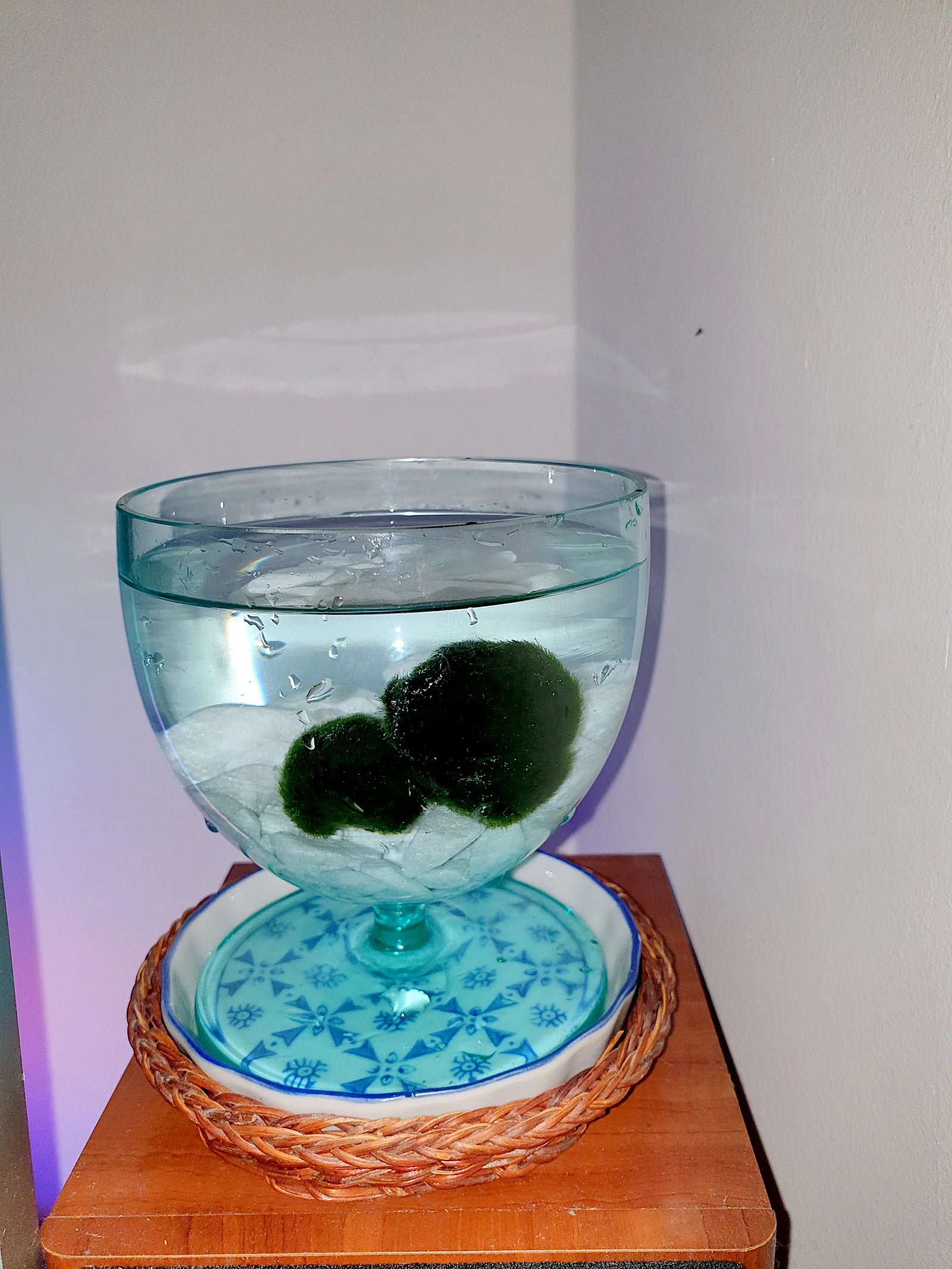
Use bottled spring water, or tap water treated with a dechlorinator (water conditioner). Tap water left out for a few days works only if your city uses chlorine, not chloramine. Never use distilled. Change water every 2 to 4 weeks.
Marimo need some minerals, and distilled water has had those taken out. Leaving tap water out can let free chlorine leave, but it does not remove chloramine, which many US water systems use. That's why a dechlorinator is the safer choice for tap water.
Quick facts
- Water type Use bottled spring water, or tap water treated with a dechlorinator (water conditioner). Tap water left out for a few days works only if your city uses chlorine, not chloramine. Never use distilled.
- How often change water every 2 to 4 weeks.
- Chlorine and chloramine leaving tap water out can let free chlorine leave. Official US guidance says that may take a few days, and it does not remove chloramine.2
- Distilled water in lab culture, marimo threads may turn white, and in some cases die, in distilled or low-mineral tap water, even with nutrients added.3
- pH there is no home pH to aim for. Lab and lake figures are background only.34
- Salt not a home care step.7
What water should I use for a marimo?
Use bottled spring water, or tap water treated with a dechlorinator (water conditioner). Tap water left out for a few days works only if your city uses chlorine, not chloramine. Never use distilled.
That matches what marimo experts do with big display tanks. At the Lake Akan Eco-Museum Center, the display tanks use tap water with the chlorine removed by bubbling air through it. The same expert's own advice for other museums is to leave tap water out overnight, or bubble air through it, before use.1 Those are methods for large museum tanks, not extra steps for a home jar, but they point the same way as our care card: tap water with the chlorine taken out, not mineral-free water.
No published study has tested bottled spring water against other waters in a home jar, or that says any brand is needed.
Is tap water OK? Chlorine and chloramine
Yes, with one step first. Use bottled spring water, or tap water treated with a dechlorinator (water conditioner). Tap water left out for a few days works only if your city uses chlorine, not chloramine. Never use distilled. Here's why.
Most US water systems add either chlorine or chloramine to keep tap water safe to drink, and some switch between them. The CDC says chlorine can leave water that sits out for a few days, but chloramine can't be removed that way. The EPA says letting water sit at room temperature, or boiling it, doesn't remove chloramine, and that more than one in five Americans use drinking water treated with chloramines.2
So leaving tap water out can let free chlorine leave. It does not remove chloramine. Your water system's yearly water quality report says which one your city uses. If it's chloramine, or you're not sure, use a dechlorinator (water conditioner) or bottled spring water.2
Official US guidance also says fish and other animals that live in water shouldn't be kept in water that still has chlorine or chloramine in it, and that pet stores sell products to remove both.2 That guidance is about fish, not a lab test on marimo. No published study has tested how chlorine or chloramine affect marimo, so we take the careful route and keep them out of the water.
Why not distilled water?
Marimo need some minerals. Distilled water has had those taken out.
In lab culture, marimo threads grew best in water that was close to neutral and needed small amounts of minerals like boron and iron. In distilled or low-mineral tap water, the threads may turn white, and in some cases die, even with nutrients added.3 In the wild, marimo mostly live in lakes with moderate to high calcium, so they aren't a soft-water species.4
That's why "distilled is best because it's pure" is a myth. Pure, mineral-free water is the one water our care card rules out.3
How often should I change marimo water?
Change water every 2 to 4 weeks.
The expert "every 2 to 4 weeks" figure you may see quoted is about cleaning algae off display tanks, not a water-change study.1 Other public advice differs. A Japanese tourism page for souvenir marimo says every 1 to 2 weeks, and some shops say weekly.5 Every 2 to 4 weeks is our care card, and we're sticking with it.
While the water is out, it's a good time to give your marimo a rinse: rinse in cool water, gently squeezing is OK, then roll to keep round. More in Cleaning and rolling marimo
Please don't pour old marimo water outside or into a pond or stream. Why that matters is in Are marimo moss balls illegal?
Does the 2 to 4 week rule apply in a shared aquarium?
Our water rules are written for marimo kept on their own. There is no published study or historical record for how they fit a shared aquarium that already has its own maintenance, so keep up your tank's own routine.
If fish share the tank, official US guidance says not to keep fish or other animals that live in water in water that still has chlorine or chloramine in it.2 Tank mates, filters and tropical tanks are covered in Marimo in aquariums
What is Lake Akan's water like?
Lake Akan in Japan is one of the best studied marimo lakes. In surveys in 2013 and 2014, its surface water averaged about pH 7.9, slightly alkaline, and was clear to about 4.5 m.4 Older official records from 1981 to 1983 show a similar range, about pH 7.7 to 8.3.4 Across the world, wild marimo mostly grow in lakes with a pH between 7 and 9.4
Lab culture and a wild lake are different settings, so their pH figures differ a little, and neither is a target for a jar. Those Lake Akan figures are wild-lake background, not a recipe. Wild marimo grow in lakes in several countries, not only Japan. More in Lake Akan, Japan and Where do marimo grow?
Do marimo lower pH, remove ammonia or add oxygen?
Marimo make their own food from light, water and carbon dioxide, and they give off oxygen in the light.6 That oxygen is also why a marimo may float. More in Why is my marimo floating? They also use nitrogen as a nutrient.6
But using nutrients and making oxygen isn't the same as cleaning a home tank. No published study has shown that marimo lower pH, or remove ammonia or nitrate, in a home tank.6 So we don't call them a natural filter.
Should I add salt to marimo water?
No. Some wild marimo live in slightly salty water, and lab work found they can survive a range of salt levels.7 That isn't a test showing salt helps them grow at home. Our water rule is fresh water. Use bottled spring water, or tap water treated with a dechlorinator (water conditioner). Tap water left out for a few days works only if your city uses chlorine, not chloramine. Never use distilled.
What if the water is cloudy or smelly?
There is no published study or historical record for what cloudy water in a home jar means, so we won't guess that it's harmless or that your marimo is dying.
A rotten smell is different. It's a sign of decay inside the ball and a reason to keep the water cooler, not proof that the marimo is dead.8 Keep below 77°F, out of direct sun and away from heaters. For what to look for and what to do next, see Is my marimo dead? and Marimo light and temperature
What to do: our care steps
- Change water every 2 to 4 weeks.
- Use bottled spring water, or tap water treated with a dechlorinator (water conditioner). Tap water left out for a few days works only if your city uses chlorine, not chloramine. Never use distilled.
- Keep below 77°F, out of direct sun and away from heaters.
- Rinse in cool water, gently squeezing is OK, then roll to keep round.
The full guide is at Caring for your Moss Ball Pets™
FAQ
What water do moss balls need?
Use bottled spring water, or tap water treated with a dechlorinator (water conditioner). Tap water left out for a few days works only if your city uses chlorine, not chloramine. Never use distilled.
How often should I change moss ball water?
Change water every 2 to 4 weeks.
Can I use tap water for a marimo?
Yes, with one step first. Use bottled spring water, or tap water treated with a dechlorinator (water conditioner). Tap water left out for a few days works only if your city uses chlorine, not chloramine. Never use distilled.2
Can marimo live in distilled water?
Distilled water isn't recommended. In lab culture, marimo threads may turn white, and in some cases die, in distilled or low-mineral water.3
Do moss balls oxygenate water?
They give off oxygen in the light, but no published study has shown that they clean a home tank.6
Discover the Magic of Marimo
Design your own terrarium, or start with a ready-made kit.
Footnotes
- Isamu Wakana 2019.
- US Centers for Disease Control and Prevention 2024; Agency and Water 2009; US Environmental Protection Agency, Chloramines in Drinking Water.
- Isamu Wakana 2019; Boedeker et al. 2010.
- Wakana et al. 2023; Committee, Database and Akan 1981; Boedeker et al. 2010.
- Kushiro and Lake Akan tourism site 2023.
- Cano-Ramirez et al. 2018; Phillips et al. 2025.
- Boedeker et al. 2010.
- Isamu Wakana 2019.
Sources
- Isamu Wakana (若菜勇) (2019). ⑤ 球状マリモの栽培方法 (マリモ博士の研究日記) [(5) How to cultivate ball marimo (Dr. Marimo's research diary)]. Link: https://ameblo.jp/maromo-lab/entry-12473448831.html. Checked 2026-11-10.
- US Centers for Disease Control and Prevention (CDC) (2024). About Water Disinfection with Chlorine and Chloramine. Link: https://www.cdc.gov/drinking-water/about/about-water-disinfection-with-chlorine-and-chloramine.html. Checked 2026-11-10.
- US Environmental Protection Agency, Office of Water. Common Health Questions Related to Monochloramine, question 29 (2009). How can I remove monochloramine from my drinking water? Link: https://www.epa.gov/sites/default/files/2015-09/documents/how_can_i_remove_monochloramine_from_my_drinking_water.pdf. Checked 2026-11-10.
- US Environmental Protection Agency. Chloramines in Drinking Water. Link: https://www.epa.gov/dwreginfo/chloramines-drinking-water. Checked 2026-11-10.
- Isamu Wakana (2019). ③ マリモ糸状体の生長条件 [(3) Growth conditions for marimo filaments]. Link: https://ameblo.jp/maromo-lab/entry-12465710386.html. Checked 2026-11-10.
- Christian Boedeker, Anja Eggert, Anne Immers, Erik Smets (2010). Global Decline of and Threats to Aegagropila linnaei, with Special Reference to the Lake Ball Habit. BioScience 60(3): 187-198. Link: https://doi.org/10.1525/bio.2010.60.3.5. Checked 2026-11-09.
- Isamu Wakana, Yasuro Kadono, Jotaro Urabe, Yuki Tamura, Yoshifusa Suzuki, Hiroyuki Yamada, Yoichi Oyama, Keiji Wada, Takeshi Hasegawa, Masashi Ohara (2023). Varying stages of ecological succession in lakes subdivided by volcanic eruptions at Akan Caldera, Japan. Hydrobiologia. Link: https://doi.org/10.1007/s10750-023-05231-5. Checked 2026-11-10.
- International Lake Environment Committee (ILEC), World Lake Database, Lake Akan (ASI-21). Questionnaire filled by the Hokkaido Prefectural Government (1981). Transparency, pH, SS, DO, COD, TN, and TP (1981-1983). Link: https://wldb.ilec.or.jp/Display/plain/7423. Checked 2026-11-10.
- Kushiro and Lake Akan tourism site (2023). 阿寒湖のお土産マリモ (Kushiro and Lake Akan tourism site, overview page) [Souvenir marimo of Lake Akan]. Link: https://ja.kushiro-lakeakan.com/overview/17818/. Checked 2026-11-10.
- Dora L. Cano-Ramirez, Tara Saskia de Fraine, Olivia G. Griffiths, Antony N. Dodd (2018). Photosynthesis and circadian rhythms regulate the buoyancy of marimo lake balls. Current Biology 28(16): R869-R870. Link: https://doi.org/10.1016/j.cub.2018.07.027. Checked 2026-11-10.
- Neil Phillips, Thomas C. Draper, Andrew P. Geary, Kathryn Lamb-Riddell, Darren M. Reynolds, Joshua A. C Steven, Freya Radford, Abdul R. Farooq, Andrew Adamatzky (2025). Marimo for monitoring and filtering of aquatic environments. Environmental Science and Pollution Research. Link: https://doi.org/10.1007/s11356-025-37259-6. Checked 2026-11-10.
- Christian Boedeker, Anja Eggert, Anne Immers, Isamu Wakana (2010). Biogeography of Aegagropila linnaei (Cladophorophyceae, Chlorophyta): a widespread freshwater alga with low effective dispersal potential shows a glacial imprint in its distribution. Journal of Biogeography 37: 1491-1503. Link: https://doi.org/10.1111/j.1365-2699.2010.02309.x. Checked 2026-11-09.
Related guides

Marimo in Aquariums and Fish Tanks
Yes, marimo are often kept in cool freshwater aquariums and fish tanks. Our care steps say keep the water below 77°F, out of direct sun and away from heaters. A tank kept warmer than that is not a match for those steps. Research does not tell us which tank mates are safe, or whether marimo clean a home tank.
Read the guide →
Is My Marimo Dead? Brown, White or Falling Apart
There is no sure home test for whether a marimo is dead or alive. A 2017 library reference answer said that, in general, it is difficult to tell. Green color alone is not proof of life. Brown, white, a smell, floating, or falling apart can be clues, not proof.
Read the guide →
Why Is My Marimo Floating? What the Bubbles Mean
A marimo usually floats because tiny bubbles of oxygen from photosynthesis get caught in it, and in lab studies it sinks again in the dark. Floating means it is making oxygen in the light, not that it feels happy. And a marimo that stays on the bottom is not, by that alone, unwell.
Read the guide →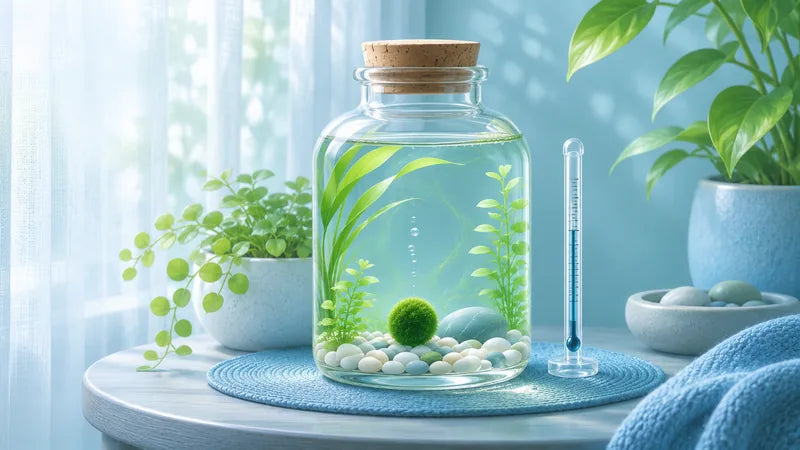
Marimo Light and Temperature: How Much Light and How Cool?
Keep below 77°F, out of direct sun and away from heaters. Marimo make their food from gentle light and can live in quite dim conditions. Strong light is most clearly shown to hurt them in very cold water, and a sunny windowsill can still heat a jar. 77°F is our care ceiling, not a death point.
Read the guide →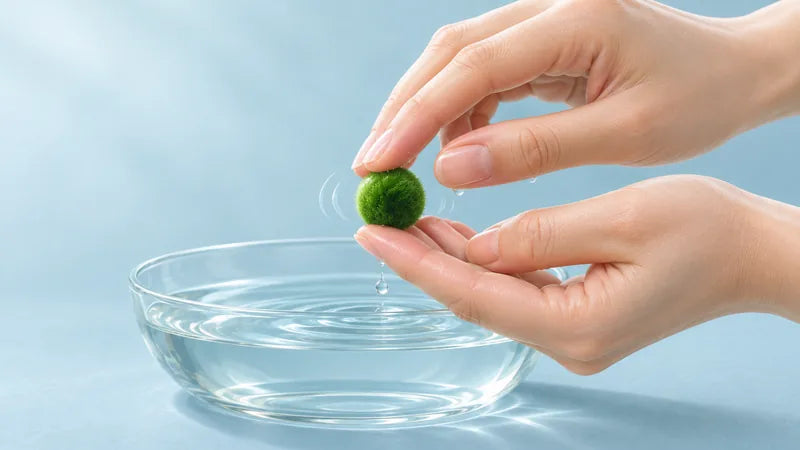
Cleaning and Rolling Your Marimo: Rinsing, Squeezing and Shape
Rinse in cool water, gently squeezing is OK, then roll to keep round. In a lake, gentle waves roll marimo and keep them round. In a still jar they can go flat or shaggy, so a gentle roll helps.
Read the guide →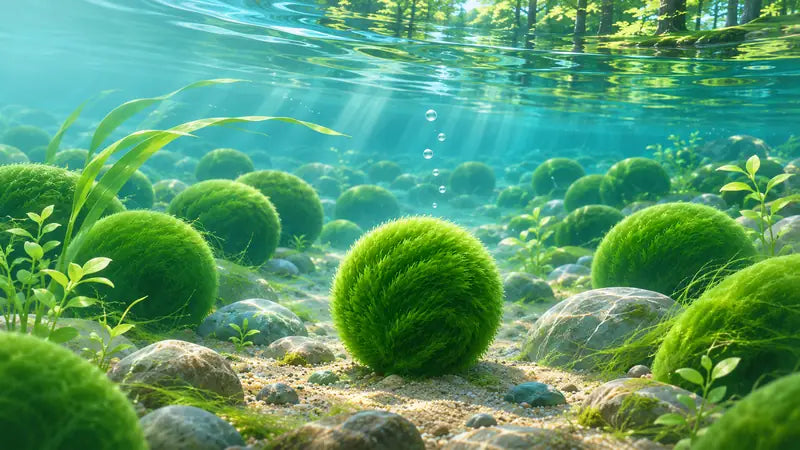
Lake Akan Marimo
Lake Akan is a freshwater lake in Kushiro City, Hokkaido, inside Akan-Mashu National Park. It sits in the Akan caldera. It is the only place now known with confidence to still hold colonies of large wild marimo balls, about 12 cm or more. The species itself does not grow only in Japan, and Japan has several lakes with the alga. This page is about the wild lake, not about the marimo we sell.
Read the guide →