






Marimo in Terrariums
Marimo are green algae that live in water. A marimo terrarium is a glass vessel that holds water, not a dry planted closed terrarium. They need to stay wet, and if the vessel holds water, our care steps still apply.
Quick facts
- They live in water they are green algae, not moss, and they make their own food from light, water and carbon dioxide.1
- A glass vessel with water for marimo, a terrarium is a glass vessel that holds water, not a dry planted closed terrarium.
- A closed planted terrarium, or moist air with no standing water no published study has tested either one.
- Drying is dangerous they dry out easily and have no tough resting stage. A single filament can dry in under a minute in room air.2
- Lab drying times in a lab test, filaments that had been blotted dry and left in air were often damaged after 1 hour, and more after 6 hours, though some cells can survive. That is not a home time limit.3
- When a ball is taken out museum advice is to keep it thoroughly wet and return it to the water quickly, because sudden drying can damage cells. That is expert practice, not a new timed step.4
- If the vessel holds water the same care steps still apply.
What is a marimo terrarium?
People use the word terrarium for more than one thing. For marimo, we mean a glass vessel that holds water. That is not the same as a dry or soil closed terrarium made for land mosses.
Marimo are a green alga, not a moss. They live in water, and they make their own food from light, water and carbon dioxide.1 More on that is in What is a marimo? and What do marimo eat?
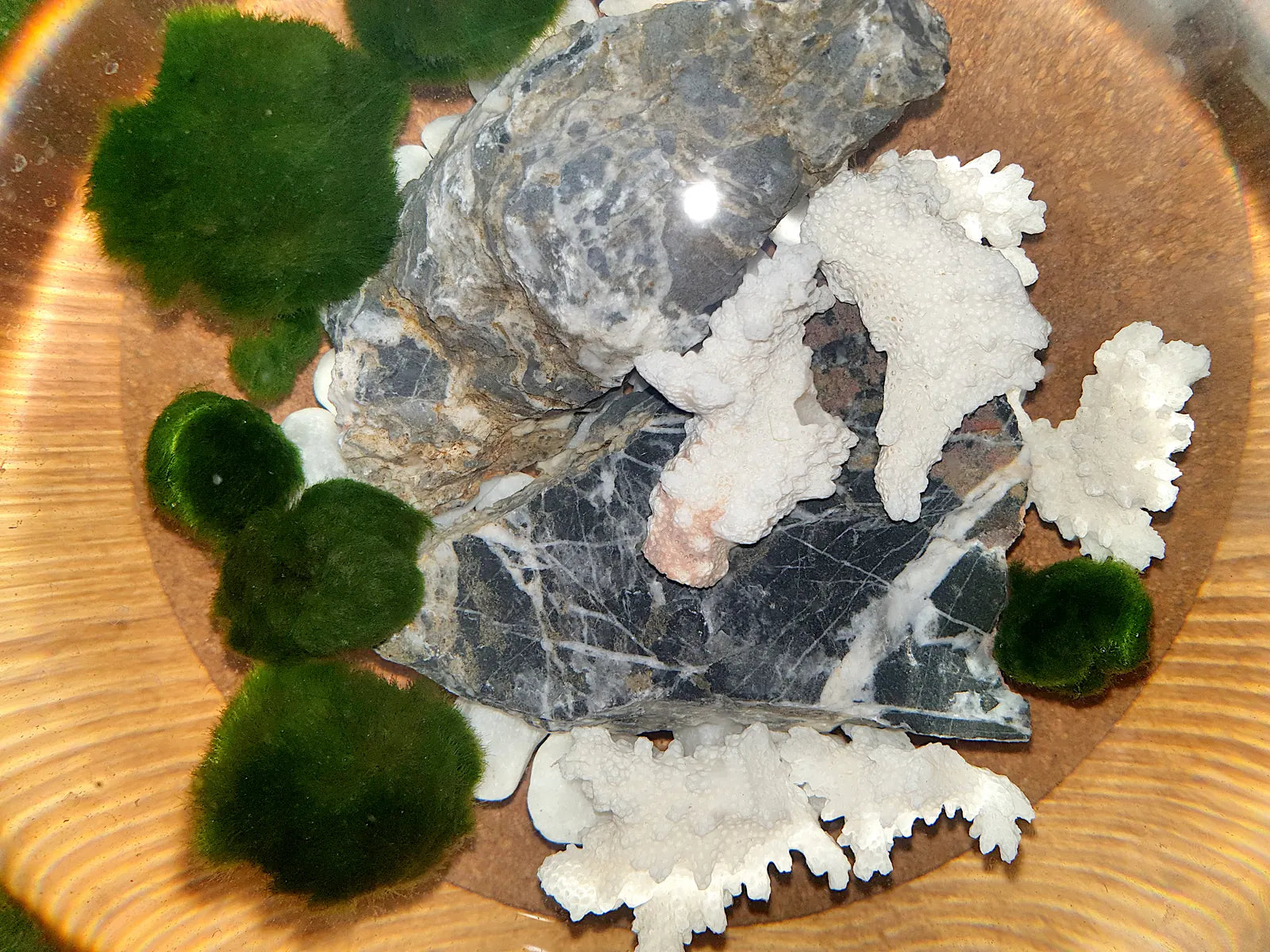
Can they live out of water, or only in moist air?
They need to stay wet. No published study has tested a moist terrarium with no standing water, so we don't tell you that humidity is enough, and we don't say they can be kept like other mosses.
Marimo dry out easily and die. They have no tough resting stage, their cells are very sensitive to drying, and quick drying breaks the cell structure.2 In a 1959 lab test, a single filament dried in under a minute in room air, and dried balls put back in water broke apart in 2 to 3 weeks and turned red-brown, though a few new green filaments regrew months later.2
A 2010 study tested vegetative filaments, not whole home balls and not a humid terrarium. The filaments were blotted dry and left in air for 1 hour or 6 hours at 10°C. After 1 hour, two of the three isolates had more than half of their cells damaged, and a third had much less. After 6 hours, damage was higher in all three. The share of damaged cells never fell after a week of recovery, and none of the undamaged cells divided within a month. Some cells can survive, but those lab times are research background, not a safe time to leave a ball out of water, and not a test of a moist terrarium. There is no published study or historical record for a home "safe time out of water" limit.3
Museum advice, written for another museum, says that when a ball is taken out for cleaning it should be kept thoroughly wet and returned to the water quickly, because sudden drying can damage the cell structure. That agrees with the lab drying work. It is expert practice, not a new home step, and not a timed "minutes out of water" rule.4 Our care card already says: Rinse in cool water, gently squeezing is OK, then roll to keep round. More on rinsing is in Cleaning and rolling your marimo
If a ball has dried out or is falling apart, see Is my marimo dead?
What about a lid, a cork, or a sealed container?
No published study has tested a lid, a cork, a sealed container, or opening a closed vessel weekly, on a home-kept marimo or on the water in a small glass vessel. So we are not adding "open weekly" or "seal it" as a rule. If the vessel holds water, stay with the care steps below.
Our own pages disagree about lids, and none of those lines is a published test, so here are the sides, with no winner picked. - The live care hub says they can survive in a closed container but need oxygen exchange, and tells people to open the container weekly. - An older DIY terrarium post on our site says to fill the vessel with water and "Seal (for closed terrarium) or leave partially open." - An older basics post says they can be kept in a covered or uncovered container, and that a cover will help keep the water clean.
Those lines are not our locked care. Museum staff sometimes keep marimo sealed and dark in a fridge for weeks to treat other algae, and one ball has been kept in a fridge since 2012. That is expert practice, not home care, and it is not a test of a decorative lidded vessel on a desk.5
How little light a home container needs, and whether a small or shaded glass vessel is enough, is also a gap: there is no published study or historical record for a light recipe for a small or shaded glass vessel.5 They need light to make food.1 Details are in Marimo light and temperature
How do I care for a marimo in a glass terrarium that holds water?
A glass terrarium that holds water is still a water home. If the vessel holds water, the same care steps still apply. This page does not teach a second care system.
The full water story, including why we never use distilled water, is in Marimo water. Light and temperature are in Marimo light and temperature. Rinsing and rolling are in Cleaning and rolling your marimo
A closed glass vessel in direct sun can heat up. No published study has tested a color or death result of that in a home vessel. The care line already covers it: Keep below 77°F, out of direct sun and away from heaters.
Can I keep them with other terrarium plants?
No published study has tested effect of keeping a home marimo with Java moss, air plants, or other terrarium plants in the same vessel. Hobby pages mention combinations. Those are opinions, not tests, so we won't publish a companion-plant list.
Java moss is a different plant. A short comparison is on our older Java moss post. Air-plant care, such as misting or soaking, is a different routine, and it is not marimo care. Shared tanks and tank mates are in Marimo in aquariums
Terrarium myths
- "Marimo can be kept like other mosses in a dry or soil closed terrarium, or can live without standing water if the air is humid or the container is sealed." No, not as a dry-moss or no-water claim. They are aquatic algae, and drying is dangerous. No published study has tested a moist, no-water terrarium, or lids and sealed containers.
- "Marimo are moss." No. They are green algae. See What is a marimo?6
- "A dried-out marimo can be brought back." Usually not. Drying is deadly, though a few threads may later regrow. See Is my marimo dead?7
- "Distilled water is best because it is pure." No. In culture, filaments could turn white, or sometimes die, in distilled water. See Marimo water8
- "Marimo purify the air or the water." There is no published study or historical record for a cleaning, air-purifying or oxygenating benefit in a home tank or a terrarium. See Marimo in aquariums
- "Marimo can be kept in a fridge." Experts sometimes do that, but it is not home care. See Marimo light and temperature5
What to do: our care steps
- Change water every 2 to 4 weeks.
- Use bottled spring water, or tap water treated with a dechlorinator (water conditioner). Tap water left out for a few days works only if your city uses chlorine, not chloramine. Never use distilled.
- Keep below 77°F, out of direct sun and away from heaters.
- Rinse in cool water, gently squeezing is OK, then roll to keep round.
With simple care, marimo can live for decades. The full guide is at Caring for your Moss Ball Pets™
FAQ
What is a marimo terrarium?
A glass vessel that holds water, not a dry planted closed terrarium made for land mosses.
Can marimo live in a closed terrarium?
No published study has tested closed-terrarium care, or keeping a ball in moist air with no standing water. They need to stay wet.
Do marimo need to stay underwater?
Should I put a lid or a cork on the container?
No published study has tested a lid, a cork, or opening a closed vessel weekly, so we are not adding "open weekly" or "seal it" as a rule. If the vessel holds water, stay with the care steps on this page.
Can I keep marimo with Java moss or air plants?
No published study has tested mixed terrarium plantings, so we don't publish a companion-plant list. Air-plant care is not marimo care.
How do I care for a marimo in a glass terrarium?
If the vessel holds water, the same care steps still apply. Change water every 2 to 4 weeks. Use bottled spring water, or tap water treated with a dechlorinator (water conditioner). Tap water left out for a few days works only if your city uses chlorine, not chloramine. Never use distilled. Keep below 77°F, out of direct sun and away from heaters. Rinse in cool water, gently squeezing is OK, then roll to keep round.
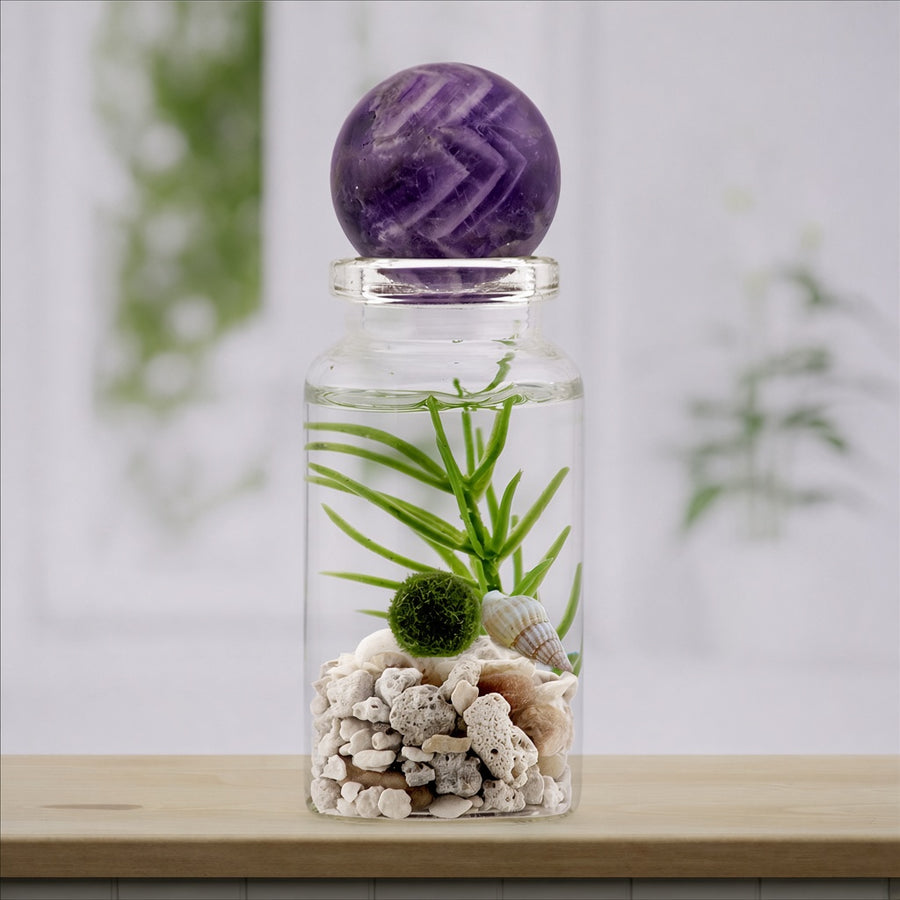
Discover the Magic of Marimo
Design your own terrarium, or start with a ready-made kit.
Footnotes
- Hanyuda et al. 2002; Web and Akan", マリモの育て方(2) How to raise marimo.
- Boedeker et al. 2010; Isao Terumoto 1959.
- Boedeker et al. 2010. These are lab results on blotted filaments in air at 10°C, not a home "safe for 1 hour" limit, and not a humid-terrarium test.
- Isamu Wakana 2019. This is expert practice, not a new home step, and not a timed "minutes out of water" rule.
- Web and Akan", マリモの育て方(2) How to raise marimo; Isamu Wakana 2019. Museum fridge treatments are expert practice, not home care.
- Hanyuda et al. 2002.
- Isao Terumoto 1959; Boedeker et al. 2010.
- Isamu Wakana 2019; Boedeker et al. 2010.
Sources
- Takeaki Hanyuda, Isamu Wakana, Shogo Arai, Kazuyuki Miyaji, Yasuyuki Watano, Kunihiko Ueda (2002). Phylogenetic relationships within Cladophorales (Ulvophyceae, Chlorophyta) inferred from 18S rRNA gene sequences, with special reference to Aegagropila linnaei. Journal of Phycology 38(3): 564-571. Link: https://doi.org/10.1046/j.1529-8817.2002.01151.x. Checked 2026-11-04.
- MARIMO Web, official site of the Special Natural Monument "Marimo of Lake Akan" (run by Akan tourism groups, Kushiro City Board of Education and the marimo protection society). マリモの育て方(2) [How to raise marimo (2)]. Link: http://www.marimo-web.org/faq/qa_grow2.html. Checked 2026-11-04.
- Christian Boedeker, Anja Eggert, Anne Immers, Isamu Wakana (2010). Biogeography of Aegagropila linnaei (Cladophorophyceae, Chlorophyta): a widespread freshwater alga with low effective dispersal potential shows a glacial imprint in its distribution. Journal of Biogeography 37: 1491-1503. Link: https://doi.org/10.1111/j.1365-2699.2010.02309.x. Checked 2026-11-09.
- Isao Terumoto (照本勲) (1959). マリモの凍害と乾燥害 [Freezing injury and drying injury in marimo]. 低温科學 生物篇 (Low Temperature Science, Series B: Biological Sciences) 17: 1 to 7, Institute of Low Temperature Science, Hokkaido University. Link: https://eprints.lib.hokudai.ac.jp/repo/huscap/all/17616/. Checked 2026-11-10.
- Isamu Wakana (若菜勇) (2019). ⑤ 球状マリモの栽培方法 (マリモ博士の研究日記) [(5) How to cultivate ball marimo (Dr. Marimo's research diary)]. Link: https://ameblo.jp/maromo-lab/entry-12473448831.html. Checked 2026-11-10.
- Isamu Wakana (2019). ⑥ 付着生物の除去方法 [(6) How to remove organisms growing on marimo]. Link: https://ameblo.jp/maromo-lab/entry-12474578551.html. Checked 2026-11-10.
- Isamu Wakana (2019). ③ マリモ糸状体の生長条件 [(3) Growth conditions for marimo filaments]. Link: https://ameblo.jp/maromo-lab/entry-12465710386.html. Checked 2026-11-10.
- Christian Boedeker, Anja Eggert, Anne Immers, Erik Smets (2010). Global Decline of and Threats to Aegagropila linnaei, with Special Reference to the Lake Ball Habit. BioScience 60(3): 187-198. Link: https://doi.org/10.1525/bio.2010.60.3.5. Checked 2026-11-09.
Related guides
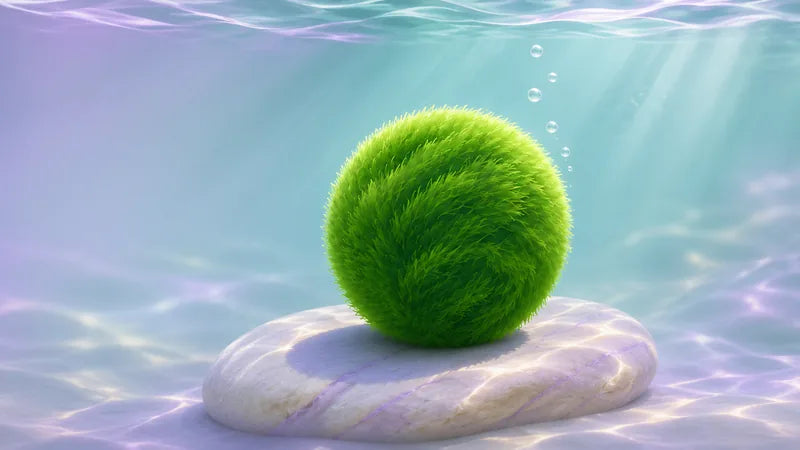
What Is a Marimo? The Moss Ball, Explained
A marimo, often called a moss ball, is a ball of green algae, not moss. Each one is made of many fine threads of the alga Aegagropila linnaei growing together. In a few lakes, gentle waves roll those threads into round balls. Marimo are alive and make their own food from light, so they need no feeding.
Read the guide →
Marimo in Aquariums and Fish Tanks
Yes, marimo are often kept in cool freshwater aquariums and fish tanks. Our care steps say keep the water below 77°F, out of direct sun and away from heaters. A tank kept warmer than that is not a match for those steps. Research does not tell us which tank mates are safe, or whether marimo clean a home tank.
Read the guide →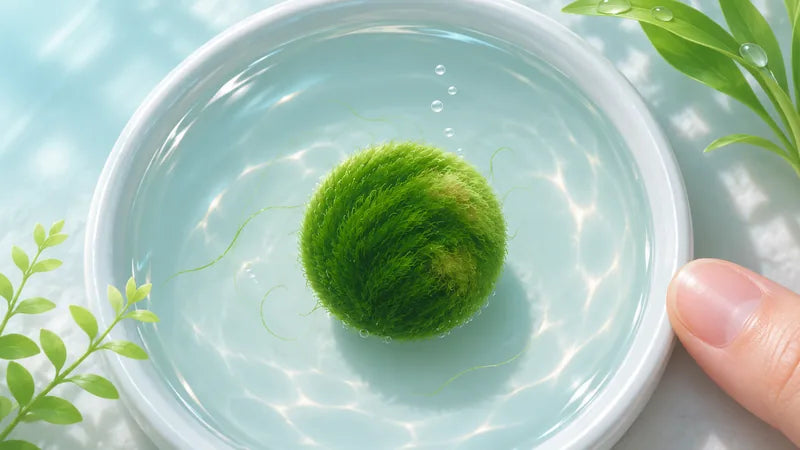
Is My Marimo Dead? Brown, White or Falling Apart
There is no sure home test for whether a marimo is dead or alive. A 2017 library reference answer said that, in general, it is difficult to tell. Green color alone is not proof of life. Brown, white, a smell, floating, or falling apart can be clues, not proof.
Read the guide →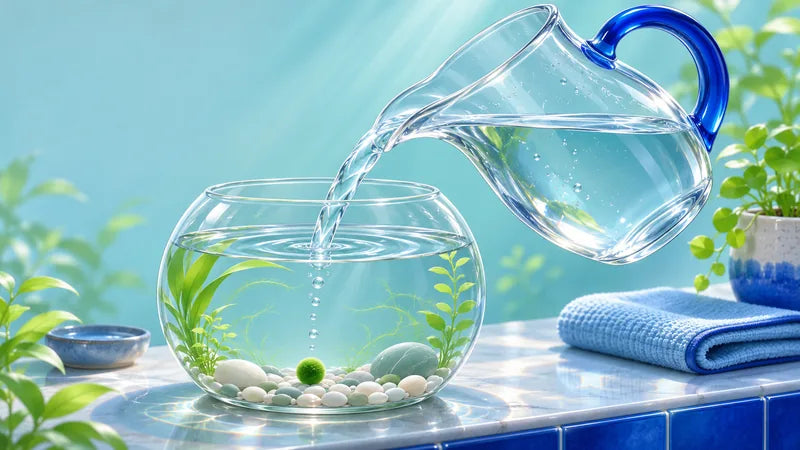
Marimo Water: What to Use and How Often to Change It
Use bottled spring water, or tap water treated with a dechlorinator (water conditioner). Tap water left out for a few days works only if your city uses chlorine, not chloramine. Never use distilled. Change water every 2 to 4 weeks. Marimo need some minerals, and distilled water has had those taken out. Leaving tap water out can let free chlorine leave, but it does not remove chloramine, which many US water systems use. That's why a dechlorinator is the safer choice for tap water.
Read the guide →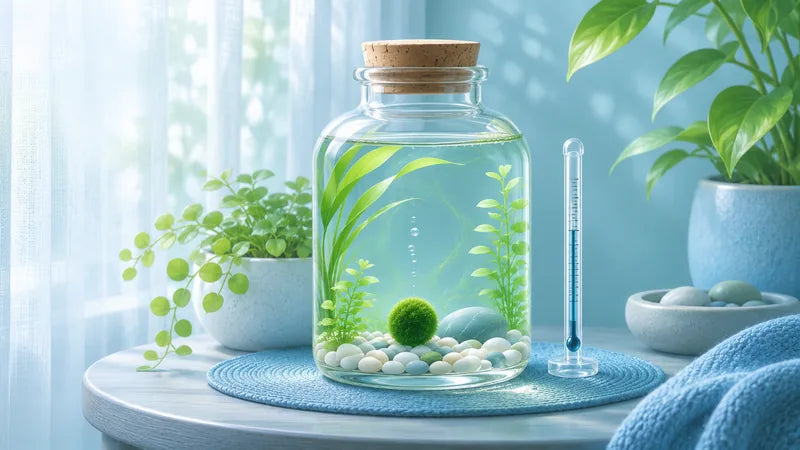
Marimo Light and Temperature: How Much Light and How Cool?
Keep below 77°F, out of direct sun and away from heaters. Marimo make their food from gentle light and can live in quite dim conditions. Strong light is most clearly shown to hurt them in very cold water, and a sunny windowsill can still heat a jar. 77°F is our care ceiling, not a death point.
Read the guide →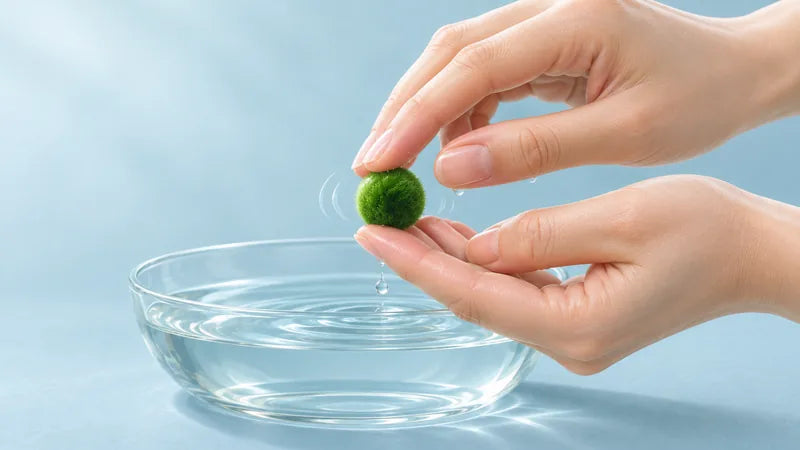
Cleaning and Rolling Your Marimo: Rinsing, Squeezing and Shape
Rinse in cool water, gently squeezing is OK, then roll to keep round. In a lake, gentle waves roll marimo and keep them round. In a still jar they can go flat or shaggy, so a gentle roll helps.
Read the guide →