A marimo, often called a moss ball, is a ball of green algae, not moss. This glossary gathers terms used in the Moss Ball Pets™ Marimo Guide, with a link to the guide that covers each one.
Since 2023, two major naming databases list Aegagropila brownii as the correct name, and both names mean the same species as Aegagropila linnaei. The name brownii honors the botanist Robert Brown.
Marimo's scientific name is Aegagropila linnaei (also listed as A. brownii). It's a green alga in its own genus, Aegagropila, not a moss and not Cladophora.
Ainu names for marimo exist, and sources translate them in different ways. Ainu kamuynomi prayers have been part of the Lake Akan Marimo Festival from the start, and the festival is a modern event, not an ancient Ainu tradition.
Ainu names for marimo exist, and sources translate them in different ways. Names in our sources include torasanpe, tokarip (also written tōkarip), and tosuruku.
A marimo, often called a moss ball, is a ball of green algae, not moss. Marimo is a green alga, not a moss, and it belongs to its own genus, Aegagropila, separate from Cladophora.
Use bottled spring water, or tap water treated with a dechlorinator (water conditioner). Tap water left out for a few days works only if your city uses chlorine, not chloramine. Never use distilled. Leaving tap water out can let free chlorine leave, but it does not remove chloramine.
Use bottled spring water, or tap water treated with a dechlorinator (water conditioner). Tap water left out for a few days works only if your city uses chlorine, not chloramine. Never use distilled. Leaving tap water out can let free chlorine leave, but it does not remove chloramine.
It's a green alga in its own genus, Aegagropila, not a moss and not Cladophora. Marimo was long named Cladophora aegagropila (also Cladophora sauteri) because it looks like Cladophora.
Use bottled spring water, or tap water treated with a dechlorinator (water conditioner). Tap water left out for a few days works only if your city uses chlorine, not chloramine. Never use distilled.
Use bottled spring water, or tap water treated with a dechlorinator (water conditioner). Tap water left out for a few days works only if your city uses chlorine, not chloramine. Never use distilled. Marimo need some minerals, and distilled water has had those taken out.
"Japanese moss ball" is an English trade and hobby name for marimo, not a label of where they grow. Wild marimo grow in hundreds of lakes, mostly in northern and central Europe.
Ainu people have offered the kamuynomi, a prayer rite, from the start of the Lake Akan Marimo Festival. The festival uses Ainu ritual forms, but it is not an ancient Ainu tradition.
In Iceland the lake-ball form is called kúluskítur, roughly "ball muck". Iceland has protected wild lake balls (kúluskítur) as a species, wherever they grow wild, since notice no. 523 of 13 June 2006.
Lake Akan is a freshwater lake in Kushiro City, Hokkaido, inside Akan-Mashu National Park, and the only place now known with confidence to still hold colonies of large wild marimo balls, about 12 cm or more. The species itself does not grow only in Japan, and this is about the wild lake, not about the marimo we sell.
"Cladophora ball" and "lake ball" were English names for the ball by the 1910s and 1930s. Gentle waves roll marimo along a shallow lake bottom, and that rolling makes them round; the ball form is the rarest of the three forms.
Lake Mývatn, a shallow lake in north Iceland, once held dense beds of lake balls, mostly about 10 to 15 cm across. Those beds collapsed between the 1990s and about 2013, and this is about the wild lake, not about the marimo we sell.
Law for the Protection of Cultural Properties (文化財保護法)
The governing law today is the Law for the Protection of Cultural Properties (文化財保護法), Act No. 214 of 30 May 1950. A Special Natural Monument is the higher class of Natural Monument under that 1950 law, and it is not a National Treasure.
"Marimo" is a Japanese word, written 毬藻, meaning "ball alga" (毬, a ball, and 藻, algae or water plants). Kawakami Takiya collected it at Lake Akan in 1897 and named it, after its shape, in a paper published in 1898.
The Lake Akan Marimo Festival (まりも祭り) began in 1950 as a new event to protect Lake Akan's marimo and return balls that people had taken. It uses Ainu ritual forms, but it is not an ancient Ainu tradition, and it is held every year on 8, 9 and 10 October.
Marimokkori is a Hokkaido souvenir character, not an official mascot, an Ainu figure, or a conservation symbol. He is a character, not a living marimo, and a Sapporo souvenir company created him in 2005.
Lake Akan's marimo were made a Natural Monument of Japan on 3 March 1921 and a Special Natural Monument on 29 March 1952. Do not call 1921 "Special", and do not call either designation a National Treasure.
A 2010 survey found this alga had not been recorded in the previous 30 years at more than 50% of its known locations, and nutrient pollution was the main cause the authors suspected. "Not recorded" is not the same as confirmed gone.
Marimo make their own food from light, water and carbon dioxide, so they don't need feeding. A marimo usually floats because tiny bubbles of oxygen from photosynthesis get caught in it, and in lab studies it sinks again in the dark.
Current name databases place the genus Aegagropila in the family Pithophoraceae. One museum screen says marimo now has its own family, but the paper behind that screen isn't known.
Lake Akan (Akan-ko) was registered as a Ramsar wetland on 8 November 2005 as site 1540, and the Mývatn-Laxá region has been Ramsar site 167 since 2 December 1977. A Ramsar listing is not the same as the Special Natural Monument.
Japan's 2025 Red List, which lists marimo in Japan as critically endangered, is a national list of wildlife that inhabit or grow in Japan, not a global IUCN assessment. The Red List is not, by itself, a collecting ban or a ban on owning a home-kept marimo.
Lake Akan's marimo (阿寒湖のマリモ, Marimo of Lake Akan) were made a Natural Monument of Japan on 3 March 1921 and a Special Natural Monument on 29 March 1952. That is the higher class under the 1950 Law for the Protection of Cultural Properties, and it does not make cultivated, shop or foreign marimo a Special Natural Monument.
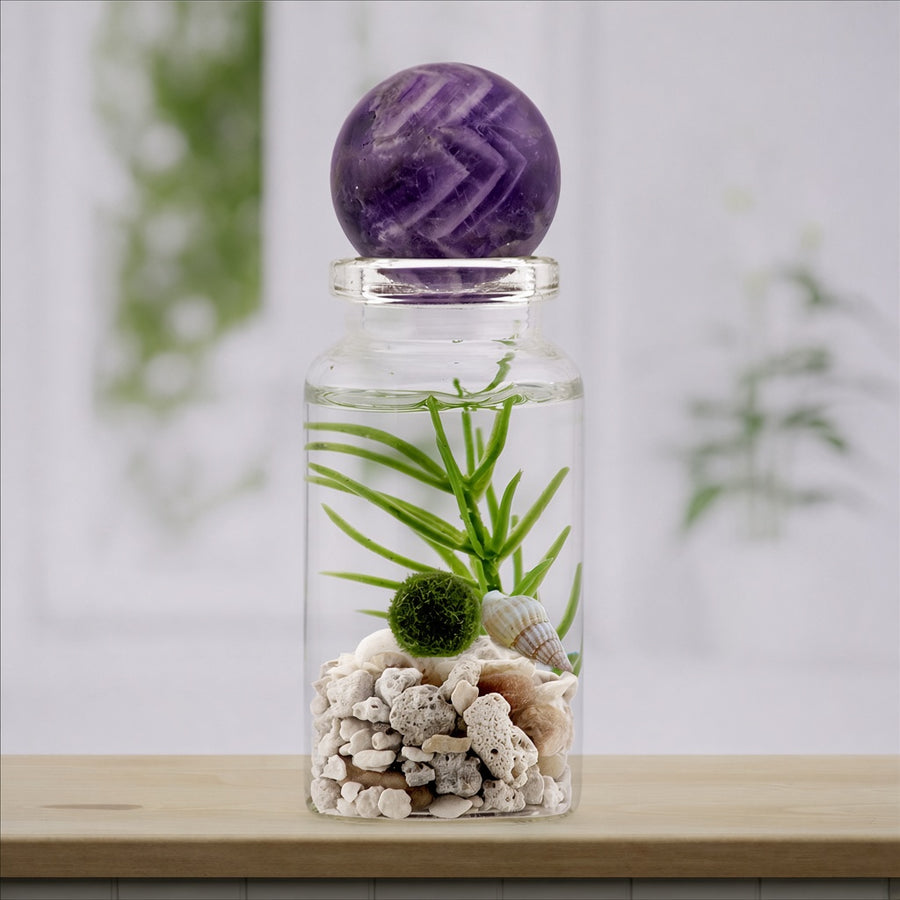
A marimo terrarium is a glass vessel that holds water, not a dry planted closed terrarium. They need to stay wet, and if the vessel holds water, our care steps still apply.