






Are Marimo Moss Balls Alive? Yes, and Here's How You Can Tell
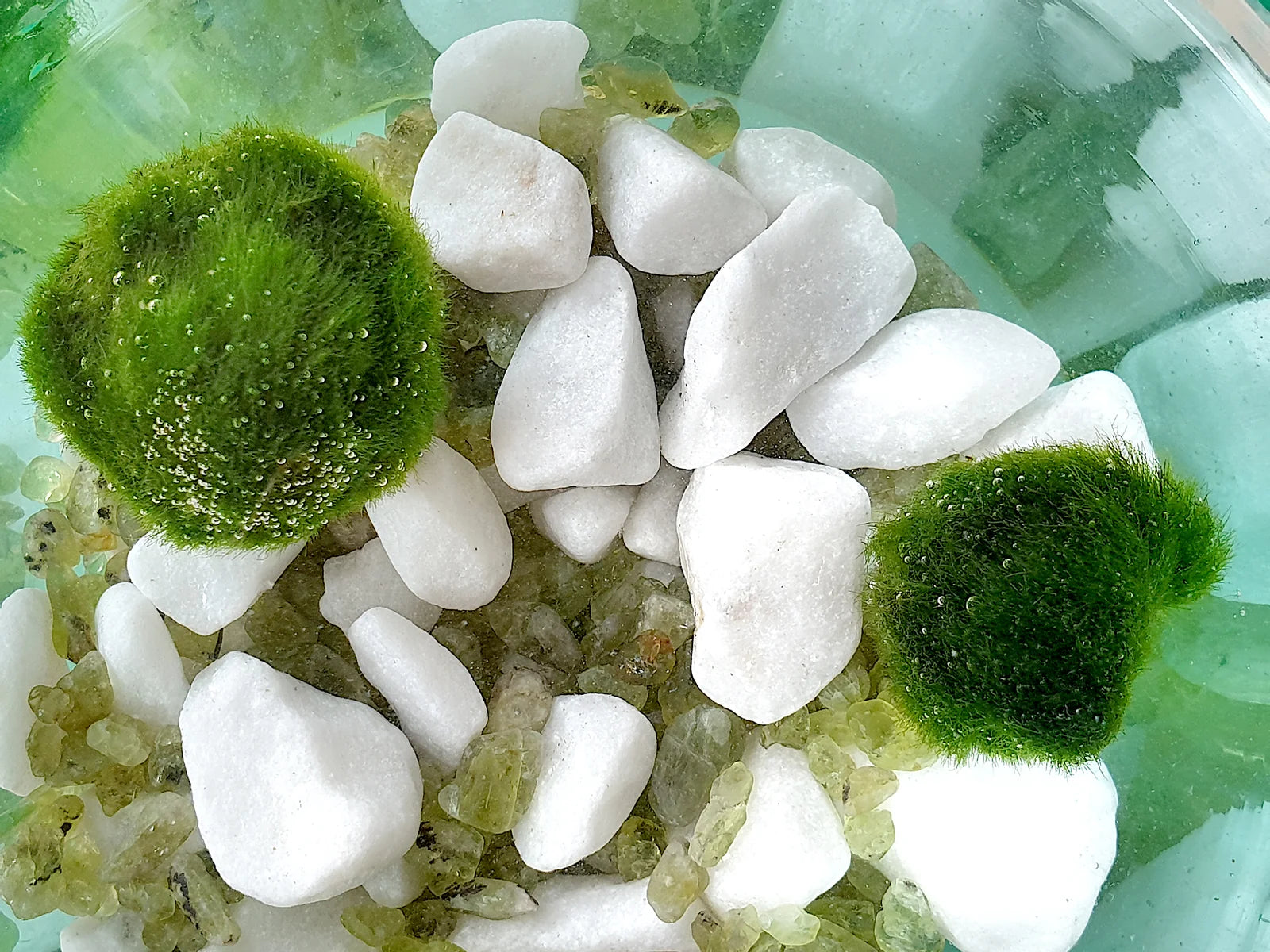
Yes, marimo moss balls are alive. Each one is a ball of living green algae that makes its own food from light, so it never needs feeding. Marimo grow, can make new marimo, and can even float when oxygen bubbles from photosynthesis get caught in their threads. They are not moss, and they are not a toy.
Are marimo alive?
Yes. Marimo are living green algae. They make their own food from light and never need feeding.1
Quick facts
- What it is a living green alga, not a moss.2
- How it's built many living threads growing together.3
- Scientific name Aegagropila linnaei (also listed as A. brownii).4
- Food none needed. It makes its own from light.1
- A sign you can see it can float when oxygen bubbles get caught in it, and sink in the dark.10
- The busy part the outer layer is where most of the light-driven work happens.78
- Growth very slow, and it spreads by breaking into pieces.1112
- Lifespan with simple care, marimo can live for decades.
How does a marimo live without food?
A marimo is made of living green algae cells. Those cells make their own food from light, water and carbon dioxide (photosynthesis). They grow and can reproduce. Marimo have no mouth, and they don't need to be fed.1 The carbon dioxide they use is the kind already in the water.5 For more, see What do marimo eat?
Is a marimo a plant or an animal?
A marimo is a green alga, not a moss and not an animal, so neither label quite fits. DNA studies place it in its own genus, Aegagropila.2 It makes food from light the way a plant does, and it has no nerves or brain. No source shows that marimo have feelings.
One marimo also isn't one single living thing. It's a crowd of thread-like filaments growing together into a ball.3 Read more in What is a marimo?
How the ball forms and lives
In the wild, gentle wind waves roll the alga across a shallow, firm lake bottom. Rolling keeps every side in the light and shakes off debris.6 See How marimo become balls for the full story.
The outside of the ball is where the light-driven work happens. Very large wild balls can go hollow inside because light can't reach the center. Studies do not agree on one size at which hollowness begins, or on one thickness for the living layer. Balls larger than about 10 cm are often described as hollow inside, because light cannot reach the center, with a living layer about 4 to 5 cm thick.7 Radial-type balls are also said to start going hollow from about 7 to 10 cm across, and a later study of two large radial balls measured an outer algal mass about 2.5 cm thick.7 So the exact cutoff and the thickness of the living layer are still a range, not a single settled figure. In a lab study, photosynthesis at the surface rose with the light and fell in the dark, while the interior didn't show that day and night change.8 Large radial balls in Lake Akan, Japan, are even home to a community of bacteria, with inner layers of sediment and bacteria.9
Signs of life you can see
Floating and sinking. When a marimo photosynthesizes, oxygen bubbles can get caught in its threads and lift it up. In the dark, it sinks. In a lab study, marimo under a day and night light cycle rose and fell in the water over the day, and how quickly they floated when the light came on followed a daily body clock.10 These were lab results, so a home marimo won't always float on a schedule, and not floating doesn't mean it's unwell. More in Why is my marimo floating?
Slow growth. Marimo grow very slowly, roughly a centimeter a year or less in the wild.11
New marimo. Marimo mostly make new marimo by breaking into pieces that keep growing. Spores are rare.12 See Marimo babies and splitting.
What a healthy marimo is like
There's no sure home test that proves a marimo is alive. Here's what research does tell us: - Springiness. In a 1959 lab study, freeze-damaged balls lost their springiness and felt like wet cotton, even while they still looked green.13 - Green isn't proof. In a lab test, dead marimo cells stayed green for at least 15 days in cold conditions.14 - Brown patches can mean trouble, but there's no sure home test for what brown means. - White or pale patches: in lab cultures, marimo threads sometimes turned white, and in some cases died, in distilled or low-mineral tap water, even with nutrients added.15 That's one reason our care guide says never to use distilled water.
If your marimo looks off, start with Is my marimo dead?
How long do marimo live?
With simple care, marimo can live for decades. In one well-documented case in Japan, a family kept Fuji marimo from Lake Yamanaka, a close relative of Lake Akan marimo, for more than 50 years.16 More in How long do marimo live?
Can a marimo die?
Yes. Marimo die if they dry out. Their cells are very sensitive to drying, and they have no tough resting stage to wait it out.17 In a lab study, dried balls put back in water broke apart in 2 to 3 weeks and turned red-brown, though a few new green threads grew back months later.18 In the wild, big lake balls can also break apart naturally, and the pieces keep growing.19
The everyday care that keeps a marimo alive is simple: keep below 77°F, out of direct sun and away from heaters, and change water every 2 to 4 weeks. Our full guide is at Caring for Your Moss Ball Pets™.
Are marimo pets?
Calling marimo "pets" is a friendly way to talk about caring for them, not biology. They're living algae with no brain, not an animal. But they are alive, they grow, and they do best with a little care, which is why so many people love keeping them.
Caring for a marimo at home? Our full care guide is at Caring for Your Moss Ball Pets™.
FAQ
Are moss balls alive?
Yes. Marimo moss balls are living green algae that make their own food from light.1
Do moss balls need to be fed?
No. Marimo make their own food from light, so they never need feeding.1
Is a moss ball a plant or an animal?
It's a green alga, not an animal and not a moss. It makes food from light the way plants do.2
Why does my marimo float?
Oxygen bubbles from photosynthesis can get caught in its threads and lift it. In the dark, it sinks.10
If my marimo is still green, is it alive?
Not necessarily. In a lab test, dead marimo cells stayed green for at least 15 days in cold conditions, so color alone isn't a reliable test.14
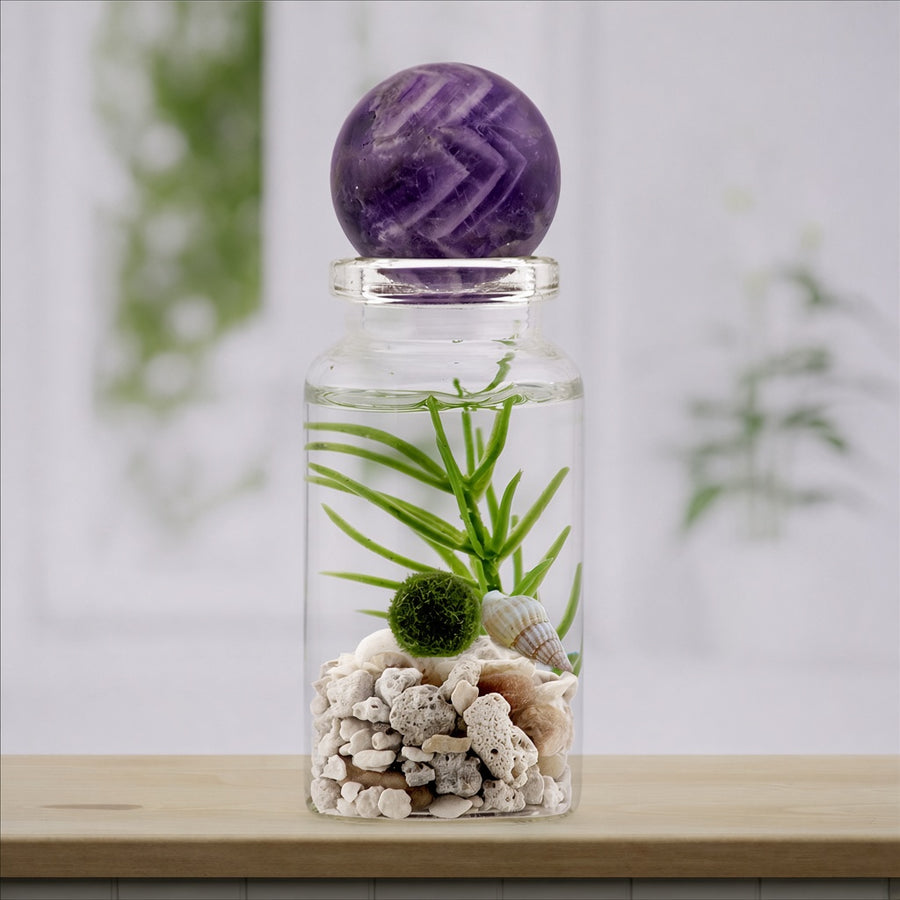
Discover the Magic of Marimo
Design your own terrarium, or start with a ready-made kit.
Footnotes
- Cano-Ramirez et al. 2018; Web and Akan", マリモの育て方(2) How to raise marimo.
- Hanyuda et al. 2002; Boedeker et al. 2012.
- Nakayama et al. 2021; Kushiro City, 阿寒湖のマリモ|釧路市ホームページ Marimo of Lake Akan.
- Guiry and Frödén 2023; AlgaeBase, Aegagropila linnaei Kützing 1843; World Register of Marine Species, Aegagropila linnaei Kützing, 1843.
- Web and Akan", マリモの育て方(2) How to raise marimo.
- Nakayama et al. 2021.
- Nakayama et al. 2021; Isamu Wakana 2019; Togashi, Sasaki and Yoshimura 2014; Kushiro City, 阿寒湖のマリモ|釧路市ホームページ Marimo of Lake Akan; Nakai, Wakana and Niki 2021.
- Cano-Ramirez et al. 2018.
- Nakai, Wakana and Niki 2021.
- Cano-Ramirez et al. 2018; University of Bristol 2018.
- Nakayama et al. 2021.
- Umekawa, Wakana and Ohara 2021.
- Isao Terumoto 1959.
- Obara et al. 2022.
- Isamu Wakana 2019.
- Tsuji, Science and Tokyo, 夏休みの自由研究で守られた貴重なマリモ - 絶滅危惧の山中湖フジマリモ A rare marimo saved b; Office and Yamanashi, 山中湖村フジマリモ生息調査報告書の公表及び花の都公園マリモの展示について Release of the Yaman.
- Boedeker et al. 2010; Isamu Wakana 2019.
- Isao Terumoto 1959.
- Nakayama et al. 2021.
Sources
- Dora L. Cano-Ramirez, Tara Saskia de Fraine, Olivia G. Griffiths, Antony N. Dodd (2018). Photosynthesis and circadian rhythms regulate the buoyancy of marimo lake balls. Current Biology 28(16): R869-R870. Link: https://doi.org/10.1016/j.cub.2018.07.027. Checked 2026-11-10.
- MARIMO Web, official site of the Special Natural Monument "Marimo of Lake Akan" (run by Akan tourism groups, Kushiro City Board of Education and the marimo protection society). マリモの育て方(2) [How to raise marimo (2)]. Link: http://www.marimo-web.org/faq/qa_grow2.html. Checked 2026-11-04.
- Takeaki Hanyuda, Isamu Wakana, Shogo Arai, Kazuyuki Miyaji, Yasuyuki Watano, Kunihiko Ueda (2002). Phylogenetic relationships within Cladophorales (Ulvophyceae, Chlorophyta) inferred from 18S rRNA gene sequences, with special reference to Aegagropila linnaei. Journal of Phycology 38(3): 564-571. Link: https://doi.org/10.1046/j.1529-8817.2002.01151.x. Checked 2026-11-04.
- Christian Boedeker, Charles J. O'Kelly, Wim Star, Frederik Leliaert (2012). Molecular phylogeny and taxonomy of the Aegagropila clade (Cladophorales, Ulvophyceae), including the description of Aegagropilopsis gen. nov. and Pseudocladophora gen. nov. Journal of Phycology 48(3): 808-825. Link: https://biblio.ugent.be/publication?q=keyword+exact+%22LINNAEI%22. Checked 2026-11-04.
- Keisuke Nakayama, Katsuaki Komai, Keisuke Ogata, Toshiro Yamada, Yukinobu Sato, Fumiya Sano, Shintarou Horii, Yuichiro Somiya, Etsuko Kumamoto, Yoichi Oyama (2021). The structure and formation of giant Marimo (Aegagropila linnaei) in Lake Akan, Japan. Scientific Reports 11: 22017. Link: https://doi.org/10.1038/s41598-021-01028-5. Checked 2026-11-10.
- Kushiro City (釧路市教育委員会 マリモ研究室). 阿寒湖のマリモ|釧路市ホームページ [Marimo of Lake Akan (Kushiro City website, Board of Education marimo page)]. Link: https://www.city.kushiro.lg.jp/museum/bunkazai/1005708/kinenbutsu/1005712.html. Checked 2026-11-12.
- Michael D. Guiry, Patrik Frödén (2023). Aegagropila brownii (Dillwyn) Kützing is the correct name for Aegagropila linnaei Kützing, the type of Aegagropila Kützing (Pithophoraceae, Chlorophyta), widely known as "Marimo" or "Cladophora Balls". Notulae Algarum 293: 1-7. Link: https://notulaealgarum.org/2023/documents/Notulae%20Algarum%20No.%20293.pdf. Checked 2026-11-10.
- AlgaeBase (Guiry & Guiry, University of Galway). Aegagropila linnaei Kützing 1843 (species record). Link: https://www.algaebase.org/search/species/detail/?species_id=59094. Checked 2026-11-10.
- World Register of Marine Species. Aegagropila linnaei Kützing, 1843 (WoRMS name details). Link: https://www.marinespecies.org/aphia.php?id=381150&p=taxdetails. Checked 2026-11-10.
- Isamu Wakana (2019). ② 球状マリモの生長特性 (マリモの育て方, 国立台湾博物館用マニュアル) [(2) Growth traits of ball marimo (How to raise marimo, manual written for the National Taiwan Museum)]. Link: https://ameblo.jp/maromo-lab/entry-12465480295.html. Checked 2026-11-10.
- Tatsuya Togashi, Hironobu Sasaki, Jin Yoshimura (2014). A geometrical approach explains Lake Ball (Marimo) formations in the green alga, Aegagropila linnaei. Scientific Reports 4: 3761. Link: https://doi.org/10.1038/srep03761. Checked 2026-11-10.
- Ryosuke Nakai, Isamu Wakana, Hironori Niki (2021). Internal microbial zonation during the massive growth of marimo, a lake ball of Aegagropila linnaei in Lake Akan. iScience. Link: https://doi.org/10.1016/j.isci.2021.102720. Checked 2026-11-10.
- University of Bristol (2018). August: algae balls float and sink (press release for Cano-Ramirez et al. 2018). Link: https://www.bristol.ac.uk/news/2018/august/algae-balls-float-and-sink.html. Checked 2026-11-10.
- Taketo Umekawa, Isamu Wakana, Masashi Ohara (2021). Reproductive behavior and role in maintaining an aggregative form of the freshwater green alga Marimo, Aegagropila linnaei, in Lake Akan, Hokkaido, Japan. Aquatic Botany 168: 103309. Link: https://doi.org/10.1016/j.aquabot.2020.103309. Checked 2026-11-10.
- Isao Terumoto (照本勲) (1959). マリモの凍害と乾燥害 [Freezing injury and drying injury in marimo]. 低温科學 生物篇 (Low Temperature Science, Series B: Biological Sciences) 17: 1 to 7, Institute of Low Temperature Science, Hokkaido University. Link: https://eprints.lib.hokudai.ac.jp/repo/huscap/all/17616/. Checked 2026-11-10.
- Akina Obara, Mari Ogawa, Yoichi Oyama, Yoshihiro Suzuki, Masaru Kono (2022). Effects of High Irradiance and Low Water Temperature on Photoinhibition and Repair of Photosystems in Marimo (Aegagropila linnaei) in Lake Akan, Japan. International Journal of Molecular Sciences 24(1): 60. Link: https://doi.org/10.3390/ijms24010060. Checked 2026-11-10.
- Isamu Wakana (2019). ③ マリモ糸状体の生長条件 [(3) Growth conditions for marimo filaments]. Link: https://ameblo.jp/maromo-lab/entry-12465710386.html. Checked 2026-11-10.
- Akihiro Tsuji (辻彰洋), National Museum of Nature and Science, Tokyo (Kahaku). 夏休みの自由研究で守られた貴重なマリモ - 絶滅危惧の山中湖フジマリモ [A rare marimo saved by a summer homework project: the endangered Fuji marimo of Lake Yamanaka]. Link: https://www.kahaku.go.jp/pickup-science/nid00000976.html. Checked 2026-11-10.
- Yamanakako Village Office, Yamanashi. 山中湖村フジマリモ生息調査報告書の公表及び花の都公園マリモの展示について [Release of the Yamanakako village Fuji marimo survey report and marimo display at Hananomiyako Park]. Link: https://www.vill.yamanakako.lg.jp/Info/110. Checked 2026-11-10.
- Christian Boedeker, Anja Eggert, Anne Immers, Isamu Wakana (2010). Biogeography of Aegagropila linnaei (Cladophorophyceae, Chlorophyta): a widespread freshwater alga with low effective dispersal potential shows a glacial imprint in its distribution. Journal of Biogeography 37: 1491-1503. Link: https://doi.org/10.1111/j.1365-2699.2010.02309.x. Checked 2026-11-09.
- Isamu Wakana (若菜勇) (2019). ⑤ 球状マリモの栽培方法 (マリモ博士の研究日記) [(5) How to cultivate ball marimo (Dr. Marimo's research diary)]. Link: https://ameblo.jp/maromo-lab/entry-12473448831.html. Checked 2026-11-10.
Related guides
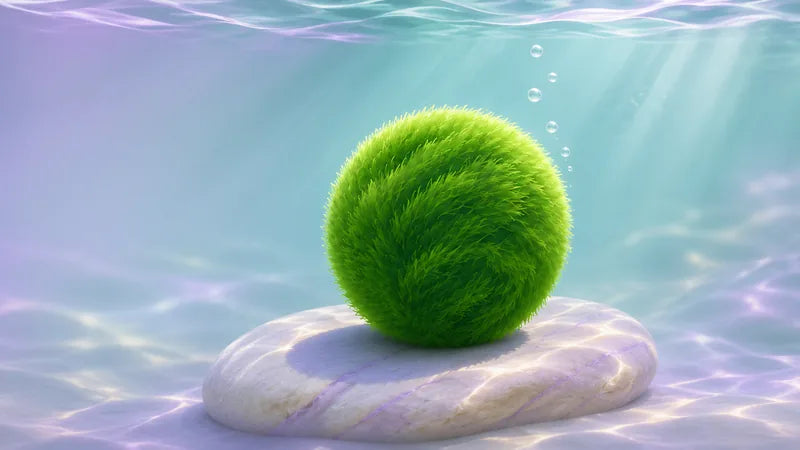
What Is a Marimo? The Moss Ball, Explained
A marimo, often called a moss ball, is a ball of green algae, not moss. Each one is made of many fine threads of the alga Aegagropila linnaei growing together. In a few lakes, gentle waves roll those threads into round balls. Marimo are alive and make their own food from light, so they need no feeding.
Read the guide →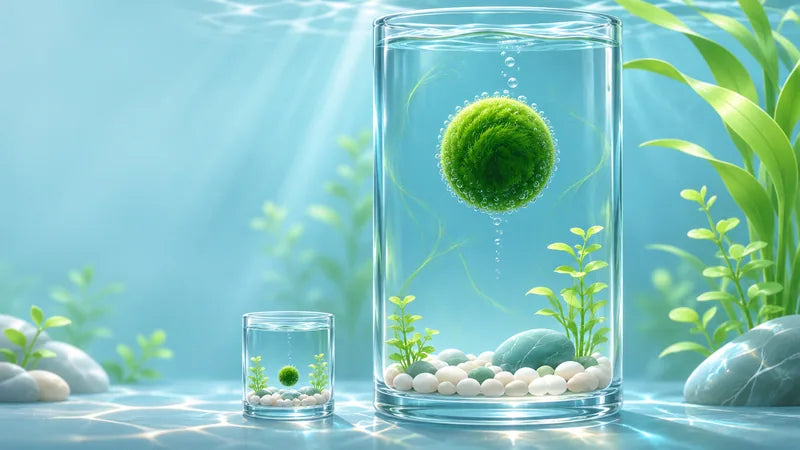
Why Is My Marimo Floating? What the Bubbles Mean
A marimo usually floats because tiny bubbles of oxygen from photosynthesis get caught in it, and in lab studies it sinks again in the dark. Floating means it is making oxygen in the light, not that it feels happy. And a marimo that stays on the bottom is not, by that alone, unwell.
Read the guide →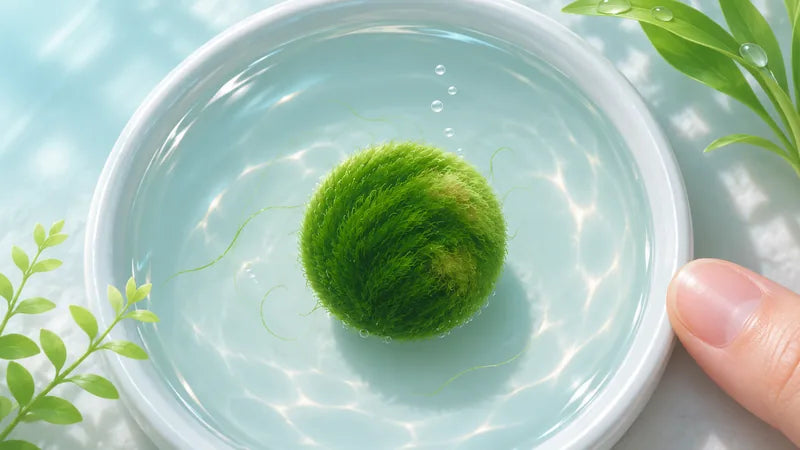
Is My Marimo Dead? Brown, White or Falling Apart
There is no sure home test for whether a marimo is dead or alive. A 2017 library reference answer said that, in general, it is difficult to tell. Green color alone is not proof of life. Brown, white, a smell, floating, or falling apart can be clues, not proof.
Read the guide →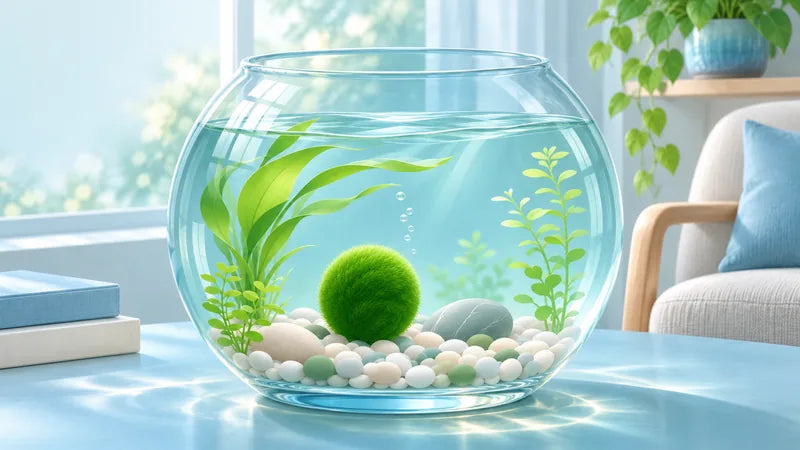
How Long Do Marimo Live, and How Big Do They Get?
With simple care, marimo can live for decades. The longest published home record is a family that kept a close relative of the marimo for more than 50 years. No published study has documented any single ball reaching 100 years.
Read the guide →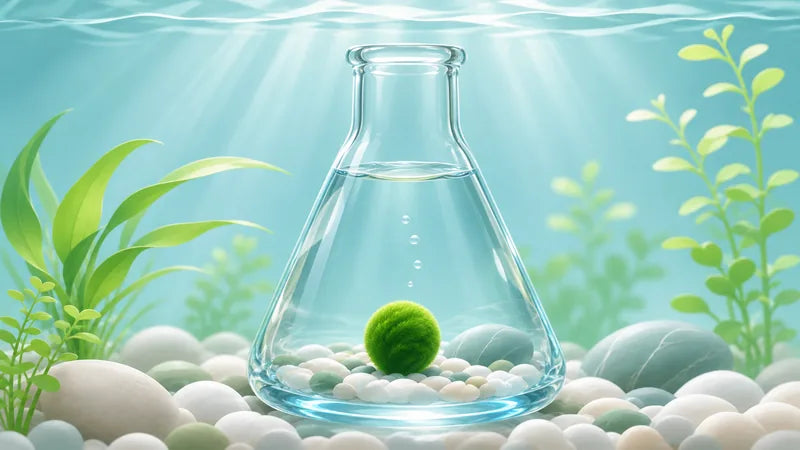
What Do Marimo Eat? They Make Their Own Food
Marimo make their own food from light, water and carbon dioxide, so they don't need feeding. They have no mouth, and the whole ball makes sugar from light. They also take up some minerals and a little nitrogen from the water, but that isn't a meal.
Read the guide →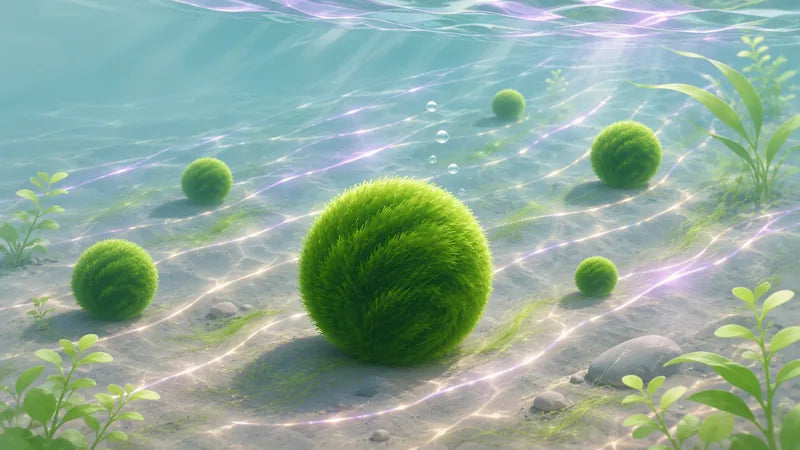
How Marimo Become Balls, and Whether You Can Make One
Gentle waves roll marimo along a shallow lake bottom, and that rolling makes them round. They are living green algae, a crowd of threads growing together, not moss and not built around a stone. The ball form is the rarest of the three forms. No published study has shown a way to make a true marimo ball at home.
Read the guide →